THE ADVENTURE COLLECTIVE® · Independent discovery and booking for outdoor travel

Skip lines at Athens’ Ancient Agora and walk where philosophers and citizens once debated. This ticket includes entry to the Temple of Hephaistos and a self-guided audio tour to set your own pace through classical Athens.
Skip lines at Athens’ Ancient Agora and walk where philosophers and citizens once debated. This ticket includes entry to the Temple of Hephaistos and a self-guided audio tour to set your own pace through classical Athens.
You arrive under a sharp Athenian sky, footsteps echoing on sun-warmed stone as the city hums beyond the marble columns. The Ancient Agora opens like a page of living history: market rows, the low silhouette of the Temple of Hephaistos, and the squat bell tower of the Church of the Holy Apostles. The site asks you to slow down and listen to the weight of centuries.
Verified experiences and guided adventures in the surrounding area.
Operated by My Travelons Ltd · Athens, Attica
You arrive under a sharp Athenian sky, footsteps echoing on sun-warmed stone as the city hums beyond the marble columns. The Ancient Agora opens like a page of living history: market rows, the low silhouette of the Temple of Hephaistos, and the squat bell tower of the Church of the Holy Apostles. The site asks you to slow down and listen to the weight of centuries.
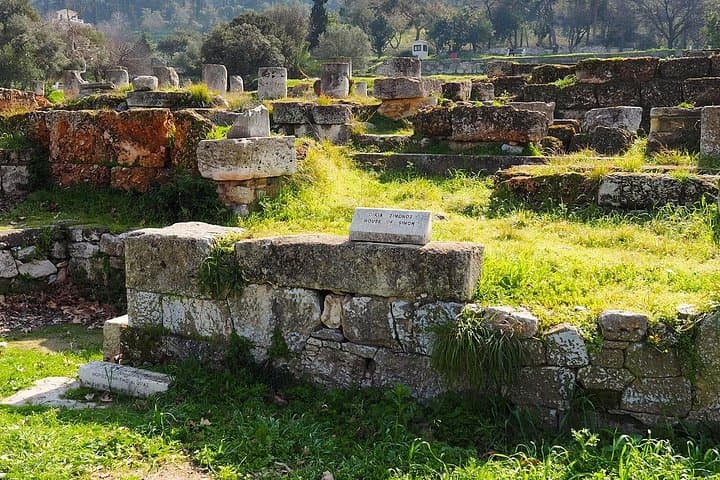
This was the civic heart of Classical Athens — a place of debate, commerce, and ritual where citizens and philosophers once crossed paths. Geologically, the Agora sits on Pleistocene sediments with scattered limestone outcrops that builders quarried for Doric columns; the Temple of Hephaistos survives as one of Greece’s clearest examples of classical Doric masonry. Culturally, the square ushers you through layers: Hellenistic foundations, Roman repairs, Byzantine chapels, and Ottoman-era traces near Plaka.
A skip-the-line ticket plus a self-guided audio tour lets you set the pace: linger at the Stoa of Attalos (now a reconstructed museum), map the ancient shops, and stand beneath the Hephaistos cornice to imagine its original painted frieze. Local insight: mornings are cooler and quieter; late afternoons throw the stones into warm contrast with the city skyline.
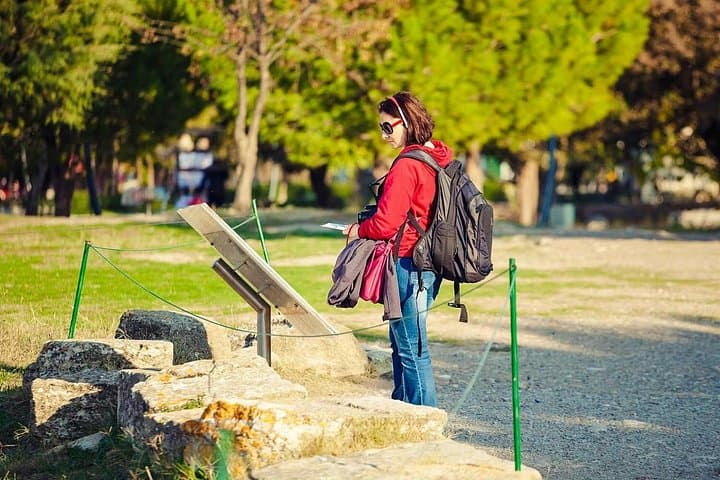
Practical guidance: bring sun protection and a full battery for your audio device, follow marked paths to protect fragile ruins, and allow 1–3 hours depending on how deeply you explore adjoining streets of Monastiraki and Plaka. Respect signage and small-scale conservation efforts — these stones have a long memory.
easy.
1–3 hours.
Suitable for most fitness levels; requires walking on uneven ground and short inclines.
Yes — the ticket provides timed entry that bypasses the main ticket queue at the Ancient Agora entrance.
A self-guided audio tour is provided; download or stream it on your mobile device and follow the mapped points at your own pace.
The site has uneven surfaces and some slopes; while core areas are reachable, full accessibility is limited—contact site staff for the best route and assistance.
Plan 1–3 hours: one hour covers highlights; allow up to three if you’re visiting the Stoa of Attalos museum and wandering Plaka nearby.
The Ancient Agora functioned as Athens’ public square during Classical times—a center for commerce, law and philosophy—and includes the well-preserved Doric Temple of Hephaistos.
Ongoing preservation overseen by the Greek Ministry of Culture limits access to sensitive areas; visitors are asked to stick to paths, avoid touching carved surfaces, and carry out waste.
My Travelons Ltd operates guided outdoor trips and adventures with an emphasis on safety, stewardship, and memorable experiences.
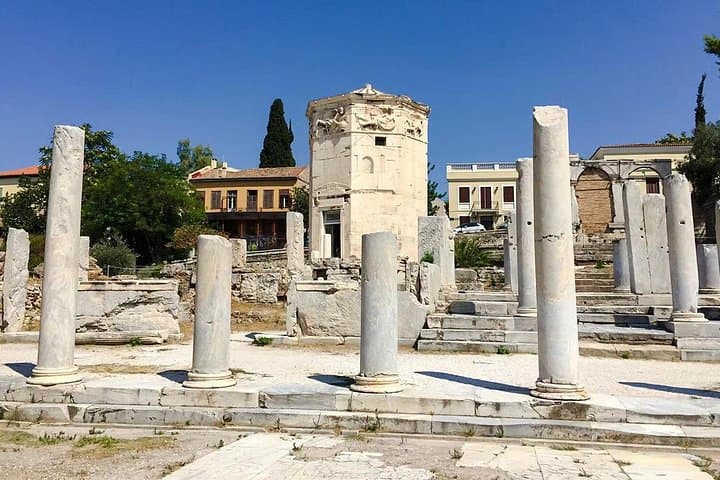
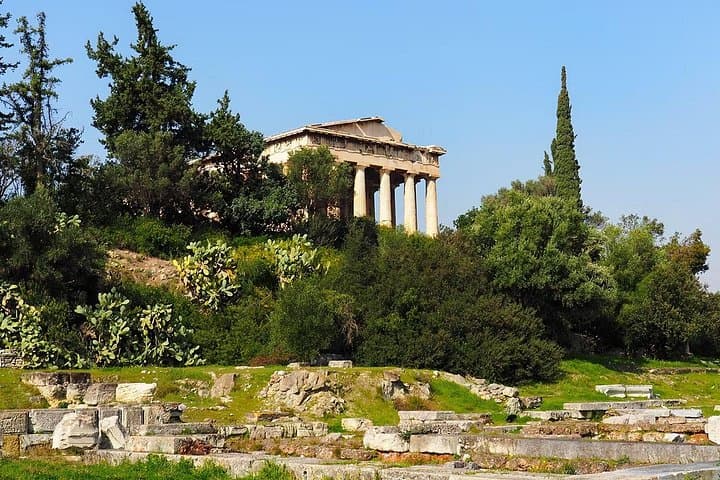
You arrive under a sharp Athenian sky, footsteps echoing on sun-warmed stone as the city hums beyond the marble columns. The Ancient Agora opens like a page of living history: market rows, the low silhouette of the Temple of Hephaistos, and the squat bell tower of the Church of the Holy Apostles. The site asks you to slow down and listen to the weight of centuries.
You arrive under a sharp Athenian sky, footsteps echoing on sun-warmed stone as the city hums beyond the marble columns. The Ancient Agora opens like a page of living history: market rows, the low silhouette of the Temple of Hephaistos, and the squat bell tower of the Church of the Holy Apostles. The site asks you to slow down and listen to the weight of centuries.
This was the civic heart of Classical Athens — a place of debate, commerce, and ritual where citizens and philosophers once crossed paths. Geologically, the Agora sits on Pleistocene sediments with scattered limestone outcrops that builders quarried for Doric columns; the Temple of Hephaistos survives as one of Greece’s clearest examples of classical Doric masonry. Culturally, the square ushers you through layers: Hellenistic foundations, Roman repairs, Byzantine chapels, and Ottoman-era traces near Plaka.
A skip-the-line ticket plus a self-guided audio tour lets you set the pace: linger at the Stoa of Attalos (now a reconstructed museum), map the ancient shops, and stand beneath the Hephaistos cornice to imagine its original painted frieze. Local insight: mornings are cooler and quieter; late afternoons throw the stones into warm contrast with the city skyline.
Practical guidance: bring sun protection and a full battery for your audio device, follow marked paths to protect fragile ruins, and allow 1–3 hours depending on how deeply you explore adjoining streets of Monastiraki and Plaka. Respect signage and small-scale conservation efforts — these stones have a long memory.