THE ADVENTURE COLLECTIVE® · Independent discovery and booking for outdoor travel

Spend a full day exploring Sri Lanka’s Cultural Triangle: spice gardens in Matale, the painted caverns of Dambulla, and the climb up Sigiriya’s ancient rock fortress. Comfortable private transport from Kandy and an English-speaking driver keep the day efficient and flexible.
Spend a full day exploring Sri Lanka’s Cultural Triangle: spice gardens in Matale, the painted caverns of Dambulla, and the climb up Sigiriya’s ancient rock fortress. Comfortable private transport from Kandy and an English-speaking driver keep the day efficient and flexible.
When the minivan eases out of Kandy before dawn, the countryside opens like a map of layered greens—rice paddies flattening into scrub, small temples punctuating the road, and the occasional coconut grove watching the horizon. The drive to Sigiriya is more than transit; it’s a gradual introduction to Sri Lanka’s Cultural Triangle: spice gardens that smell of cardamom and cinnamon, a Hindu kovil with bright paint and brass bells, and, toward mid-morning, the squat, iconic silhouette of Sigiriya rising from the plain.
Verified experiences and guided adventures in the surrounding area.
Operated by The Visit Lanka Tours · Sigiriya, Central Province
When the minivan eases out of Kandy before dawn, the countryside opens like a map of layered greens—rice paddies flattening into scrub, small temples punctuating the road, and the occasional coconut grove watching the horizon. The drive to Sigiriya is more than transit; it’s a gradual introduction to Sri Lanka’s Cultural Triangle: spice gardens that smell of cardamom and cinnamon, a Hindu kovil with bright paint and brass bells, and, toward mid-morning, the squat, iconic silhouette of Sigiriya rising from the plain.
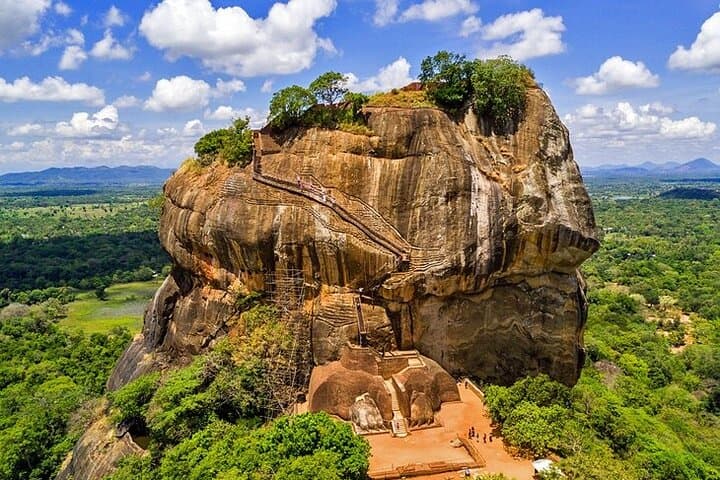
The day follows a clear arc: a quick stop at a Matale spice garden to sniff and sample, the atmospheric Dambulla Cave Temple, then the main event—Sigiriya Rock Fortress. Dambulla’s caves, carved into a ridge and painted across centuries, feel intimate and slow: Buddha statues crowded into dim rock chambers, pigments darkened by incense and age. Geologically, Sigiriya itself is a volcanic plug—an ancient core of magma hardened into a sheer, resistant rock that now watches over the plains. You climb through a procession of steps, metal staircases and platforms, and past the Mirror Wall and the faded frescoes that once greeted royal visitors.
King Kashyapa’s 5th-century fortress is an engineered drama—water gardens, ramparts and a carved lion’s paws that once framed the entrance. From the summit, roughly a 200-meter vertical gain and about 1,000–1,200 steps depending on route, the plain stretches in patchwork: reservoirs, temple domes, and small villages where daily life continues oblivious to the UNESCO plaque.
Culturally, this circuit stitches together Sinhala and Tamil influences, colonial trade routes for spices, and the long continuity of Buddhist practice. Drivers and local guides often function as walking encyclopedias—ask them about the frescoes, about how the water gardens were planned, or the best local eateries in Habarana on the way back.
Practicalities matter. Start early—the heat builds quickly and the climb is exposed. Wear sturdy shoes and bring at least 1.5 liters of water per person; temples require modest clothing (shoulders and knees covered). There’s no official site guide included with the vehicle—your driver can share context and arrange paid local guides at the entrances if desired.
Expect a full day: vehicle pickup from Kandy, multiple short stops, guided time at Dambulla, a focused ascent of Sigiriya, and the return drive. Entrance fees for Sigiriya and Dambulla are paid at the sites; have cash or card handy. For photographers, mid-morning light reveals the frescoes while late afternoon softens the plain; for quieter views, consider Pidurangala Rock at sunrise.
This tour is a compact but rich way to take in the region’s geology, history and living culture—comfortable transport between sites, a friendly English-speaking driver, and a day that ends with the satisfaction of having climbed into Sri Lanka’s layered past.
moderate.
10–12 hours.
Moderately fit: able to handle a sustained climb of roughly 200 meters and multiple flights of stairs.
A local guide is not required but adds depth—drivers can arrange paid site guides at entrances if you want detailed historical interpretation.
No; entrance fees for Sigiriya Rock and Dambulla Cave Temple are paid at the sites—bring cash or a card for tickets.
The vehicle can accommodate wheelchair users, but Dambulla and Sigiriya involve stairs and steep paths and are not fully accessible.
Expect a moderate challenge: roughly 1,000–1,200 steps and about 200 meters of elevation gain—rest stops and platforms are available.
This specific day tour operates during daylight hours from Kandy; for sunrise on Sigiriya or Pidurangala you’ll need a tailored early-morning transfer.
Wildlife like monkeys is common and elephants may be seen in nearby reserves—observe from a distance and never feed animals.
Sigiriya was converted into a fortified palace by King Kashyapa in the 5th century AD; Dambulla’s caves contain Buddhist murals and statues dating back to the 1st century BCE.
Tour operators emphasize low-impact transit and regulated ticketing; avoid littering, don’t touch frescoes, and follow site rules to protect fragile pigments and rock surfaces.
The Visit Lanka Tours operates guided outdoor trips and adventures with an emphasis on safety, stewardship, and memorable experiences.
When the minivan eases out of Kandy before dawn, the countryside opens like a map of layered greens—rice paddies flattening into scrub, small temples punctuating the road, and the occasional coconut grove watching the horizon. The drive to Sigiriya is more than transit; it’s a gradual introduction to Sri Lanka’s Cultural Triangle: spice gardens that smell of cardamom and cinnamon, a Hindu kovil with bright paint and brass bells, and, toward mid-morning, the squat, iconic silhouette of Sigiriya rising from the plain.
When the minivan eases out of Kandy before dawn, the countryside opens like a map of layered greens—rice paddies flattening into scrub, small temples punctuating the road, and the occasional coconut grove watching the horizon. The drive to Sigiriya is more than transit; it’s a gradual introduction to Sri Lanka’s Cultural Triangle: spice gardens that smell of cardamom and cinnamon, a Hindu kovil with bright paint and brass bells, and, toward mid-morning, the squat, iconic silhouette of Sigiriya rising from the plain.
The day follows a clear arc: a quick stop at a Matale spice garden to sniff and sample, the atmospheric Dambulla Cave Temple, then the main event—Sigiriya Rock Fortress. Dambulla’s caves, carved into a ridge and painted across centuries, feel intimate and slow: Buddha statues crowded into dim rock chambers, pigments darkened by incense and age. Geologically, Sigiriya itself is a volcanic plug—an ancient core of magma hardened into a sheer, resistant rock that now watches over the plains. You climb through a procession of steps, metal staircases and platforms, and past the Mirror Wall and the faded frescoes that once greeted royal visitors.
King Kashyapa’s 5th-century fortress is an engineered drama—water gardens, ramparts and a carved lion’s paws that once framed the entrance. From the summit, roughly a 200-meter vertical gain and about 1,000–1,200 steps depending on route, the plain stretches in patchwork: reservoirs, temple domes, and small villages where daily life continues oblivious to the UNESCO plaque.
Culturally, this circuit stitches together Sinhala and Tamil influences, colonial trade routes for spices, and the long continuity of Buddhist practice. Drivers and local guides often function as walking encyclopedias—ask them about the frescoes, about how the water gardens were planned, or the best local eateries in Habarana on the way back.
Practicalities matter. Start early—the heat builds quickly and the climb is exposed. Wear sturdy shoes and bring at least 1.5 liters of water per person; temples require modest clothing (shoulders and knees covered). There’s no official site guide included with the vehicle—your driver can share context and arrange paid local guides at the entrances if desired.
Expect a full day: vehicle pickup from Kandy, multiple short stops, guided time at Dambulla, a focused ascent of Sigiriya, and the return drive. Entrance fees for Sigiriya and Dambulla are paid at the sites; have cash or card handy. For photographers, mid-morning light reveals the frescoes while late afternoon softens the plain; for quieter views, consider Pidurangala Rock at sunrise.
This tour is a compact but rich way to take in the region’s geology, history and living culture—comfortable transport between sites, a friendly English-speaking driver, and a day that ends with the satisfaction of having climbed into Sri Lanka’s layered past.