THE ADVENTURE COLLECTIVE® · Independent discovery and booking for outdoor travel

A private, all-inclusive day trip that pairs Sigiriya’s dramatic rock fortress with the Dambulla Golden Cave Temple. Expect long drives from the southwest coast, an early start, included guides and lunch, plus two of Sri Lanka’s most powerful UNESCO sites.
A private, all-inclusive day trip that pairs Sigiriya’s dramatic rock fortress with the Dambulla Golden Cave Temple. Expect long drives from the southwest coast, an early start, included guides and lunch, plus two of Sri Lanka’s most powerful UNESCO sites.
At 4:00 a.m. the minivan idles while the coastline still sleeps — coconut palms dark against an orange smudge of horizon. You slide into a seat with a guide who speaks of kings and monks, and the road north gobbles miles of paddy, tank reservoirs and the slow-rise of the central plains. By midmorning a solitary, sheer slab of rock juts up from the emerald flatland: Sigiriya, the so-called Lion Rock, a climb that rearranges perspective as efficiently as altitude.
Verified experiences and guided adventures in the surrounding area.
Operated by Bentota Travel Mart · Sigiriya, Central Province
At 4:00 a.m. the minivan idles while the coastline still sleeps — coconut palms dark against an orange smudge of horizon. You slide into a seat with a guide who speaks of kings and monks, and the road north gobbles miles of paddy, tank reservoirs and the slow-rise of the central plains. By midmorning a solitary, sheer slab of rock juts up from the emerald flatland: Sigiriya, the so-called Lion Rock, a climb that rearranges perspective as efficiently as altitude.
The drive from Bentota to Sigiriya is long — expect 4–5 hours of road through shifting landscapes — but the payoff is immediate. Sigiriya is a geological outcrop of Precambrian gneiss and granite that was quarried by nature into a 200‑metre fortress. In the 5th century CE King Kashyapa crowned the summit with palaces and gardens; below, a dramatic lion’s paws mark the half-weathered gateway. The site’s frescoes and the polished, mirror-like wall are not decorative afterthoughts but records of court life and technical daring.
A short ride from Sigiriya, Dambulla’s cave temple hangs on a low basalt ridge. Its five cave shrines shelter more than 150 Buddha images and ceilings painted in deep ochres — devotional art layered over more than two millennia. The cave complex reads like a living chronicle: kings donated patronage, Buddhist monastics kept the site alive, and travelers since antiquity have paused to practice reverence and tally the artistry.
Culturally the itinerary is two-sided: Sigiriya is imperial showmanship — engineered water gardens, ramparts and a summit panorama that forces a reckoning with time — while Dambulla is a quieter religious archive, intimate and cool, smelling faintly of incense and worn stone.
Practical edge: this is a full-day private tour with pickup from Bentota and many coastal towns; entry fees, English‑speaking site guides and lunch are included. Expect to climb about 200 metres at Sigiriya on roughly 1,000–1,200 steps, some steep metal staircases and narrow passages. Dambulla involves a short uphill approach and stairway to the cave complex; shoes are removed at the temple. The day runs 12–14 hours total — start early, carry lightweight layers, and pack sun protection plus electrolytes. Your guide times each visit to avoid worst crowds where possible and will point out where to pause for photographs, or for a quiet moment on a summit bench.
If you go: wear grippy shoes, modest clothes for temple interiors, and plan for heat by mid-day. The cliffs and caves give up different rewards: one thrills the sense of human ambition; the other rewards quiet reflection.
moderate.
12–14 hours.
Good baseline fitness for a long day and sustained stair-climbing (200 m ascent at Sigiriya). Those with limited mobility should note many steps and narrow passages.
Expect roughly 4–5 hours each way depending on traffic; the tour is structured as a full 12–14 hour day with pickup included.
Yes — all entry fees and professional site guides for Sigiriya and Dambulla are included in the package.
The climb includes about 1,000–1,200 steps with sections of metal stairways and narrow ledges; it is exposed in places and requires sure footing.
Modest clothing that covers shoulders and knees is required; shoes must be removed before entering the caves.
Yes — lunch and bottled water are included during the day.
The tour is family-friendly, but the Sigiriya ascent may be challenging for very young children or travelers with spinal/back issues; infant seats are available for vehicle transport.
Sigiriya was the site of a 5th-century palace-fortress built by King Kashyapa; Dambulla has served as a monastic complex and pilgrimage site for over two millennia.
Both sites are UNESCO-protected — visitors are asked to stay on marked paths, avoid littering, and follow guides’ instructions to protect fragile frescoes and cave environments.
Bentota Travel Mart operates guided outdoor trips and adventures with an emphasis on safety, stewardship, and memorable experiences.
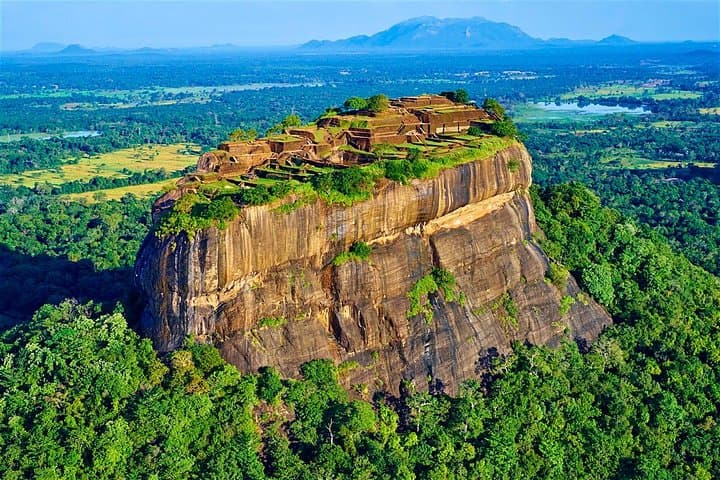


At 4:00 a.m. the minivan idles while the coastline still sleeps — coconut palms dark against an orange smudge of horizon. You slide into a seat with a guide who speaks of kings and monks, and the road north gobbles miles of paddy, tank reservoirs and the slow-rise of the central plains. By midmorning a solitary, sheer slab of rock juts up from the emerald flatland: Sigiriya, the so-called Lion Rock, a climb that rearranges perspective as efficiently as altitude.
At 4:00 a.m. the minivan idles while the coastline still sleeps — coconut palms dark against an orange smudge of horizon. You slide into a seat with a guide who speaks of kings and monks, and the road north gobbles miles of paddy, tank reservoirs and the slow-rise of the central plains. By midmorning a solitary, sheer slab of rock juts up from the emerald flatland: Sigiriya, the so-called Lion Rock, a climb that rearranges perspective as efficiently as altitude.
The drive from Bentota to Sigiriya is long — expect 4–5 hours of road through shifting landscapes — but the payoff is immediate. Sigiriya is a geological outcrop of Precambrian gneiss and granite that was quarried by nature into a 200‑metre fortress. In the 5th century CE King Kashyapa crowned the summit with palaces and gardens; below, a dramatic lion’s paws mark the half-weathered gateway. The site’s frescoes and the polished, mirror-like wall are not decorative afterthoughts but records of court life and technical daring.
A short ride from Sigiriya, Dambulla’s cave temple hangs on a low basalt ridge. Its five cave shrines shelter more than 150 Buddha images and ceilings painted in deep ochres — devotional art layered over more than two millennia. The cave complex reads like a living chronicle: kings donated patronage, Buddhist monastics kept the site alive, and travelers since antiquity have paused to practice reverence and tally the artistry.
Culturally the itinerary is two-sided: Sigiriya is imperial showmanship — engineered water gardens, ramparts and a summit panorama that forces a reckoning with time — while Dambulla is a quieter religious archive, intimate and cool, smelling faintly of incense and worn stone.
Practical edge: this is a full-day private tour with pickup from Bentota and many coastal towns; entry fees, English‑speaking site guides and lunch are included. Expect to climb about 200 metres at Sigiriya on roughly 1,000–1,200 steps, some steep metal staircases and narrow passages. Dambulla involves a short uphill approach and stairway to the cave complex; shoes are removed at the temple. The day runs 12–14 hours total — start early, carry lightweight layers, and pack sun protection plus electrolytes. Your guide times each visit to avoid worst crowds where possible and will point out where to pause for photographs, or for a quiet moment on a summit bench.
If you go: wear grippy shoes, modest clothes for temple interiors, and plan for heat by mid-day. The cliffs and caves give up different rewards: one thrills the sense of human ambition; the other rewards quiet reflection.