THE ADVENTURE COLLECTIVE® · Independent discovery and booking for outdoor travel

See Nashville’s skyline from a helicopter in a compact, high-impact ride. This short tour flies over the Parthenon, Broadway, the state capital and the Cumberland—perfect for visitors who want a quick, memorable perspective on Music City.
See Nashville’s skyline from a helicopter in a compact, high-impact ride. This short tour flies over the Parthenon, Broadway, the state capital and the Cumberland—perfect for visitors who want a quick, memorable perspective on Music City.
You feel the rotor wash before you see the helicopter—an anticipatory gust that lifts the smell of tarmac and hot asphalt as the pilot runs through a quick safety brief. Minutes later the city pulls away: blue rooftops give way to a grid of streets and the familiar curve of the Cumberland River. From the best seat in the house the city rearranges itself into landmarks and lanes you thought you knew—only now Broadway’s neon and the Parthenon’s columned silhouette sit side-by-side beneath you.
Verified experiences and guided adventures in the surrounding area.
Operated by Helistar Aviation · Nashville, Tennessee
You feel the rotor wash before you see the helicopter—an anticipatory gust that lifts the smell of tarmac and hot asphalt as the pilot runs through a quick safety brief. Minutes later the city pulls away: blue rooftops give way to a grid of streets and the familiar curve of the Cumberland River. From the best seat in the house the city rearranges itself into landmarks and lanes you thought you knew—only now Broadway’s neon and the Parthenon’s columned silhouette sit side-by-side beneath you.
This short flight, advertised as roughly eight minutes airborne with about 20 minutes total including briefing, is a compact introduction to Nashville’s layered identity. The Parthenon in Centennial Park—an unusual full-scale replica dating to the 1897 Tennessee Centennial Exposition—reads like classical punctuation against the region’s rolling, oak-studded topography. The tour sweeps over historic music sites where early recordings and late-night rehearsals forged the Grand Ole Opry sound, then traces the river corridor where downtown expansion and ballparks have remade the skyline.
Geologically, Nashville is gentle—low ridges and limestone bedrock under a veneer of urban development. From above the stone patterns and river oxbows are quiet reminders that this river city grew from a trading post to a music industry hub. Culturally the aerial view clarifies why they call it Music City: spread below are neighborhoods—Germantown, Midtown, Vanderbilt—each with their architectural notes and nightlife rhythms.
Practicalities matter on a flight this short. The operator meets at 110 Tune Airport Drive—look for the building with a blue tin roof and three flags—where staff handle check-in, weight verification (passenger limit per person 300 lbs), and a short safety briefing. Tours are wheelchair accessible and accommodate infants (on laps), but everyone should arrive 20–30 minutes early to sign waivers and store loose items. Weather cancels flights; operators refund full price for storms if you cancel at least 24 hours ahead.
For photographers, bring a fast lens and hold the camera steady—glass reflects light against the cabin, so a low ISO and fast shutter help freeze the city’s motion. Wear layers; dawn and dusk rides feel colder in the open sky than on the ground.
This is not a deep-dive tour; it’s a concentrated skyline orientation that hands you an aerial map of Nashville’s culture, history, and developing skyline. For visitors short on time but eager for perspective, the short helicopter tour is a sharp, exhilarating way to see Music City from above and understand how its past and present stack up against the Cumberland’s steady flow.
easy.
20 minutes total (≈8 minutes airborne).
No special fitness required—suitable for most travelers comfortable with short flights
The airborne portion is about eight minutes; total visit time is roughly 20 minutes including briefing and boarding.
Meet at 110 Tune Airport Drive—look for a building with a blue tin roof and three flagpoles; a representative greets guests in the lobby.
Yes—individual passengers are limited to 300 lbs (137 kg) for safety and balance reasons; you’ll be asked to provide weight at booking.
Infants may ride on an adult’s lap; the operator states surfaces are wheelchair accessible—confirm any specific mobility needs when booking.
Full refund available if you cancel at least 24 hours before departure; flights are also canceled for bad weather with refunds.
Service animals are permitted; check with the operator in advance for specifics and any documentation required.
The Parthenon replica dates to 1897 and anchors Centennial Park; the city’s music industry grew from river trade and radio broadcasts in the early 20th century.
Operators adhere to FAA noise and safety regulations; choose providers that follow local noise-abatement routes to limit disturbance to neighborhoods and wildlife.
Helistar Aviation operates guided outdoor trips and adventures with an emphasis on safety, stewardship, and memorable experiences.


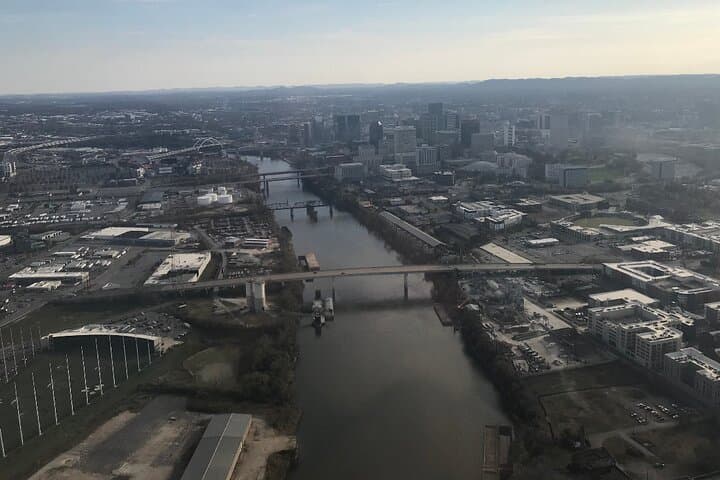

You feel the rotor wash before you see the helicopter—an anticipatory gust that lifts the smell of tarmac and hot asphalt as the pilot runs through a quick safety brief. Minutes later the city pulls away: blue rooftops give way to a grid of streets and the familiar curve of the Cumberland River. From the best seat in the house the city rearranges itself into landmarks and lanes you thought you knew—only now Broadway’s neon and the Parthenon’s columned silhouette sit side-by-side beneath you.
You feel the rotor wash before you see the helicopter—an anticipatory gust that lifts the smell of tarmac and hot asphalt as the pilot runs through a quick safety brief. Minutes later the city pulls away: blue rooftops give way to a grid of streets and the familiar curve of the Cumberland River. From the best seat in the house the city rearranges itself into landmarks and lanes you thought you knew—only now Broadway’s neon and the Parthenon’s columned silhouette sit side-by-side beneath you.
This short flight, advertised as roughly eight minutes airborne with about 20 minutes total including briefing, is a compact introduction to Nashville’s layered identity. The Parthenon in Centennial Park—an unusual full-scale replica dating to the 1897 Tennessee Centennial Exposition—reads like classical punctuation against the region’s rolling, oak-studded topography. The tour sweeps over historic music sites where early recordings and late-night rehearsals forged the Grand Ole Opry sound, then traces the river corridor where downtown expansion and ballparks have remade the skyline.
Geologically, Nashville is gentle—low ridges and limestone bedrock under a veneer of urban development. From above the stone patterns and river oxbows are quiet reminders that this river city grew from a trading post to a music industry hub. Culturally the aerial view clarifies why they call it Music City: spread below are neighborhoods—Germantown, Midtown, Vanderbilt—each with their architectural notes and nightlife rhythms.
Practicalities matter on a flight this short. The operator meets at 110 Tune Airport Drive—look for the building with a blue tin roof and three flags—where staff handle check-in, weight verification (passenger limit per person 300 lbs), and a short safety briefing. Tours are wheelchair accessible and accommodate infants (on laps), but everyone should arrive 20–30 minutes early to sign waivers and store loose items. Weather cancels flights; operators refund full price for storms if you cancel at least 24 hours ahead.
For photographers, bring a fast lens and hold the camera steady—glass reflects light against the cabin, so a low ISO and fast shutter help freeze the city’s motion. Wear layers; dawn and dusk rides feel colder in the open sky than on the ground.
This is not a deep-dive tour; it’s a concentrated skyline orientation that hands you an aerial map of Nashville’s culture, history, and developing skyline. For visitors short on time but eager for perspective, the short helicopter tour is a sharp, exhilarating way to see Music City from above and understand how its past and present stack up against the Cumberland’s steady flow.