THE ADVENTURE COLLECTIVE® · Independent discovery and booking for outdoor travel

Explore Windsor beyond the postcard: a 60–90 minute self-guided walking tour that threads castle ramparts, the Long Walk and a riverside promenade. Practical route notes, local history and tips for timing help you make the most of a short urban adventure.
Explore Windsor beyond the postcard: a 60–90 minute self-guided walking tour that threads castle ramparts, the Long Walk and a riverside promenade. Practical route notes, local history and tips for timing help you make the most of a short urban adventure.
You start where the castle looms above the High Street, its stone bulk altering the light as you step into town. Paving stones click underfoot, shop fronts and pubs opening into view, while the distant avenue of plane trees that is the Long Walk gestures toward Windsor Great Park.
Verified experiences and guided adventures in the surrounding area.
Operated by VoiceMap Audio Tours · Windsor, Berkshire
You start where the castle looms above the High Street, its stone bulk altering the light as you step into town. Paving stones click underfoot, shop fronts and pubs opening into view, while the distant avenue of plane trees that is the Long Walk gestures toward Windsor Great Park.
Windsor grew up around a Norman keep built to command the Thames and the road to the west; centuries of royal presence shaped the town’s streets, markets and civic buildings. The castle’s layered architecture — medieval keep, Tudor refurbishments, Victorian refits — reads like a compact history of Britain’s monarchy. Geologically, Windsor sits on chalk bedrock capped by river alluvium; the Thames carved the low-lying floodplain that makes the riverside so walkable.
Local culture still orbits ceremonial life: guildhalls, blue plaques, and weekend regattas on the Thames link contemporary rhythm to pageantry. Walks here are social and practical — commuters, students from nearby Eton, and visitors share the same paths.
Practical guidance: allow 60–90 minutes to cover the castle frontage, Guildhall, St John’s Church and a riverside stretch to Windsor Bridge at a relaxed pace. Public transport is frequent — Windsor & Eton Central or Riverside stations are within easy reach. Wear supportive shoes for cobbles, carry a light waterproof, and use a map app to keep your place; many points of interest are passed without entry charges. Visit early morning or late afternoon for fewer crowds and softer light along the Long Walk; avoid high river levels after heavy rain if planning to follow narrow towpaths.
easy.
1–1.5 hours.
Suitable for most fitness levels—urban walking with brief inclines, mainly on paved surfaces
No — the self-guided walking tour passes the castle and explains points of interest, but castle entry fees are not included.
Much of the town centre and the Thames promenade are level, but cobbles and some narrow sections can be challenging—check specific paths before setting out.
Yes — many apps allow offline access to maps and audio. Download any necessary files ahead of time to avoid roaming charges.
Dogs are welcome on public streets and towpaths but must be kept on a lead near wildlife and in busy pedestrian areas; some indoor venues may restrict entry.
Windsor expanded around a Norman motte-and-bailey castle built in the 11th century; it has been a royal residence for nearly a thousand years.
High foot traffic and river use require sticking to paths and using bins—support local businesses and avoid disturbing riverside vegetation and nesting waterfowl.
VoiceMap Audio Tours operates guided outdoor trips and adventures with an emphasis on safety, stewardship, and memorable experiences.
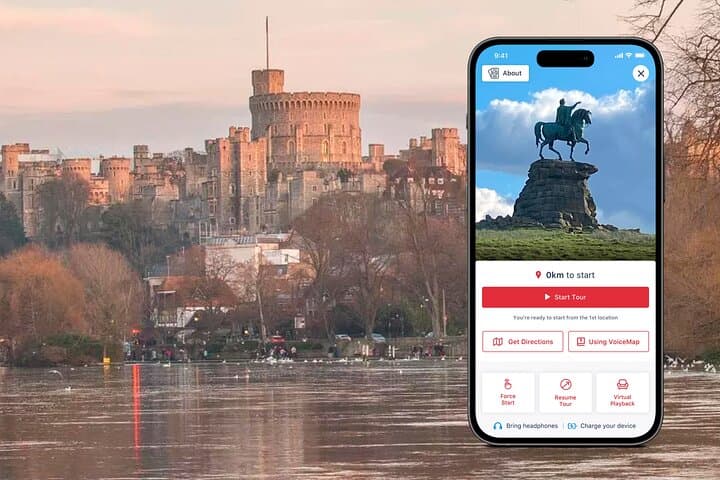

You start where the castle looms above the High Street, its stone bulk altering the light as you step into town. Paving stones click underfoot, shop fronts and pubs opening into view, while the distant avenue of plane trees that is the Long Walk gestures toward Windsor Great Park.
You start where the castle looms above the High Street, its stone bulk altering the light as you step into town. Paving stones click underfoot, shop fronts and pubs opening into view, while the distant avenue of plane trees that is the Long Walk gestures toward Windsor Great Park.
Windsor grew up around a Norman keep built to command the Thames and the road to the west; centuries of royal presence shaped the town’s streets, markets and civic buildings. The castle’s layered architecture — medieval keep, Tudor refurbishments, Victorian refits — reads like a compact history of Britain’s monarchy. Geologically, Windsor sits on chalk bedrock capped by river alluvium; the Thames carved the low-lying floodplain that makes the riverside so walkable.
Local culture still orbits ceremonial life: guildhalls, blue plaques, and weekend regattas on the Thames link contemporary rhythm to pageantry. Walks here are social and practical — commuters, students from nearby Eton, and visitors share the same paths.
Practical guidance: allow 60–90 minutes to cover the castle frontage, Guildhall, St John’s Church and a riverside stretch to Windsor Bridge at a relaxed pace. Public transport is frequent — Windsor & Eton Central or Riverside stations are within easy reach. Wear supportive shoes for cobbles, carry a light waterproof, and use a map app to keep your place; many points of interest are passed without entry charges. Visit early morning or late afternoon for fewer crowds and softer light along the Long Walk; avoid high river levels after heavy rain if planning to follow narrow towpaths.