THE ADVENTURE COLLECTIVE® · Independent discovery and booking for outdoor travel

Explore Stoke Newington at your own pace with an audio guide that traces dissenting churches, Georgian houses, and a 400-year-old engineered waterway. This 2–3 hour walk mixes social history with urban nature and practical route guidance.
Explore Stoke Newington at your own pace with an audio guide that traces dissenting churches, Georgian houses, and a 400-year-old engineered waterway. This 2–3 hour walk mixes social history with urban nature and practical route guidance.
You step out of Stoke Newington station and the city rearranges itself: the clatter of trains fades behind a line of plane trees, and a High Street hums with market chatter and the smell of fresh coffee. This self-guided audio walk threads those contrasts—industrial edges, quiet churchyards, and a ribbon of engineered water that still moves the neighborhood.
Verified experiences and guided adventures in the surrounding area.
Operated by VoiceMap Audio Tours · London, England
You step out of Stoke Newington station and the city rearranges itself: the clatter of trains fades behind a line of plane trees, and a High Street hums with market chatter and the smell of fresh coffee. This self-guided audio walk threads those contrasts—industrial edges, quiet churchyards, and a ribbon of engineered water that still moves the neighborhood.
Walk past Victorian gravestones at Abney Park where the monuments lean into moss and history; the audio explains how dissenting congregations, Quakers and abolitionist families shaped local politics and philanthropy. A Georgian mansion turned community cafe shows the shift from private estates to public life. The New River, an artificial 17th-century waterway, cuts through with steady purpose—the engineering that fed growing London and still whispers of trades long gone.
Expect narrow, paved streets, occasional cobbles and park paths across roughly 2–4 miles depending on detours. The tour balances cultural history—religion, commerce and social reform—with small natural surprises: urban wetlands and parkland birdsong that push back against the city noise.
Practical edge: this is low-impact walking suitable for most fitness levels, but wear grippy shoes for damp cemetery paths and bring a charged phone for offline audio and maps. Peak times are mornings and early evenings; quieter mid-afternoon reveals more of the neighborhood’s rhythms. Take time at Manor House to compare the modern junction with the old manor boundary where this story began.
easy.
2–3 hours.
Suitable for most people who can walk 2–4 miles with short stops; minimal continuous elevation.
The audio experience is designed for about 2–3 hours and typically covers 2–4 miles depending on detours and how long you linger at sites.
No—downloadable audio, maps and geodata are provided for offline use so you can follow the route without mobile data.
Many streets and parks are accessible and stroller-friendly, but some cemetery paths may be uneven—check specific sections before attempting with a wheelchair.
Yes—the tour is self-guided with lifetime access, so you can begin when it suits you during daylight hours for safety and best visibility.
Stoke Newington grew from a Saxon hamlet into a haven for religious dissenters; in the 18th–19th centuries Quakers and abolitionist families played outsized roles in local civic life.
Local green spaces and wetlands are managed for urban biodiversity—stick to paths, avoid disturbing nesting birds, and use local recycling points to minimize impact.
VoiceMap Audio Tours operates guided outdoor trips and adventures with an emphasis on safety, stewardship, and memorable experiences.
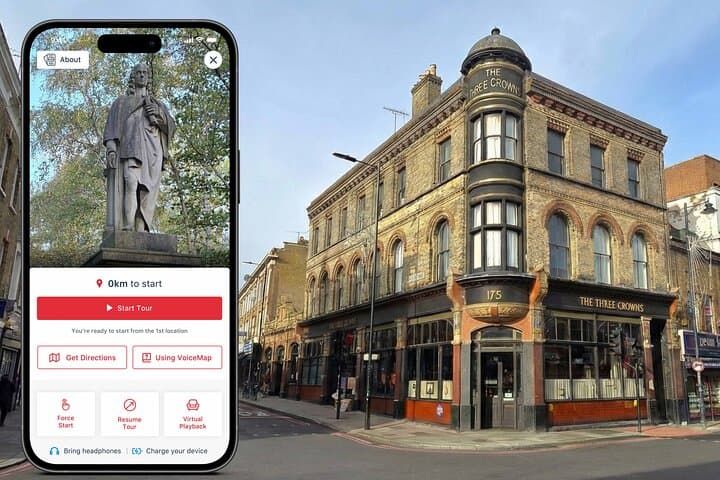


You step out of Stoke Newington station and the city rearranges itself: the clatter of trains fades behind a line of plane trees, and a High Street hums with market chatter and the smell of fresh coffee. This self-guided audio walk threads those contrasts—industrial edges, quiet churchyards, and a ribbon of engineered water that still moves the neighborhood.
You step out of Stoke Newington station and the city rearranges itself: the clatter of trains fades behind a line of plane trees, and a High Street hums with market chatter and the smell of fresh coffee. This self-guided audio walk threads those contrasts—industrial edges, quiet churchyards, and a ribbon of engineered water that still moves the neighborhood.
Walk past Victorian gravestones at Abney Park where the monuments lean into moss and history; the audio explains how dissenting congregations, Quakers and abolitionist families shaped local politics and philanthropy. A Georgian mansion turned community cafe shows the shift from private estates to public life. The New River, an artificial 17th-century waterway, cuts through with steady purpose—the engineering that fed growing London and still whispers of trades long gone.
Expect narrow, paved streets, occasional cobbles and park paths across roughly 2–4 miles depending on detours. The tour balances cultural history—religion, commerce and social reform—with small natural surprises: urban wetlands and parkland birdsong that push back against the city noise.
Practical edge: this is low-impact walking suitable for most fitness levels, but wear grippy shoes for damp cemetery paths and bring a charged phone for offline audio and maps. Peak times are mornings and early evenings; quieter mid-afternoon reveals more of the neighborhood’s rhythms. Take time at Manor House to compare the modern junction with the old manor boundary where this story began.