THE ADVENTURE COLLECTIVE® · Independent discovery and booking for outdoor travel

Walk Münster at your own pace with a GPS‑guided audio tour in seven languages. Explore the cathedral, Prinzipalmarkt, and hidden local stories over a 2–3 hour route you can pause and resume.
Walk Münster at your own pace with a GPS‑guided audio tour in seven languages. Explore the cathedral, Prinzipalmarkt, and hidden local stories over a 2–3 hour route you can pause and resume.
Morning light slants across Prinzipalmarkt’s gabled facades as footsteps click on stone — the audio guide nudges you onward in clear, friendly narration. This self-guided Münster walk threads the compact medieval core: cathedral spires, arcaded merchants’ houses, and the regular chime of carillons that mark the city’s daily pulse.
Verified experiences and guided adventures in the surrounding area.
Operated by City App Tour · Münster, North Rhine-Westphalia
Morning light slants across Prinzipalmarkt’s gabled facades as footsteps click on stone — the audio guide nudges you onward in clear, friendly narration. This self-guided Münster walk threads the compact medieval core: cathedral spires, arcaded merchants’ houses, and the regular chime of carillons that mark the city’s daily pulse.
Münster’s story stretches from a ninth‑century episcopal foundation through its role in the Peace of Westphalia to the post‑war rebuilding that gave the Stadttheater its modern face. Geologically the landscape is flat Westphalian plain, so the route is easy underfoot; the city’s historic moat has been overtaken by a green Promenade, where trees lean toward the river and bicycle traffic weaves like practiced currents.
Culturally, Münster is a student town with museum collections and lively cafés tucked between churches and courtyards. Expect touches of local lore — the nightly horn atop St. Lambert’s tower and the municipal carillon schedule — woven into the audio script alongside architectural context.
Practical guidance: the tour runs about 2–3 hours but can be paused and resumed until the end of the next day. You’ll need a smartphone with internet and GPS enabled and a pair of headphones. Wear comfortable walking shoes for cobbles and light rain gear in spring and autumn. Time the carillon at noon or late afternoon for full effect, and leave space for a coffee stop on Prinzipalmarkt.
The experience is low‑impact and highly flexible: it’s a paced, informative way to own Münster on your own timetable while learning the city’s history and noticing details you might otherwise miss.
easy.
2–3 hours.
Suitable for most fitness levels; expect several hours of standing and walking on mostly flat, paved surfaces.
The audio content covers about 2–3 hours of walking, but you can pause and return to finish by the end of the next day.
Yes — the tour requires an internet connection and GPS to deliver route guidance and audio tracks.
Much of Münster’s center is on paved streets and Promenade paths, but some older areas have cobblestones; accessibility may vary by segment.
Yes — the itinerary is flexible and allows time for museums, cafés, and detours; your booking grants access to the audio until the end of the next day.
Münster grew as a bishopric in the early Middle Ages and later hosted the 1648 Peace of Westphalia negotiations that reshaped European borders.
Münster prioritizes sustainable urban mobility—bikes and public transport reduce car traffic in the historic core; stay on paths and respect quiet hours.
City App Tour operates guided outdoor trips and adventures with an emphasis on safety, stewardship, and memorable experiences.
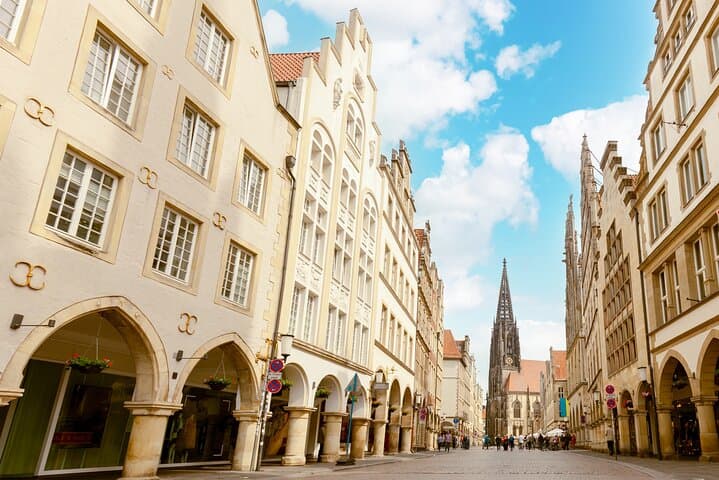


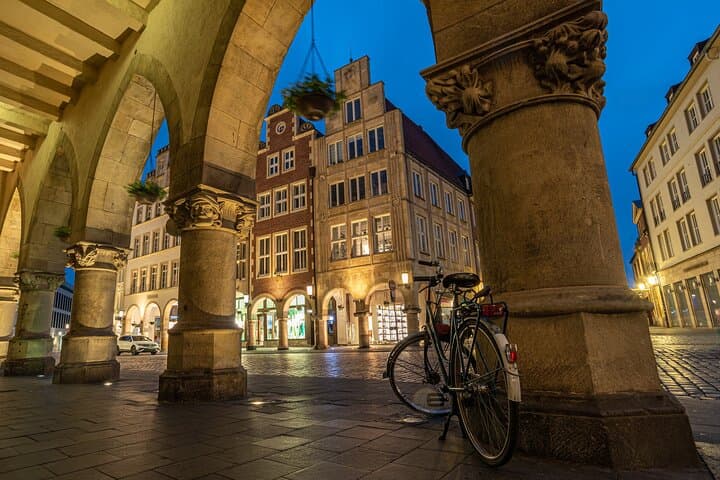
Morning light slants across Prinzipalmarkt’s gabled facades as footsteps click on stone — the audio guide nudges you onward in clear, friendly narration. This self-guided Münster walk threads the compact medieval core: cathedral spires, arcaded merchants’ houses, and the regular chime of carillons that mark the city’s daily pulse.
Morning light slants across Prinzipalmarkt’s gabled facades as footsteps click on stone — the audio guide nudges you onward in clear, friendly narration. This self-guided Münster walk threads the compact medieval core: cathedral spires, arcaded merchants’ houses, and the regular chime of carillons that mark the city’s daily pulse.
Münster’s story stretches from a ninth‑century episcopal foundation through its role in the Peace of Westphalia to the post‑war rebuilding that gave the Stadttheater its modern face. Geologically the landscape is flat Westphalian plain, so the route is easy underfoot; the city’s historic moat has been overtaken by a green Promenade, where trees lean toward the river and bicycle traffic weaves like practiced currents.
Culturally, Münster is a student town with museum collections and lively cafés tucked between churches and courtyards. Expect touches of local lore — the nightly horn atop St. Lambert’s tower and the municipal carillon schedule — woven into the audio script alongside architectural context.
Practical guidance: the tour runs about 2–3 hours but can be paused and resumed until the end of the next day. You’ll need a smartphone with internet and GPS enabled and a pair of headphones. Wear comfortable walking shoes for cobbles and light rain gear in spring and autumn. Time the carillon at noon or late afternoon for full effect, and leave space for a coffee stop on Prinzipalmarkt.
The experience is low‑impact and highly flexible: it’s a paced, informative way to own Münster on your own timetable while learning the city’s history and noticing details you might otherwise miss.