THE ADVENTURE COLLECTIVE® · Independent discovery and booking for outdoor travel

Turn Osnabrück’s streets into an interactive city game: a self-guided e-scavenger hunt that combines local history, public art, and GPS challenges. Ideal for families and groups wanting a flexible 2–4 hour outdoor exploration.
Turn Osnabrück’s streets into an interactive city game: a self-guided e-scavenger hunt that combines local history, public art, and GPS challenges. Ideal for families and groups wanting a flexible 2–4 hour outdoor exploration.
A morning breeze lifts the scent of fresh bread and roasted coffee as you step onto Osnabrück’s Markt. Cobblestones click underfoot while the late-Gothic town hall watches over the square, daring you to learn its stories. With only a smartphone and an app, the city rearranges itself into a game: alleys become puzzles, public art becomes clues, and the river Hase seems to nudge you toward the next discovery.
Verified experiences and guided adventures in the surrounding area.
Operated by Qula · Osnabrück, Lower Saxony
A morning breeze lifts the scent of fresh bread and roasted coffee as you step onto Osnabrück’s Markt. Cobblestones click underfoot while the late-Gothic town hall watches over the square, daring you to learn its stories. With only a smartphone and an app, the city rearranges itself into a game: alleys become puzzles, public art becomes clues, and the river Hase seems to nudge you toward the next discovery.
Osnabrück’s streets carry centuries — from its medieval cathedral complex and the Romanesque elements of St. Peter’s to the university’s baroque façades. The town played a real part in European history: the city shared hosting duties for the Peace of Westphalia negotiations in 1648. Geology here is gentle; the Hase has carved a modest valley, and the terrain is flat to rolling, ideal for easy walking and frequent stops to read plaques or photograph facades.
Culturally, the city mixes student energy, craft shops along Heger Straße, and quiet church squares where locals sip espresso. The app leads you to highlights (town hall, Mariakerk, Waterloopoort) and lesser-known corners, so you build your own rhythm.
Practical guidance: expect 2–4 hours depending on pace and detours. The tour is self-guided, wheelchair- and stroller-accessible in core areas, and works offline for mapped routes but needs GPS to validate answers. Bring a charged phone, comfortable shoes, and time between tasks to enjoy cafés or detours. Start early to avoid crowds and use the route as a flexible framework — pause, explore, and return when you’re ready.
easy.
2–4 hours.
Basic walking fitness; suitable for most ages and mobility levels with many accessible sections
Yes — you’ll receive instructions after booking to log into the online app; download or bookmark it and grant location access before starting.
Core areas and many stops are wheelchair- and stroller-accessible, though some side streets have cobblestones; plan an easier route if needed.
Yes — the tour is self-guided and available anytime, but daytime hours offer open galleries and café service.
Yes — the app supports group play and the format works well for families, corporate teams, or private gatherings.
Osnabrück shared in negotiating the Peace of Westphalia in 1648 and the town hall is a notable late-Gothic civic building from 1487–1512.
Respect historic streets and public art by staying on paths, disposing of waste, and limiting noise; using a self-guided app reduces paper guides and supports low-impact tourism.
Qula operates guided outdoor trips and adventures with an emphasis on safety, stewardship, and memorable experiences.

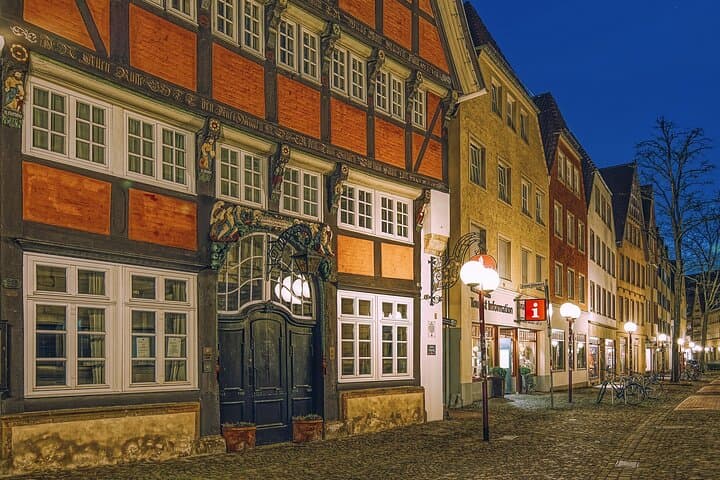

A morning breeze lifts the scent of fresh bread and roasted coffee as you step onto Osnabrück’s Markt. Cobblestones click underfoot while the late-Gothic town hall watches over the square, daring you to learn its stories. With only a smartphone and an app, the city rearranges itself into a game: alleys become puzzles, public art becomes clues, and the river Hase seems to nudge you toward the next discovery.
A morning breeze lifts the scent of fresh bread and roasted coffee as you step onto Osnabrück’s Markt. Cobblestones click underfoot while the late-Gothic town hall watches over the square, daring you to learn its stories. With only a smartphone and an app, the city rearranges itself into a game: alleys become puzzles, public art becomes clues, and the river Hase seems to nudge you toward the next discovery.
Osnabrück’s streets carry centuries — from its medieval cathedral complex and the Romanesque elements of St. Peter’s to the university’s baroque façades. The town played a real part in European history: the city shared hosting duties for the Peace of Westphalia negotiations in 1648. Geology here is gentle; the Hase has carved a modest valley, and the terrain is flat to rolling, ideal for easy walking and frequent stops to read plaques or photograph facades.
Culturally, the city mixes student energy, craft shops along Heger Straße, and quiet church squares where locals sip espresso. The app leads you to highlights (town hall, Mariakerk, Waterloopoort) and lesser-known corners, so you build your own rhythm.
Practical guidance: expect 2–4 hours depending on pace and detours. The tour is self-guided, wheelchair- and stroller-accessible in core areas, and works offline for mapped routes but needs GPS to validate answers. Bring a charged phone, comfortable shoes, and time between tasks to enjoy cafés or detours. Start early to avoid crowds and use the route as a flexible framework — pause, explore, and return when you’re ready.