THE ADVENTURE COLLECTIVE® · Independent discovery and booking for outdoor travel

Explore Bonn at your own pace with a self-guided e-scavenger hunt that turns city landmarks into interactive puzzles. Walk 2–4 hours through Beethoven’s birthplace, Romanesque churches, and cherry-lined avenues while learning local history via a GPS-enabled app.
Explore Bonn at your own pace with a self-guided e-scavenger hunt that turns city landmarks into interactive puzzles. Walk 2–4 hours through Beethoven’s birthplace, Romanesque churches, and cherry-lined avenues while learning local history via a GPS-enabled app.
You step off the tram and the Rhine greets you first—broad, deliberate, tugging at the city’s edges as if directing your route. Streets open into squares where bronze Beethoven presides and church towers cut into the sky; your phone pings and the game begins.
Verified experiences and guided adventures in the surrounding area.
Operated by Qula · Bonn, North Rhine-Westphalia
You step off the tram and the Rhine greets you first—broad, deliberate, tugging at the city’s edges as if directing your route. Streets open into squares where bronze Beethoven presides and church towers cut into the sky; your phone pings and the game begins.
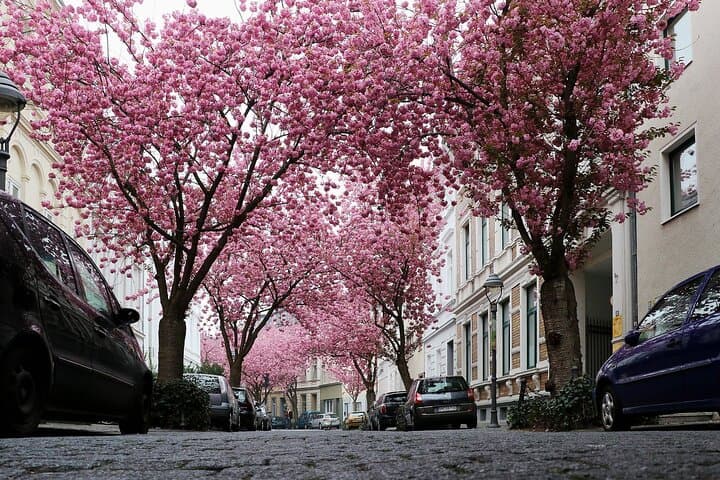
This self-guided e-scavenger hunt threads Bonn’s compact center: Münsterplatz, the Beethoven-Haus, the Romanesque Bonn Minster, Poppelsdorfer Palace, and the quieter lanes of Nordstadt with its famous cherry-tree avenue on Heerstraße. Bonn’s history reaches from Roman settlement through medieval walls to its 20th-century role as the provisional capital of West Germany; the city wears each era plainly in masonry and museum placards. Geologically, the city sits on the Rhine floodplain beneath the rising slopes of the Siebengebirge—visible on clear days—so expect flat walking with occasional riverside breezes.
Culturally you’ll pass university life, classical music heritage, and museums like the Alexander Koenig natural history and the LVR-LandesMuseum. The app guides you with location-based prompts and light puzzles that reveal local facts as you go.
Practical side: the route is flexible—plan 2–4 hours and roughly 3–6 km depending on detours. The game is family-friendly and wheelchair accessible; carry a charged smartphone, a portable battery, and water. Watch for trams and cobbles in some squares. Start in the morning to avoid café crowds, or take an evening stroll when the city softens and monuments light up. This is an urban walk that rewards curiosity and steady feet.
easy.
2–4 hours.
Suitable for all fitness levels; standing and light walking for a few hours is required.
You receive instructions and login details after booking; download the app, sign in, and begin at your chosen starting point.
It’s self-guided—there’s no live guide, so you control pace and timing using the app’s GPS prompts.
Yes—most areas and surfaces are wheelchair and stroller accessible, but some older squares have cobbles that may be uneven.
Yes—the app allows you to pause and resume, so you can stop for breaks, cafés, or museum visits and continue later.
Bonn is Beethoven’s birthplace and later served as the provisional capital of West Germany; its core preserves Romanesque and baroque landmarks reflecting a long urban continuum.
Stick to marked paths and respect museum rules; small-group, self-guided tours help reduce pressure on busy sites—avoid littering and support local businesses to keep tourism sustainable.
Qula operates guided outdoor trips and adventures with an emphasis on safety, stewardship, and memorable experiences.

You step off the tram and the Rhine greets you first—broad, deliberate, tugging at the city’s edges as if directing your route. Streets open into squares where bronze Beethoven presides and church towers cut into the sky; your phone pings and the game begins.
You step off the tram and the Rhine greets you first—broad, deliberate, tugging at the city’s edges as if directing your route. Streets open into squares where bronze Beethoven presides and church towers cut into the sky; your phone pings and the game begins.
This self-guided e-scavenger hunt threads Bonn’s compact center: Münsterplatz, the Beethoven-Haus, the Romanesque Bonn Minster, Poppelsdorfer Palace, and the quieter lanes of Nordstadt with its famous cherry-tree avenue on Heerstraße. Bonn’s history reaches from Roman settlement through medieval walls to its 20th-century role as the provisional capital of West Germany; the city wears each era plainly in masonry and museum placards. Geologically, the city sits on the Rhine floodplain beneath the rising slopes of the Siebengebirge—visible on clear days—so expect flat walking with occasional riverside breezes.
Culturally you’ll pass university life, classical music heritage, and museums like the Alexander Koenig natural history and the LVR-LandesMuseum. The app guides you with location-based prompts and light puzzles that reveal local facts as you go.
Practical side: the route is flexible—plan 2–4 hours and roughly 3–6 km depending on detours. The game is family-friendly and wheelchair accessible; carry a charged smartphone, a portable battery, and water. Watch for trams and cobbles in some squares. Start in the morning to avoid café crowds, or take an evening stroll when the city softens and monuments light up. This is an urban walk that rewards curiosity and steady feet.