THE ADVENTURE COLLECTIVE® · Independent discovery and booking for outdoor travel

Take a two-hour self-guided walking tour of central Dublin with an audioguide app. Follow a mapped route through Grafton Street, Trinity College, St. Patrick’s Cathedral and Temple Bar at your own pace—perfect for independent travelers who want context without a group.
Take a two-hour self-guided walking tour of central Dublin with an audioguide app. Follow a mapped route through Grafton Street, Trinity College, St. Patrick’s Cathedral and Temple Bar at your own pace—perfect for independent travelers who want context without a group.
Morning light skims the River Liffey as you step onto cobblestone streets and press play: the city opens in measured, human voice. The app maps a two-hour loop through Grafton Street’s buskers, the green calm of St. Stephen’s Green, the Gothic silhouette of St. Patrick’s Cathedral and the convivial noise of Temple Bar, ending at Dublin’s oldest pub where wooden chairs creak like memory.
Verified experiences and guided adventures in the surrounding area.
Operated by TouringBee · Dublin, County Dublin
Morning light skims the River Liffey as you step onto cobblestone streets and press play: the city opens in measured, human voice. The app maps a two-hour loop through Grafton Street’s buskers, the green calm of St. Stephen’s Green, the Gothic silhouette of St. Patrick’s Cathedral and the convivial noise of Temple Bar, ending at Dublin’s oldest pub where wooden chairs creak like memory.
Dublin’s story is readable in stone and streetplan: Georgian squares from the 18th century, Viking-era settlements along the Liffey, and Victorian civic buildings that speak to trade and empire. Geologically the city sits on Dublin Basin sedimentary rocks and glacial deposits, producing the low, walkable hills and the river corridor that shaped its port and industries.
Culturally the route traces literary lanes—Swift, Yeats and Joyce haunt plaques and façades—and offers a taste of contemporary life in cafés, galleries and markets. Local color ranges from traditional music drifting from a pub doorway to the modern art in the National Gallery.
Practical guidance: download the TouringBee app before you arrive, enable offline maps, and carry headphones and a charged phone. Walk at your own pace—audio stops let you linger in a café or detour into a narrow lane. Expect flat to gently rolling pavement, city traffic crossings, and occasional steps into historic buildings. Aim for mornings or late afternoons to avoid peak pedestrian flow; bring a compact rain layer, comfortable shoes, and a power bank if you plan photos. This self-guided format gives freedom and context: you navigate, the app narrates, and Dublin rewards both curiosity and careful pacing.
easy.
2 hours.
Suitable for most fitness levels; requires steady walking for around 2 hours and negotiating city sidewalks.
No—this tour uses a mobile audioguide; you activate it in the app and access the route on your phone.
Much of the city center is accessible, but cobbles, steps at some attractions, and narrow streets can present challenges—check specific points in the app map before you go.
Yes—the audio guide is available on-demand during your access period so you can begin whenever you prefer.
No—this self-guided tour provides commentary and an external route; entrance fees to museums and attractions are paid separately.
Dublin grew from a Viking trading settlement on the River Liffey into a Georgian commercial center; much of its street pattern reflects that layered past.
Stick to marked paths and behave respectfully in historic sites; supporting local museums and pubs helps fund preservation of Dublin’s built heritage.
TouringBee operates guided outdoor trips and adventures with an emphasis on safety, stewardship, and memorable experiences.

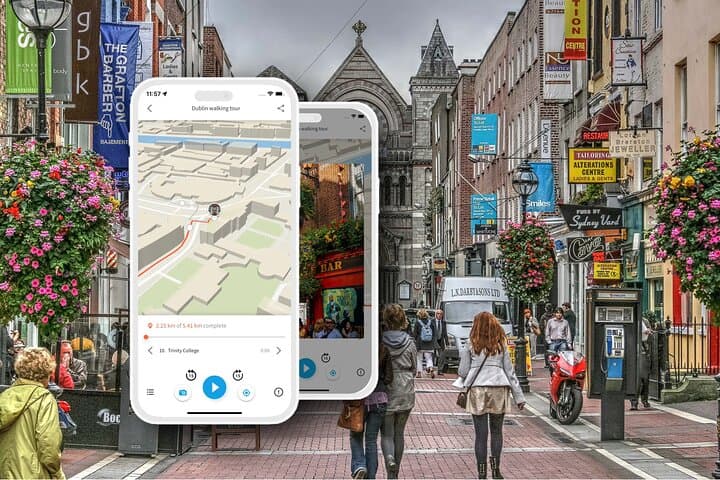


Morning light skims the River Liffey as you step onto cobblestone streets and press play: the city opens in measured, human voice. The app maps a two-hour loop through Grafton Street’s buskers, the green calm of St. Stephen’s Green, the Gothic silhouette of St. Patrick’s Cathedral and the convivial noise of Temple Bar, ending at Dublin’s oldest pub where wooden chairs creak like memory.
Morning light skims the River Liffey as you step onto cobblestone streets and press play: the city opens in measured, human voice. The app maps a two-hour loop through Grafton Street’s buskers, the green calm of St. Stephen’s Green, the Gothic silhouette of St. Patrick’s Cathedral and the convivial noise of Temple Bar, ending at Dublin’s oldest pub where wooden chairs creak like memory.
Dublin’s story is readable in stone and streetplan: Georgian squares from the 18th century, Viking-era settlements along the Liffey, and Victorian civic buildings that speak to trade and empire. Geologically the city sits on Dublin Basin sedimentary rocks and glacial deposits, producing the low, walkable hills and the river corridor that shaped its port and industries.
Culturally the route traces literary lanes—Swift, Yeats and Joyce haunt plaques and façades—and offers a taste of contemporary life in cafés, galleries and markets. Local color ranges from traditional music drifting from a pub doorway to the modern art in the National Gallery.
Practical guidance: download the TouringBee app before you arrive, enable offline maps, and carry headphones and a charged phone. Walk at your own pace—audio stops let you linger in a café or detour into a narrow lane. Expect flat to gently rolling pavement, city traffic crossings, and occasional steps into historic buildings. Aim for mornings or late afternoons to avoid peak pedestrian flow; bring a compact rain layer, comfortable shoes, and a power bank if you plan photos. This self-guided format gives freedom and context: you navigate, the app narrates, and Dublin rewards both curiosity and careful pacing.