THE ADVENTURE COLLECTIVE® · Independent discovery and booking for outdoor travel

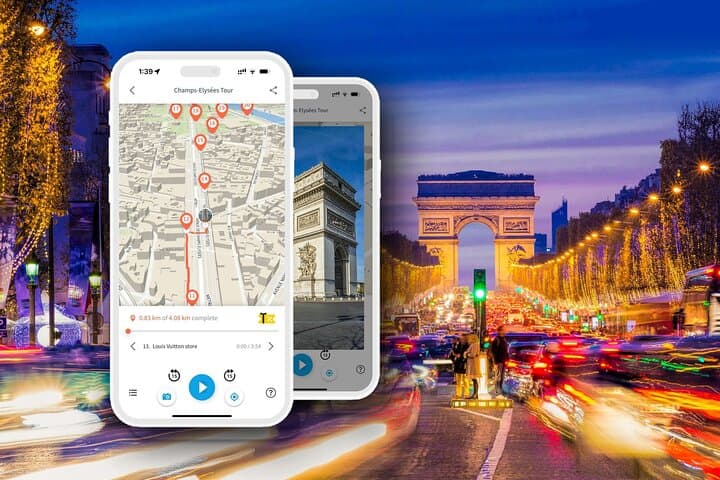
Walk the Champs-Élysées at your own pace with a GPS audio guide that highlights 24 landmarks from the Arc de Triomphe to the Petit Palais. Perfect for travelers with limited time who want history, architecture, and practical navigation on demand.
Walk the Champs-Élysées at your own pace with a GPS audio guide that highlights 24 landmarks from the Arc de Triomphe to the Petit Palais. Perfect for travelers with limited time who want history, architecture, and practical navigation on demand.
Stand at the western end of the Champs-Élysées and the city presses in: wide avenue, chestnut trees, the Arc de Triomphe cutting the skyline like a stone gate. Pedestrians thread past cafés and flagship boutiques while your phone becomes a compact guide—GPS pinning each stop as narration explains what you’re looking at.
Verified experiences and guided adventures in the surrounding area.
Operated by TouringBee · Paris, Île-de-France
Stand at the western end of the Champs-Élysées and the city presses in: wide avenue, chestnut trees, the Arc de Triomphe cutting the skyline like a stone gate. Pedestrians thread past cafés and flagship boutiques while your phone becomes a compact guide—GPS pinning each stop as narration explains what you’re looking at.
This stretch of Paris carries layers of history: imperial parades under Napoleon, the fin-de-siècle flourish of the Grand Palais and Petit Palais built for the 1900 Exposition, and 19th-century townhouses like Hôtel de la Païva that show how wealth reshaped the avenue. The route crosses the Seine on Alexandre III’s gilded bridge and ends near Place de la Concorde, where an Egyptian obelisk marks a turbulent revolutionary past.
The TouringBee audio guide lays out 24 points of interest with historian narration and illustrations, letting you move at your own pace and linger at the sights that matter. Expect about 1.5–2 hours of walking on paved sidewalks and occasional crossings; comfortable shoes matter more than fitness training.
Practical pointers: download the app and map for offline use, start early to avoid peak crowds, and buy Arc de Triomphe entry separately if you plan to climb. Use Metro stations Étoile or Franklin D. Roosevelt for the easiest access. Keep a portable charger, a refillable water bottle, and an eye on traffic when crossing the wide avenues. This is an urban walk that blends architecture, politics, and daily Parisian life into a focused, readable route.
easy.
1.5–2 hours.
Suitable for all fitness levels; requires comfortable walking on paved urban sidewalks and confidence with street crossings
Plan on 1.5–2 hours for the full route at a steady pace; you can pause longer at museums or cafés.
No—Arc access must be purchased separately in advance if you plan to climb to the viewpoint.
The booking includes one-year access to the tour in your preferred language via the mobile app; language options depend on the app version.
The route is mostly on paved sidewalks but includes some crossings and curbs; accessibility varies by exact segment—check local curb cuts and station access for Metro stops like Étoile.
The avenue became a ceremonial route under Napoleon and was redesigned through the 19th century into the grand promenade of shops and cultural institutions seen today.
Stick to marked paths, avoid feeding wildlife, and use refillable bottles; choose public transit to reduce emissions and respect protected façades by not touching or climbing monuments.
TouringBee operates guided outdoor trips and adventures with an emphasis on safety, stewardship, and memorable experiences.


Stand at the western end of the Champs-Élysées and the city presses in: wide avenue, chestnut trees, the Arc de Triomphe cutting the skyline like a stone gate. Pedestrians thread past cafés and flagship boutiques while your phone becomes a compact guide—GPS pinning each stop as narration explains what you’re looking at.
Stand at the western end of the Champs-Élysées and the city presses in: wide avenue, chestnut trees, the Arc de Triomphe cutting the skyline like a stone gate. Pedestrians thread past cafés and flagship boutiques while your phone becomes a compact guide—GPS pinning each stop as narration explains what you’re looking at.
This stretch of Paris carries layers of history: imperial parades under Napoleon, the fin-de-siècle flourish of the Grand Palais and Petit Palais built for the 1900 Exposition, and 19th-century townhouses like Hôtel de la Païva that show how wealth reshaped the avenue. The route crosses the Seine on Alexandre III’s gilded bridge and ends near Place de la Concorde, where an Egyptian obelisk marks a turbulent revolutionary past.
The TouringBee audio guide lays out 24 points of interest with historian narration and illustrations, letting you move at your own pace and linger at the sights that matter. Expect about 1.5–2 hours of walking on paved sidewalks and occasional crossings; comfortable shoes matter more than fitness training.
Practical pointers: download the app and map for offline use, start early to avoid peak crowds, and buy Arc de Triomphe entry separately if you plan to climb. Use Metro stations Étoile or Franklin D. Roosevelt for the easiest access. Keep a portable charger, a refillable water bottle, and an eye on traffic when crossing the wide avenues. This is an urban walk that blends architecture, politics, and daily Parisian life into a focused, readable route.