THE ADVENTURE COLLECTIVE® · Independent discovery and booking for outdoor travel

Traverse Budapest’s center at your own pace with a 2–3 hour audio-guided walk that links the Chain Bridge, Parliament, St. Stephen’s Basilica and lively squares. Downloadable offline maps and 30 narrated stops let you experience history, architecture, and local quirks without a group.
Traverse Budapest’s center at your own pace with a 2–3 hour audio-guided walk that links the Chain Bridge, Parliament, St. Stephen’s Basilica and lively squares. Downloadable offline maps and 30 narrated stops let you experience history, architecture, and local quirks without a group.
Morning light slides along the Danube as the city wakes—trams click, café doors open, and the river dares you to set a pace. A self-guided audio walk through central Budapest threads you between stone lions, gilded domes, and narrow pedestrian lanes, letting the city speak on its own terms through narrated stops and an offline route map.
Verified experiences and guided adventures in the surrounding area.
Operated by TouringBee · Budapest, Budapest
Morning light slides along the Danube as the city wakes—trams click, café doors open, and the river dares you to set a pace. A self-guided audio walk through central Budapest threads you between stone lions, gilded domes, and narrow pedestrian lanes, letting the city speak on its own terms through narrated stops and an offline route map.
Budapest’s story is visible in its streets: two cities—Buda’s low hills rising to the west, Pest’s broad floodplain to the east—united in 1873 and stitched together by the Széchenyi Chain Bridge (1849). The route passes late-19th-century Neo-Renaissance and Art Nouveau façades, the Gothic Revival Parliament, and St. Stephen’s Basilica, where marble and dome views narrate national memory. Geological contrast is quiet but real—the Danube’s slow current carving the urban seam; Buda’s higher ground gives framed panoramas while Pest holds the boulevards and cafés that shaped modern city life.
Local color arrives in small things: Kolodko’s miniature bronzes tucked into alleys, the Gerbeaud pastry house’s layered cakes, and the odd Michael Jackson memorial tree on Erzsébet Square. The audio app supplies 30 narrated segments and offline navigation, so travelers keep the rhythm of the city without missing context.
Practical guidance: plan 2–3 hours and expect roughly 3–5 km of mostly flat walking on cobbles and pavement, with a few steps at vantage points. Download the files and use headphones; reserve extra time if you want to enter Parliament or climb the basilica dome (tickets sold separately). Aim for morning or late afternoon for softer light and fewer crowds; bring water, comfortable shoes, and a charged phone so the map never stalls.
easy.
2–3 hours.
Suitable for most fitness levels; requires ability to walk several kilometers on cobbles and stairs at a relaxed pace
The audio tour is designed for 2–3 hours and typically covers about 3–5 km through central Pest and the riverfront; you can stop anytime.
No—entrance and dome-climb tickets are separate and should be purchased in advance if you plan to enter.
No—the app supports offline playback and mapping once the tour content is downloaded over Wi‑Fi.
Yes—it's rated easy and suitable for most ages, though parents should plan for rest stops and keep an eye on busy streets.
Budapest formed from separate settlements—Buda and Óbuda on the west bank and Pest on the east—officially unifying in 1873; the late 19th-century boom produced many of the grand boulevards and public buildings seen on this route.
Stay on walkways, avoid climbing monuments, and support local cafés and shops to keep the historic center economically and environmentally healthy.
TouringBee operates guided outdoor trips and adventures with an emphasis on safety, stewardship, and memorable experiences.

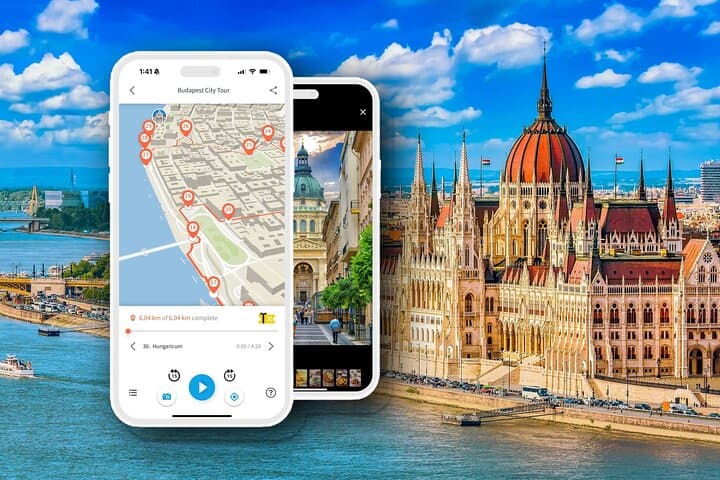


Morning light slides along the Danube as the city wakes—trams click, café doors open, and the river dares you to set a pace. A self-guided audio walk through central Budapest threads you between stone lions, gilded domes, and narrow pedestrian lanes, letting the city speak on its own terms through narrated stops and an offline route map.
Morning light slides along the Danube as the city wakes—trams click, café doors open, and the river dares you to set a pace. A self-guided audio walk through central Budapest threads you between stone lions, gilded domes, and narrow pedestrian lanes, letting the city speak on its own terms through narrated stops and an offline route map.
Budapest’s story is visible in its streets: two cities—Buda’s low hills rising to the west, Pest’s broad floodplain to the east—united in 1873 and stitched together by the Széchenyi Chain Bridge (1849). The route passes late-19th-century Neo-Renaissance and Art Nouveau façades, the Gothic Revival Parliament, and St. Stephen’s Basilica, where marble and dome views narrate national memory. Geological contrast is quiet but real—the Danube’s slow current carving the urban seam; Buda’s higher ground gives framed panoramas while Pest holds the boulevards and cafés that shaped modern city life.
Local color arrives in small things: Kolodko’s miniature bronzes tucked into alleys, the Gerbeaud pastry house’s layered cakes, and the odd Michael Jackson memorial tree on Erzsébet Square. The audio app supplies 30 narrated segments and offline navigation, so travelers keep the rhythm of the city without missing context.
Practical guidance: plan 2–3 hours and expect roughly 3–5 km of mostly flat walking on cobbles and pavement, with a few steps at vantage points. Download the files and use headphones; reserve extra time if you want to enter Parliament or climb the basilica dome (tickets sold separately). Aim for morning or late afternoon for softer light and fewer crowds; bring water, comfortable shoes, and a charged phone so the map never stalls.