THE ADVENTURE COLLECTIVE® · Independent discovery and booking for outdoor travel

Walk the rimlines and quiet parks where Sedona’s red rock and human history meet. This guided tour visits Airport Mesa, the Amitabha Stupa & Peace Park, and Rachel’s Knoll to explore geology, indigenous history, and practical ways to engage with vortex sites.
Walk the rimlines and quiet parks where Sedona’s red rock and human history meet. This guided tour visits Airport Mesa, the Amitabha Stupa & Peace Park, and Rachel’s Knoll to explore geology, indigenous history, and practical ways to engage with vortex sites.
You step out of a white minivan and the air changes—thin, clear, charged with something that feels like history and weather combined. Red-rock fins tilt toward the sky and the wind sketches stories across sandstone. At Airport Mesa the group gathers on the rim; a photographer leans into a sunrise and a guide points to the layers of rock that record millions of years of uplift and erosion. The tour begins not as a lecture but as a paced walk into place—into geography that people have treated as both map and meaning.
Verified experiences and guided adventures in the surrounding area.
Operated by Blue Bear Tours · Sedona, Arizona
You step out of a white minivan and the air changes—thin, clear, charged with something that feels like history and weather combined. Red-rock fins tilt toward the sky and the wind sketches stories across sandstone. At Airport Mesa the group gathers on the rim; a photographer leans into a sunrise and a guide points to the layers of rock that record millions of years of uplift and erosion. The tour begins not as a lecture but as a paced walk into place—into geography that people have treated as both map and meaning.
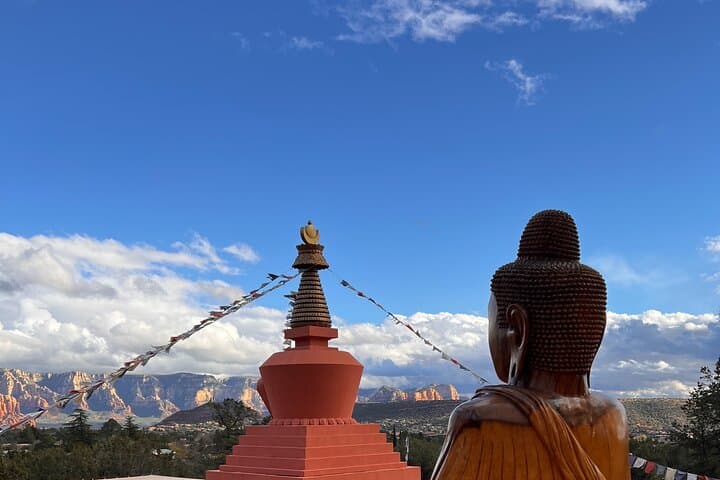
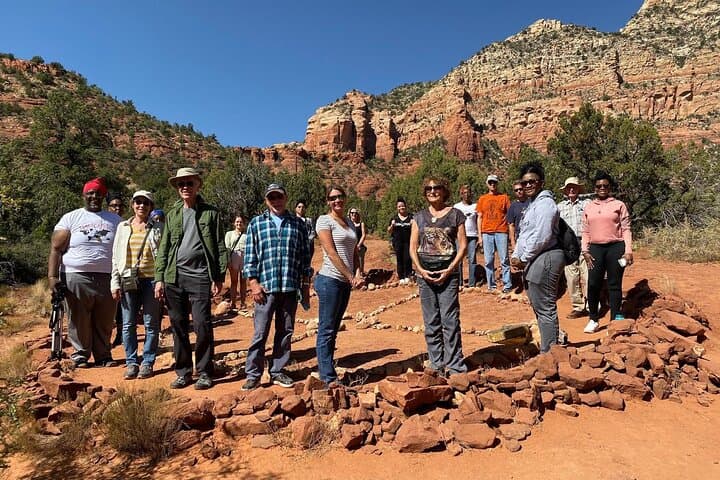
Sedona’s “vortexes” are geological features—ridges, cliffs and drainage bowls where topography, sunlight and airflow create a palpable intensity. Indigenous Peoples, including the Yavapai and Hopi, and later New Age communities, layered spiritual readings on the same landscape. On this 2.5-hour guided route you move from the panoramic sweep of Airport Mesa to the quiet of the Amitabha Stupa & Peace Park, and finally to Rachel’s Knoll and Seven Canyons, where a medicine wheel sits like an instruction manual for ancient astronomy and ritual.
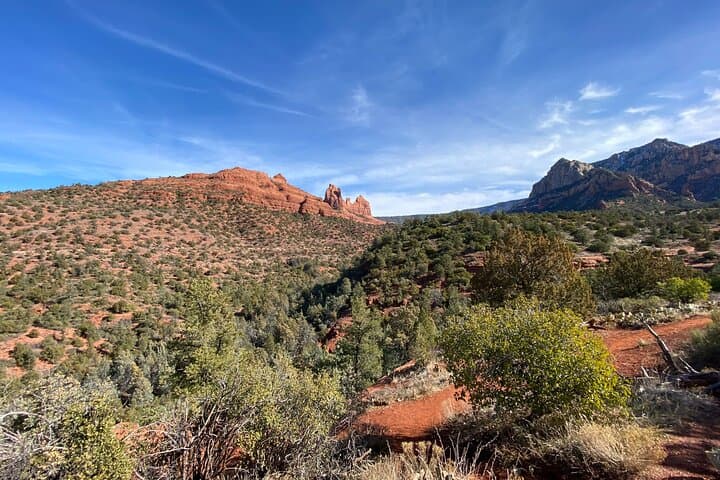
Geology shows up in the red: oxidized iron in the sandstone, horizontal beds giving way to steep, wind-carved faces. Cultural history is woven into the walk—stories of Sinagua inhabitants, the migrations and resurfacings of native beliefs, and the modern-era search for meaning that built trails and stupas. The guide mixes practical interpretation (how vortexes form, where energy collectors are most likely to be felt) with respectful context—how to approach sacred sites and when silence is part of the offering.
Practical guidance is direct. Expect short, mostly level walks with some rocky footing and a few short climbs; the tour is advertised as suitable for all fitness levels, but good shoes and sun protection matter. Bring water and a light layer: desert mornings can be cool and afternoons hot. Timing matters—early light softens the red rock and the wind tends to be gentler, making it a better time for focused moments like the flute sound healing at the stupa.
This is not a pilgrimage of dogma but a guided introduction: techniques for mindful engagement, a brief history of the medicine wheel, and guidance on personal experience. Photography stops are frequent, but the guide also asks visitors to put cameras away during meditative sections. Leave No Trace and respect for indigenous narratives are emphasized—participants are asked to keep to trails and to treat the sites as living places, not props.
By the end you understand the rocks differently: as archives of climate and life, as foundations of ritual, and as active places where the desert’s sharp clarity makes introspection feel more immediate. The tour leaves practical tools—how to approach a vortex, basic etiquette, and suggestions for deeper reading—so a visitor can return to Sedona with both directions and questions.
easy.
2–3 hours.
Suitable for most fitness levels; able to walk short distances on uneven ground and climb low steps.
A vortex refers to a topographic area where geological form, airflow and light create a focused sensation; some visitors report a physical or emotional feeling, others do not—experience varies.
Yes—the tour is rated easy with short walks; children and seniors who can manage short uneven sections generally do fine.
Only service animals are permitted due to guided stops and cultural sites—check with the operator in advance for specifics.
Meet at the Airport Road lot near the lookout and flag pole; parking usually has a small fee (often reimbursed by the guide if required).
Photography is welcomed at viewpoint stops but participants are asked to refrain from photos during meditative or sound-healing sections out of respect.
Tipping is customary for personalized guiding services—15–20% is a common guideline based on satisfaction.
The red-rock landscape was inhabited by Sinagua and later Yavapai-Apache communities; modern spiritual tourism grew in the mid-20th century as seekers and artists mapped new meanings onto the land.
Trails around vortex sites are fragile—stay on established paths, pack out trash, and follow Leave No Trace principles to protect both archaeological and natural resources.
Blue Bear Tours operates guided outdoor trips and adventures with an emphasis on safety, stewardship, and memorable experiences.
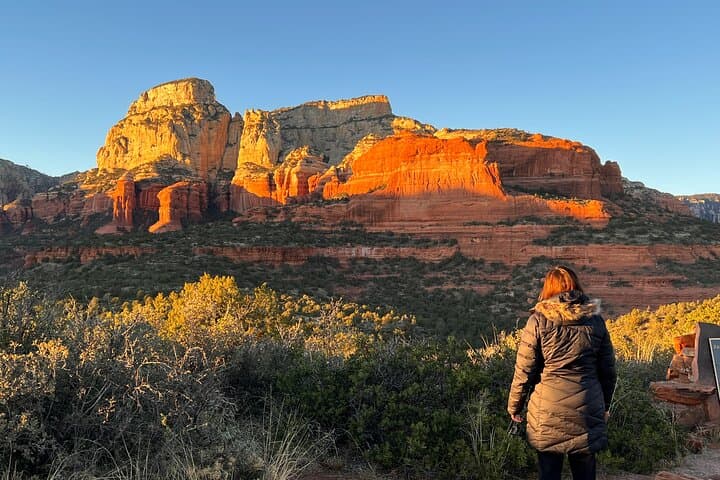
You step out of a white minivan and the air changes—thin, clear, charged with something that feels like history and weather combined. Red-rock fins tilt toward the sky and the wind sketches stories across sandstone. At Airport Mesa the group gathers on the rim; a photographer leans into a sunrise and a guide points to the layers of rock that record millions of years of uplift and erosion. The tour begins not as a lecture but as a paced walk into place—into geography that people have treated as both map and meaning.
You step out of a white minivan and the air changes—thin, clear, charged with something that feels like history and weather combined. Red-rock fins tilt toward the sky and the wind sketches stories across sandstone. At Airport Mesa the group gathers on the rim; a photographer leans into a sunrise and a guide points to the layers of rock that record millions of years of uplift and erosion. The tour begins not as a lecture but as a paced walk into place—into geography that people have treated as both map and meaning.
Sedona’s “vortexes” are geological features—ridges, cliffs and drainage bowls where topography, sunlight and airflow create a palpable intensity. Indigenous Peoples, including the Yavapai and Hopi, and later New Age communities, layered spiritual readings on the same landscape. On this 2.5-hour guided route you move from the panoramic sweep of Airport Mesa to the quiet of the Amitabha Stupa & Peace Park, and finally to Rachel’s Knoll and Seven Canyons, where a medicine wheel sits like an instruction manual for ancient astronomy and ritual.
Geology shows up in the red: oxidized iron in the sandstone, horizontal beds giving way to steep, wind-carved faces. Cultural history is woven into the walk—stories of Sinagua inhabitants, the migrations and resurfacings of native beliefs, and the modern-era search for meaning that built trails and stupas. The guide mixes practical interpretation (how vortexes form, where energy collectors are most likely to be felt) with respectful context—how to approach sacred sites and when silence is part of the offering.
Practical guidance is direct. Expect short, mostly level walks with some rocky footing and a few short climbs; the tour is advertised as suitable for all fitness levels, but good shoes and sun protection matter. Bring water and a light layer: desert mornings can be cool and afternoons hot. Timing matters—early light softens the red rock and the wind tends to be gentler, making it a better time for focused moments like the flute sound healing at the stupa.
This is not a pilgrimage of dogma but a guided introduction: techniques for mindful engagement, a brief history of the medicine wheel, and guidance on personal experience. Photography stops are frequent, but the guide also asks visitors to put cameras away during meditative sections. Leave No Trace and respect for indigenous narratives are emphasized—participants are asked to keep to trails and to treat the sites as living places, not props.
By the end you understand the rocks differently: as archives of climate and life, as foundations of ritual, and as active places where the desert’s sharp clarity makes introspection feel more immediate. The tour leaves practical tools—how to approach a vortex, basic etiquette, and suggestions for deeper reading—so a visitor can return to Sedona with both directions and questions.