THE ADVENTURE COLLECTIVE® · Independent discovery and booking for outdoor travel

Explore 1,500-year-old Huaca Pucllana, stroll a commemorative Parque Chino, and take in cliffside views along the Miraflores Malecón on this compact three-hour cultural walk. Ideal for travelers seeking history and coastal panorama without leaving the city.
Explore 1,500-year-old Huaca Pucllana, stroll a commemorative Parque Chino, and take in cliffside views along the Miraflores Malecón on this compact three-hour cultural walk. Ideal for travelers seeking history and coastal panorama without leaving the city.
You arrive on the Miraflores cliff as wind from the Pacific lifts the edge of your jacket; the city hums behind you while a silent pyramid of sun-baked adobe sits firm at your feet. The guide leads the small group through compacted pathways, and the scale of Huaca Pucllana reveals itself: stacked mud-brick terraces climbing in seven truncated levels, fingerprints of an ancient coastal culture.
Verified experiences and guided adventures in the surrounding area.
Operated by CHASKI JOURNEYS · Miraflores, Lima
You arrive on the Miraflores cliff as wind from the Pacific lifts the edge of your jacket; the city hums behind you while a silent pyramid of sun-baked adobe sits firm at your feet. The guide leads the small group through compacted pathways, and the scale of Huaca Pucllana reveals itself: stacked mud-brick terraces climbing in seven truncated levels, fingerprints of an ancient coastal culture.
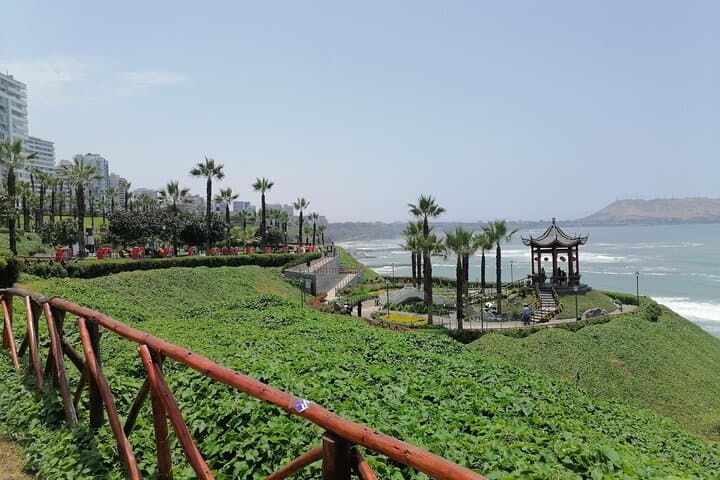
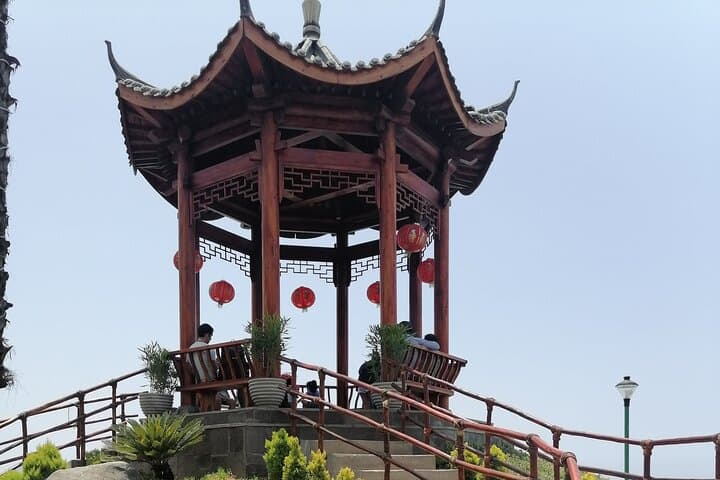
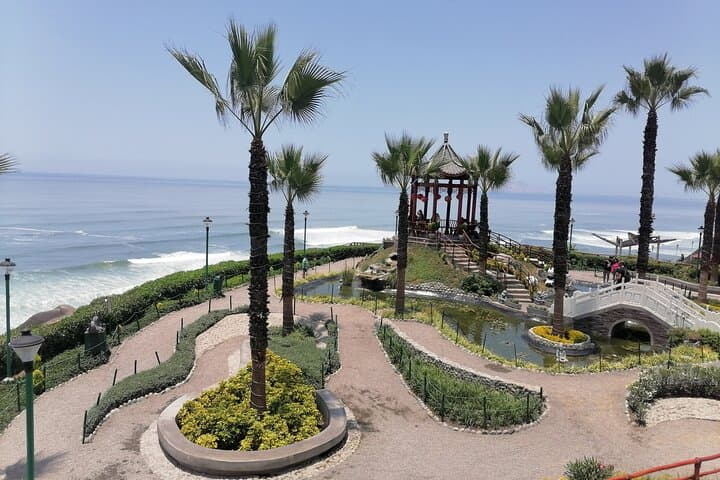
Huaca Pucllana dates to more than 1,500 years ago, built by Lima’s pre-Inca communities and later investigated by archaeologists whose trenches and ceramic finds are now showcased in the site museum. Nearby, Parque Chino marks a different cultural layer — a modern gift commemorating Chinese immigration and diplomatic ties, with granite guardian lions and a painted gazebo that contrasts with the raw earthwork of the huaca.
Geology here is simple but telling: coastal cliffs of the Costa Verde rise only a few dozen meters, composed of marine terrace sediments that create the dramatic Malecón viewpoint the tour skirts. Culture and migration mingle — pottery fragments, Chinese architectural motifs and the 20th–21st century city that frames both.
Practical guide: the half-day itinerary runs roughly three hours (90 min at Huaca Pucllana, 45 min at Parque Chino, 30–40 min walking the Malecón). Expect paved walkways, short stair sections and uneven archaeological surfaces — light, grippy footwear and sun protection are essential. Bring water, a camera, and respect the marked zones at the ruins. Timing late afternoon gives cooler air and a stronger chance for a Pacific sunset over the Malecón, but mornings are quieter. The tour is accessible, family-friendly and an efficient way to combine archaeology, immigrant history and coastal scenery in one easy outing.
easy.
3 hours.
Suitable for most fitness levels; requires standing and short walks over uneven surfaces.
The tour lasts about three hours: roughly 90 minutes at Huaca Pucllana, 45 minutes at Parque Chino and 30–40 minutes along the Malecón.
Huaca Pucllana and the tour logistics note wheelchair accessibility, but some paths at the site are uneven—contact the operator for specific accommodations.
Admission to Huaca Pucllana is included; other stops like Parque Chino and the Malecón are public spaces with no additional fee.
Late afternoon offers cooler temperatures and potential sunset views from the Malecón; mornings are quieter and cooler for photography.
Huaca Pucllana was constructed by Lima culture communities over 1,500 years ago and later excavated by archaeologists who revealed ceremonial and residential layers; Parque Chino celebrates nearly two centuries of Chinese-Peruvian ties.
The site is managed to protect fragile adobe structures—visitors should stay on designated paths and avoid touching exposed walls; support local conservation by following guide rules and avoiding single-use plastics where possible.
CHASKI JOURNEYS operates guided outdoor trips and adventures with an emphasis on safety, stewardship, and memorable experiences.
You arrive on the Miraflores cliff as wind from the Pacific lifts the edge of your jacket; the city hums behind you while a silent pyramid of sun-baked adobe sits firm at your feet. The guide leads the small group through compacted pathways, and the scale of Huaca Pucllana reveals itself: stacked mud-brick terraces climbing in seven truncated levels, fingerprints of an ancient coastal culture.
You arrive on the Miraflores cliff as wind from the Pacific lifts the edge of your jacket; the city hums behind you while a silent pyramid of sun-baked adobe sits firm at your feet. The guide leads the small group through compacted pathways, and the scale of Huaca Pucllana reveals itself: stacked mud-brick terraces climbing in seven truncated levels, fingerprints of an ancient coastal culture.
Huaca Pucllana dates to more than 1,500 years ago, built by Lima’s pre-Inca communities and later investigated by archaeologists whose trenches and ceramic finds are now showcased in the site museum. Nearby, Parque Chino marks a different cultural layer — a modern gift commemorating Chinese immigration and diplomatic ties, with granite guardian lions and a painted gazebo that contrasts with the raw earthwork of the huaca.
Geology here is simple but telling: coastal cliffs of the Costa Verde rise only a few dozen meters, composed of marine terrace sediments that create the dramatic Malecón viewpoint the tour skirts. Culture and migration mingle — pottery fragments, Chinese architectural motifs and the 20th–21st century city that frames both.
Practical guide: the half-day itinerary runs roughly three hours (90 min at Huaca Pucllana, 45 min at Parque Chino, 30–40 min walking the Malecón). Expect paved walkways, short stair sections and uneven archaeological surfaces — light, grippy footwear and sun protection are essential. Bring water, a camera, and respect the marked zones at the ruins. Timing late afternoon gives cooler air and a stronger chance for a Pacific sunset over the Malecón, but mornings are quieter. The tour is accessible, family-friendly and an efficient way to combine archaeology, immigrant history and coastal scenery in one easy outing.