THE ADVENTURE COLLECTIVE® · Independent discovery and booking for outdoor travel

Explore Dadan’s cliff-carved tombs and the dense inscriptions of Jabal Ikmah on a two-hour guided tour from AlUla. This short excursion combines geology, ancient trade history and hands-on interpretation of rock art.
Explore Dadan’s cliff-carved tombs and the dense inscriptions of Jabal Ikmah on a two-hour guided tour from AlUla. This short excursion combines geology, ancient trade history and hands-on interpretation of rock art.
Sand and stone open like pages when the minibus pulls into the valley outside AlUla. The guide points out scarred red cliffs and burial façades as desert wind tugs at your jacket, carrying a faint trace of ancient trade routes. Here, ruins rise from the sand—not as monuments frozen in time but as records of people who lived, prayed and traded across the Arabian peninsula.
Verified experiences and guided adventures in the surrounding area.
Operated by Desert Point Tourism LLC · AlUla, Al Madinah Region
Sand and stone open like pages when the minibus pulls into the valley outside AlUla. The guide points out scarred red cliffs and burial façades as desert wind tugs at your jacket, carrying a faint trace of ancient trade routes. Here, ruins rise from the sand—not as monuments frozen in time but as records of people who lived, prayed and traded across the Arabian peninsula.
Dadan was the political heart of the Dadanite and later Lihyanite kingdoms (roughly 9th–6th centuries BCE). Tombs hewn into sandstone cliffs, temple platforms and carved reliefs reflect a society that managed oasis agriculture and long-distance caravan commerce. Geologically, the valley is a collage of sandstone outcrops and weathered canyons; the rocks preserve petroglyphs and inscriptions that survive in the dry climate.
A short ride takes visitors to Jabal Ikmah, an open-air library where hundreds of inscriptions, scripts and pictographs crowd the canyon walls—messages left by travelers, traders and pilgrims over millennia. Reading the canyon is part archaeology, part field journal: names, prayers and symbols layered on older marks.
Practical guidance: expect light walking on uneven ground, shaded only in pockets; comfortable shoes and at least 1–2 liters of water are essential. Tours typically last about two hours including transfers and are suitable for most fitness levels. Respect the inscriptions—do not touch or climb on carvings—and follow your guide’s path to protect fragile surfaces. Morning or late-afternoon visits offer cooler temperatures and better light for photography, when the canyon’s textures and inscriptions come into crisp relief.
easy.
2 hours.
Suitable for most fitness levels; requires short walks on uneven terrain and low stair/cliff steps.
The guided tour runs about two hours total, including transport between Dadan and Jabal Ikmah and return to AlUla hotels.
Yes—routes are short and physically easy but watch children near cliff edges and uneven stone surfaces.
Yes; typical bookings include entrance fees, guiding and short bus transfers between sites as listed in the tour inclusions.
Photography is allowed for personal use, but avoid flash that may stress pigments and refrain from touching the carved surfaces.
Dadan and the Lihyanite polity controlled oasis agriculture and caravan traffic between the Arabian interior and Levant from roughly the 9th to 6th centuries BCE, leaving extensive tombs and inscriptions.
Saudi heritage authorities manage access to protect fragile sandstone surfaces; visitors should stay on marked trails, avoid touching inscriptions and use minimal-impact practices.
Desert Point Tourism LLC operates guided outdoor trips and adventures with an emphasis on safety, stewardship, and memorable experiences.
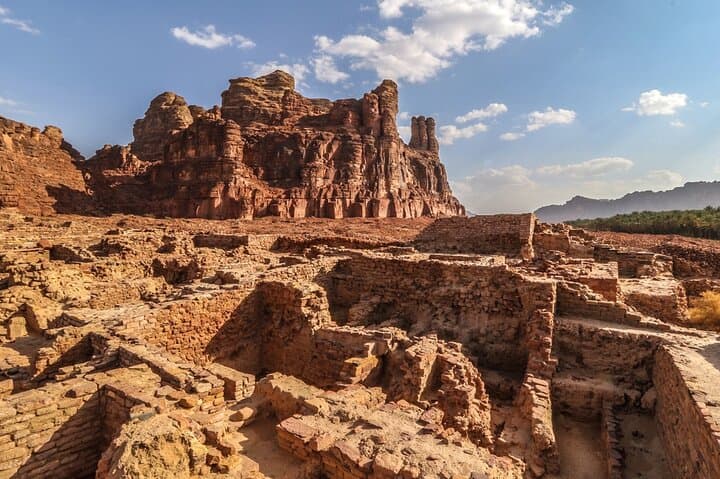


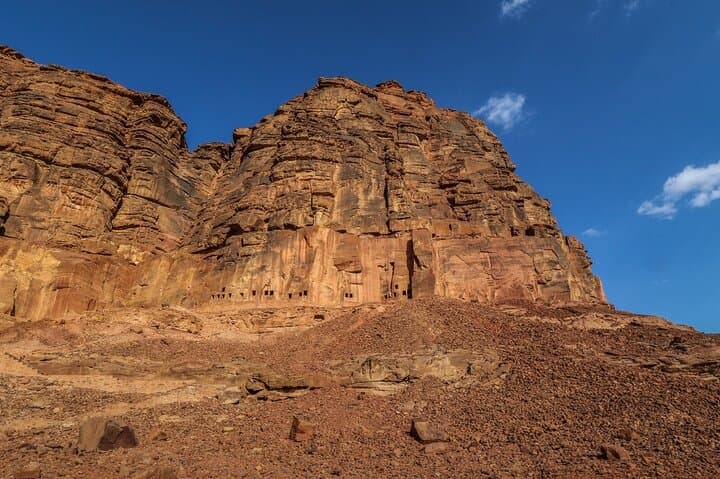
Sand and stone open like pages when the minibus pulls into the valley outside AlUla. The guide points out scarred red cliffs and burial façades as desert wind tugs at your jacket, carrying a faint trace of ancient trade routes. Here, ruins rise from the sand—not as monuments frozen in time but as records of people who lived, prayed and traded across the Arabian peninsula.
Sand and stone open like pages when the minibus pulls into the valley outside AlUla. The guide points out scarred red cliffs and burial façades as desert wind tugs at your jacket, carrying a faint trace of ancient trade routes. Here, ruins rise from the sand—not as monuments frozen in time but as records of people who lived, prayed and traded across the Arabian peninsula.
Dadan was the political heart of the Dadanite and later Lihyanite kingdoms (roughly 9th–6th centuries BCE). Tombs hewn into sandstone cliffs, temple platforms and carved reliefs reflect a society that managed oasis agriculture and long-distance caravan commerce. Geologically, the valley is a collage of sandstone outcrops and weathered canyons; the rocks preserve petroglyphs and inscriptions that survive in the dry climate.
A short ride takes visitors to Jabal Ikmah, an open-air library where hundreds of inscriptions, scripts and pictographs crowd the canyon walls—messages left by travelers, traders and pilgrims over millennia. Reading the canyon is part archaeology, part field journal: names, prayers and symbols layered on older marks.
Practical guidance: expect light walking on uneven ground, shaded only in pockets; comfortable shoes and at least 1–2 liters of water are essential. Tours typically last about two hours including transfers and are suitable for most fitness levels. Respect the inscriptions—do not touch or climb on carvings—and follow your guide’s path to protect fragile surfaces. Morning or late-afternoon visits offer cooler temperatures and better light for photography, when the canyon’s textures and inscriptions come into crisp relief.