THE ADVENTURE COLLECTIVE® · Independent discovery and booking for outdoor travel

Take a compact evening tour that combines a 360-degree view from the Space Needle with a spin on the Great Wheel. This easy-paced 2–3 hour walk blends skyline photography, waterfront atmosphere, and local history — ideal for first-time visitors or night owls.
Take a compact evening tour that combines a 360-degree view from the Space Needle with a spin on the Great Wheel. This easy-paced 2–3 hour walk blends skyline photography, waterfront atmosphere, and local history — ideal for first-time visitors or night owls.
You step out of the elevator and the city opens — a grid of light spilling toward the dark water of Elliott Bay, Mount Rainier a dim silhouette beyond the glow. The Space Needle’s observation deck hums with quiet conversation and camera clicks; at night the city feels like a mechanical constellation and your guide points out neighborhoods, bridges, and the serrated line of the Olympic Mountains. That initial hour sets the tone: precise, elevated, and quietly theatrical.
Verified experiences and guided adventures in the surrounding area.
Operated by See Sight Tours USA · Seattle, Washington
You step out of the elevator and the city opens — a grid of light spilling toward the dark water of Elliott Bay, Mount Rainier a dim silhouette beyond the glow. The Space Needle’s observation deck hums with quiet conversation and camera clicks; at night the city feels like a mechanical constellation and your guide points out neighborhoods, bridges, and the serrated line of the Olympic Mountains. That initial hour sets the tone: precise, elevated, and quietly theatrical.
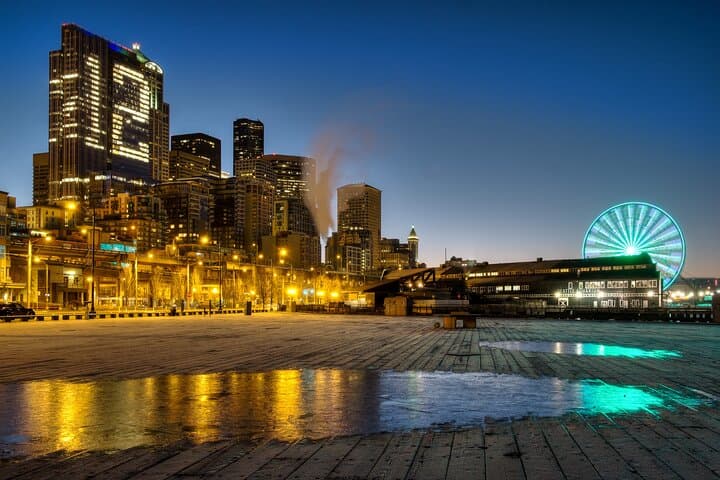
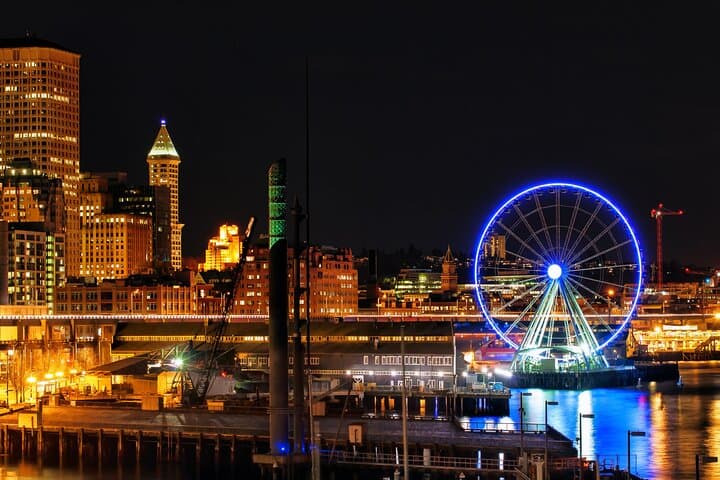
The tour moves down from that perch to the waterfront, where the Great Wheel turns like a slow lighthouse over the pier. The cabins are enclosed, the lights refract off the bay, and the skyline slides past in a loop — downtown towers, the ferry slips, and the pier’s storefronts wink below. Walking between these two anchors traces Seattle’s post-war optimism and maritime roots: the Space Needle rose for the 1962 World’s Fair as a declaration of future-focused design; the waterfront has always been the city’s working edge, shaped by glacial inlets and decades of shipping and trade.
Geology matters here — Puget Sound is a drowned glacial valley, and the city’s hills are the leftover elbows of that ice. Culturally, the route passes through Seattle Center, a civic campus that hosts festivals, music, and museums; the evening lights pick out Chihuly’s glass across the way and the occasional busker on the promenade. Your guide will fold these histories into the walk: how the monorail made quick work of the downtown-to-Needle commute, why the Great Wheel landed at Pier 57, and how the skyline changed after the tech boom.
Practically, expect about 2–3 hours of mostly level walking with brief stair and elevator transitions — Seattle Center to the waterfront is roughly a one-mile stroll (1.6 km) depending on route. The Space Needle and the Great Wheel include admission, and both sites have elevators and enclosed viewing areas, but the tour requires a moderate level of mobility; it’s not suited for those with recent spinal or serious heart issues. Weather can flip from calm to windy on the pier, so layers and a windproof shell are essential.
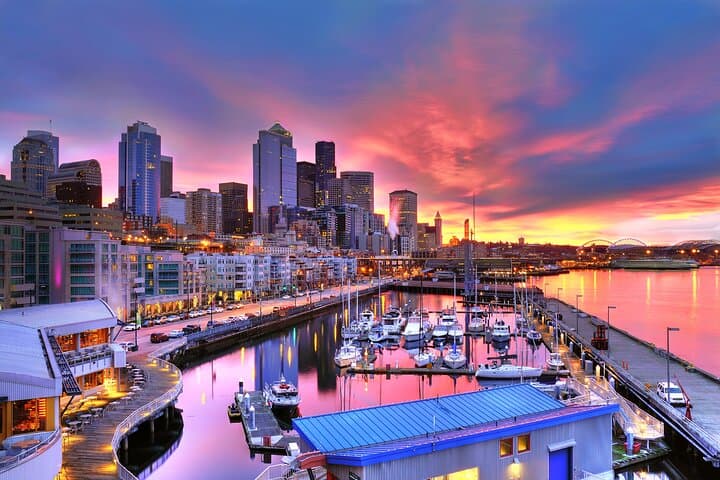
Timing matters. Blue hour (shortly after sunset) turns glass and water molten and makes the best photos; later slots trade sky color for city sparkle. Use public transit — the monorail and buses run close by — and arrive 10–15 minutes early to meet at the Space Needle entrance. Bring a charged phone or camera, a compact flashlight if you like, and comfortable shoes; the night is comfortable for wandering but brisk by the water.
This is a city tour that balances spectacle with context: an architectural high point, a maritime foreground, and just enough local color to leave you wanting more of Seattle after the lights dim.
moderate.
2–3 hours.
Moderate — participants should be comfortable standing and walking up to a mile with short stair and elevator transitions
Meet at the front entrance of the Space Needle; the tour finishes near the waterfront/Pier 57 area by the Great Wheel.
Yes — admission to both the Space Needle observation deck and the Great Wheel are included in the tour price.
The tour notes stroller access and elevators at both attractions; however, some walking routes between sites may include curb cuts and ramps — contact the operator for specific accessibility needs.
Layered clothing with a windproof outer layer and comfortable shoes; evenings on the pier can be cooler and breezier than inland.
Service animals are allowed; pets that are not service animals are generally not permitted on the observation deck or enclosed Great Wheel cabins.
Full refunds are available if you cancel at least 24 hours before the scheduled departure; check your booking confirmation for details.
The Space Needle was built for the 1962 World’s Fair as an emblem of the future; the waterfront grew from a working port shaped by glacially carved Puget Sound.
Night tours should minimize light pollution and noise; use public transit, avoid single-use plastics, and follow posted rules to protect waterfront habitats.
See Sight Tours USA operates guided outdoor trips and adventures with an emphasis on safety, stewardship, and memorable experiences.
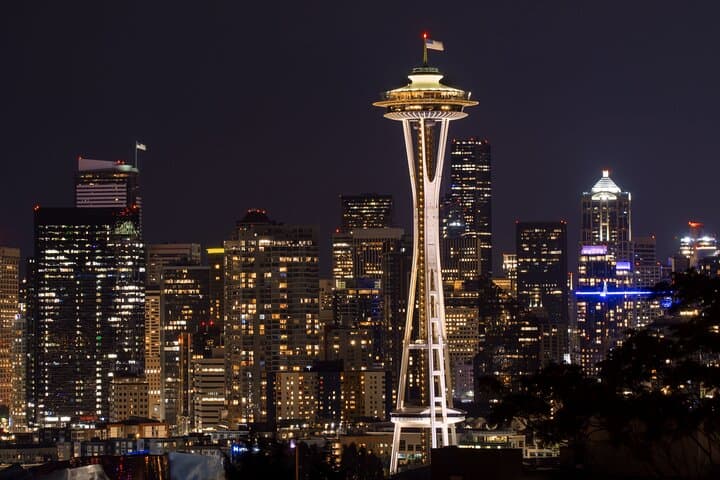
You step out of the elevator and the city opens — a grid of light spilling toward the dark water of Elliott Bay, Mount Rainier a dim silhouette beyond the glow. The Space Needle’s observation deck hums with quiet conversation and camera clicks; at night the city feels like a mechanical constellation and your guide points out neighborhoods, bridges, and the serrated line of the Olympic Mountains. That initial hour sets the tone: precise, elevated, and quietly theatrical.
You step out of the elevator and the city opens — a grid of light spilling toward the dark water of Elliott Bay, Mount Rainier a dim silhouette beyond the glow. The Space Needle’s observation deck hums with quiet conversation and camera clicks; at night the city feels like a mechanical constellation and your guide points out neighborhoods, bridges, and the serrated line of the Olympic Mountains. That initial hour sets the tone: precise, elevated, and quietly theatrical.
The tour moves down from that perch to the waterfront, where the Great Wheel turns like a slow lighthouse over the pier. The cabins are enclosed, the lights refract off the bay, and the skyline slides past in a loop — downtown towers, the ferry slips, and the pier’s storefronts wink below. Walking between these two anchors traces Seattle’s post-war optimism and maritime roots: the Space Needle rose for the 1962 World’s Fair as a declaration of future-focused design; the waterfront has always been the city’s working edge, shaped by glacial inlets and decades of shipping and trade.
Geology matters here — Puget Sound is a drowned glacial valley, and the city’s hills are the leftover elbows of that ice. Culturally, the route passes through Seattle Center, a civic campus that hosts festivals, music, and museums; the evening lights pick out Chihuly’s glass across the way and the occasional busker on the promenade. Your guide will fold these histories into the walk: how the monorail made quick work of the downtown-to-Needle commute, why the Great Wheel landed at Pier 57, and how the skyline changed after the tech boom.
Practically, expect about 2–3 hours of mostly level walking with brief stair and elevator transitions — Seattle Center to the waterfront is roughly a one-mile stroll (1.6 km) depending on route. The Space Needle and the Great Wheel include admission, and both sites have elevators and enclosed viewing areas, but the tour requires a moderate level of mobility; it’s not suited for those with recent spinal or serious heart issues. Weather can flip from calm to windy on the pier, so layers and a windproof shell are essential.
Timing matters. Blue hour (shortly after sunset) turns glass and water molten and makes the best photos; later slots trade sky color for city sparkle. Use public transit — the monorail and buses run close by — and arrive 10–15 minutes early to meet at the Space Needle entrance. Bring a charged phone or camera, a compact flashlight if you like, and comfortable shoes; the night is comfortable for wandering but brisk by the water.
This is a city tour that balances spectacle with context: an architectural high point, a maritime foreground, and just enough local color to leave you wanting more of Seattle after the lights dim.