THE ADVENTURE COLLECTIVE® · Independent discovery and booking for outdoor travel

Float between Lake Union and Puget Sound on this two-hour Argosy cruise that threads Seattle’s industrial shorelines, floating homes, and the century-old Ballard Locks. Expect close-up views of the Space Needle, Fisherman’s Terminal, and working maritime life, with live narration and both indoor and outdoor seating.
Float between Lake Union and Puget Sound on this two-hour Argosy cruise that threads Seattle’s industrial shorelines, floating homes, and the century-old Ballard Locks. Expect close-up views of the Space Needle, Fisherman’s Terminal, and working maritime life, with live narration and both indoor and outdoor seating.
The bow cuts through a cobalt morning and the city unfolds like a film reel: the Space Needle rises to port, a floatplane scribbles across the sky, and Seattle’s skyline sits patient behind a scatter of cranes and houseboats. On an Argosy Seattle Locks Cruise you sit where saltwater meets freshwater and watch the boat become cargo of the century-old Hiram M. Chittenden (Ballard) Locks — the living, hissing “boat elevator” that lowers you roughly 20 feet from Lake Union into Puget Sound.
Verified experiences and guided adventures in the surrounding area.
Operated by Argosy Cruises · Seattle, Washington
The bow cuts through a cobalt morning and the city unfolds like a film reel: the Space Needle rises to port, a floatplane scribbles across the sky, and Seattle’s skyline sits patient behind a scatter of cranes and houseboats. On an Argosy Seattle Locks Cruise you sit where saltwater meets freshwater and watch the boat become cargo of the century-old Hiram M. Chittenden (Ballard) Locks — the living, hissing “boat elevator” that lowers you roughly 20 feet from Lake Union into Puget Sound.
The cruise is equal parts mechanics and urban portrait. A local guide narrates scenes of industry and community: floating-home clusters that once housed artists and mariners; Gas Works Park with its iron ribs and grassy slopes; the Fremont Bridge, painted and theatrical, that yawns open to let the vessel slip beneath.
Geology and logistics are on display, too. Puget Sound is a glacially carved estuary; the locks were built in the early 20th century by the U.S. Army Corps of Engineers to maintain lake levels and open inland waterways for timber and shipping fleets. Pass Fisherman’s Terminal and you feel the city’s working pulse — net menders, trawlers, and the hulking profiles of boats made famous by shows like Deadliest Catch.
The cruise compresses neighborhoods and ecosystems. You skim under bridges, drift past houseboats (including the one with Hollywood credits), and crest into the broad saltwater where the Olympics loom across the channel when visibility allows. Wildlife often punctuates the narration: harbor seals surfacing to check the wake, bald eagles quartering the shorelines, and occasional porpoises playing the bow wave.
Practical notes: the trip is two hours long and offered one-way between AGC Marina on Lake Union and Pier 54 on Elliott Bay — check which direction you booked. Boarding begins about 20 minutes before departure and gates close 5 minutes prior; restrooms and indoor seating are on board, and vessels are wheelchair accessible with advance notice.
For comfort and photography plan in layers — wind and spray can be brisk even on sunny days — and bring binoculars for farshore details. If you want the lock experience in the center, pick a seat on the open deck near midship and be ready for the subtle drop as the lock fills or empties.
This cruise is achievable for nearly everyone: it’s low-effort sightseeing with a clear, immediate reward — a working lock, neighborhood snapshots, and wide marine vistas framed by mountains. It’s a concise way to read Seattle’s maritime history while feeling the tide push you between two worlds.
easy.
2 hours.
Suitable for all fitness levels; minimal walking and low physical exertion required
This is a one-way tour that operates between AGC Marina on Lake Union and Pier 54 on Elliott Bay; your ticket subtitle lists the departure location.
Yes — vessels offer wheelchair access and indoor seating, but you should call in advance for boarding support and crew assistance.
Yes, all boats used for this cruise have restrooms and both interior and exterior seating options.
Snacks and non-alcoholic drinks are allowed; policies on alcohol vary so check with Argosy Cruises before boarding.
Cruises operate in most weather conditions; if the operator cancels you’ll be notified and eligible for a refund under the booking policy if cancelled 24+ hours before departure.
Yes — harbor seals, bald eagles, and occasionally porpoises or porpoise-like activity are commonly spotted during the trip.
The Hiram M. Chittenden Locks opened in 1917 and were built by the U.S. Army Corps of Engineers to control lake levels and support commercial navigation between freshwater Lake Washington and the saltwater Puget Sound.
The locks and surrounding shorelines are managed with an emphasis on water quality and habitat protection; avoid feeding wildlife and dispose of trash in marina receptacles to minimize impacts.
Argosy Cruises operates guided outdoor trips and adventures with an emphasis on safety, stewardship, and memorable experiences.


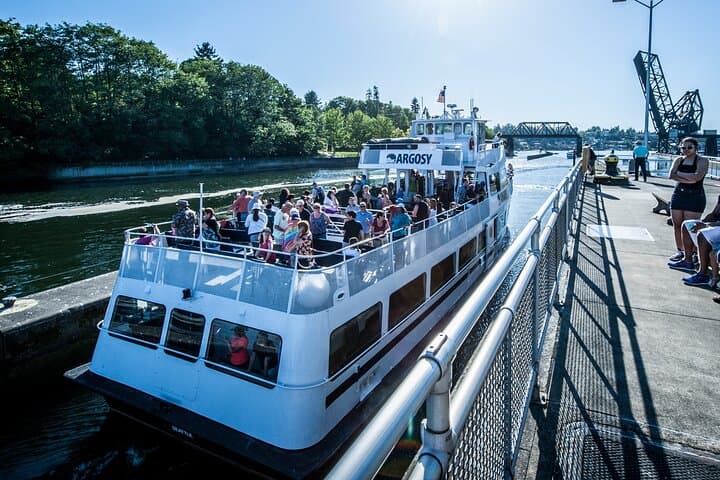
The bow cuts through a cobalt morning and the city unfolds like a film reel: the Space Needle rises to port, a floatplane scribbles across the sky, and Seattle’s skyline sits patient behind a scatter of cranes and houseboats. On an Argosy Seattle Locks Cruise you sit where saltwater meets freshwater and watch the boat become cargo of the century-old Hiram M. Chittenden (Ballard) Locks — the living, hissing “boat elevator” that lowers you roughly 20 feet from Lake Union into Puget Sound.
The bow cuts through a cobalt morning and the city unfolds like a film reel: the Space Needle rises to port, a floatplane scribbles across the sky, and Seattle’s skyline sits patient behind a scatter of cranes and houseboats. On an Argosy Seattle Locks Cruise you sit where saltwater meets freshwater and watch the boat become cargo of the century-old Hiram M. Chittenden (Ballard) Locks — the living, hissing “boat elevator” that lowers you roughly 20 feet from Lake Union into Puget Sound.
The cruise is equal parts mechanics and urban portrait. A local guide narrates scenes of industry and community: floating-home clusters that once housed artists and mariners; Gas Works Park with its iron ribs and grassy slopes; the Fremont Bridge, painted and theatrical, that yawns open to let the vessel slip beneath.
Geology and logistics are on display, too. Puget Sound is a glacially carved estuary; the locks were built in the early 20th century by the U.S. Army Corps of Engineers to maintain lake levels and open inland waterways for timber and shipping fleets. Pass Fisherman’s Terminal and you feel the city’s working pulse — net menders, trawlers, and the hulking profiles of boats made famous by shows like Deadliest Catch.
The cruise compresses neighborhoods and ecosystems. You skim under bridges, drift past houseboats (including the one with Hollywood credits), and crest into the broad saltwater where the Olympics loom across the channel when visibility allows. Wildlife often punctuates the narration: harbor seals surfacing to check the wake, bald eagles quartering the shorelines, and occasional porpoises playing the bow wave.
Practical notes: the trip is two hours long and offered one-way between AGC Marina on Lake Union and Pier 54 on Elliott Bay — check which direction you booked. Boarding begins about 20 minutes before departure and gates close 5 minutes prior; restrooms and indoor seating are on board, and vessels are wheelchair accessible with advance notice.
For comfort and photography plan in layers — wind and spray can be brisk even on sunny days — and bring binoculars for farshore details. If you want the lock experience in the center, pick a seat on the open deck near midship and be ready for the subtle drop as the lock fills or empties.
This cruise is achievable for nearly everyone: it’s low-effort sightseeing with a clear, immediate reward — a working lock, neighborhood snapshots, and wide marine vistas framed by mountains. It’s a concise way to read Seattle’s maritime history while feeling the tide push you between two worlds.