THE ADVENTURE COLLECTIVE® · Independent discovery and booking for outdoor travel

Two days of village trekking and a homestay in Sapa’s Muong Hoa Valley deliver terrace views, local culture, and accessible trails. This short itinerary pairs overnight train travel with guided walks through Ta Van, Lao Chai and Y Linh Ho.
Two days of village trekking and a homestay in Sapa’s Muong Hoa Valley deliver terrace views, local culture, and accessible trails. This short itinerary pairs overnight train travel with guided walks through Ta Van, Lao Chai and Y Linh Ho.
You step off the overnight train into a cool, thin air that carries the smell of wet earth and wood smoke. Rice terraces slope like green steps into a valley where early light teases out the ridgelines; local women in embroidered jackets move through mist as if it bends around them.
Verified experiences and guided adventures in the surrounding area.
Operated by Trekking Like A Boss · Sapa, Lao Cai
You step off the overnight train into a cool, thin air that carries the smell of wet earth and wood smoke. Rice terraces slope like green steps into a valley where early light teases out the ridgelines; local women in embroidered jackets move through mist as if it bends around them.
This short homestay trek centers on the Muong Hoa Valley and nearby villages—Ta Van, Lao Chai, Y Linh Ho and Giang Ta Chai—areas carved by centuries of upland rice agriculture and shaped by recent tectonics that raised Fansipan to the west. Sapa’s history blends French colonial hill-station remnants with the living cultures of Hmong and Red Dao communities; traditional stilt houses and indigo-dyed textiles are as much part of the landscape as the terraces.
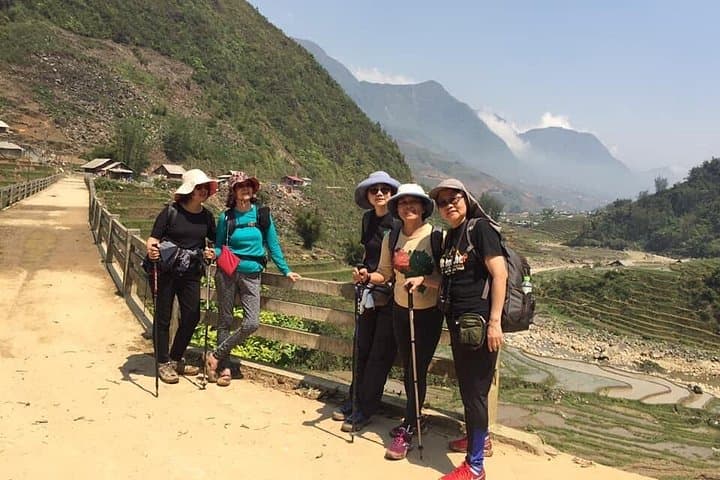
Expect walking on narrow dirt tracks, stepped stone paths and concrete village lanes, with steady climbs and short descents framed by terraces and bamboo copses. Streams will call your attention; small waterfalls punctuate lower slopes. Cultural exchange is central: homestay hosts offer home-cooked meals and an inside view of daily life.
Practical guidance: pack lightweight waterproof layers—the weather flips quickly—and sturdy shoes with grip for muddy sections. Plan for early starts and some 3–6 hour walking days; carry cash for small purchases and tips. Respect private property and ask before photographing people. Trains link Hanoi and Lao Cai overnight; transfers to Sapa are 45–60 minutes by road. With ready footwear and a patient pace, this two-day immersion offers reachable highland scenery, honest village contact and a clear sense of place.
moderate.
2–3 days.
Suitably active travelers who can walk 3–6 hours with some sustained ascents and uneven footing.
Most travelers take an overnight train from Hanoi to Lao Cai, then a 45–60 minute transfer by road to Sapa; this tour arranges those transfers.
You stay in a local homestay or simple hotel in Sapa; expect basic beds, shared facilities in some homes and home-cooked meals included as listed.
Yes—routes are moderate with manageable ascents; you should be able to walk several hours on uneven terrain but no technical skills are required.
Bring Vietnamese dong in small denominations; mobile reception is spotty in valleys so plan accordingly and download maps offline if needed.
The Muong Hoa Valley is shaped by centuries of terraced wet-rice cultivation and the area is home to Hmong and Red Dao ethnic communities with distinct textiles and customs.
Trails are fragile; stick to established paths, avoid litter, and minimize single-use plastics to protect terraces and water sources.
Trekking Like A Boss operates guided outdoor trips and adventures with an emphasis on safety, stewardship, and memorable experiences.

You step off the overnight train into a cool, thin air that carries the smell of wet earth and wood smoke. Rice terraces slope like green steps into a valley where early light teases out the ridgelines; local women in embroidered jackets move through mist as if it bends around them.
You step off the overnight train into a cool, thin air that carries the smell of wet earth and wood smoke. Rice terraces slope like green steps into a valley where early light teases out the ridgelines; local women in embroidered jackets move through mist as if it bends around them.
This short homestay trek centers on the Muong Hoa Valley and nearby villages—Ta Van, Lao Chai, Y Linh Ho and Giang Ta Chai—areas carved by centuries of upland rice agriculture and shaped by recent tectonics that raised Fansipan to the west. Sapa’s history blends French colonial hill-station remnants with the living cultures of Hmong and Red Dao communities; traditional stilt houses and indigo-dyed textiles are as much part of the landscape as the terraces.
Expect walking on narrow dirt tracks, stepped stone paths and concrete village lanes, with steady climbs and short descents framed by terraces and bamboo copses. Streams will call your attention; small waterfalls punctuate lower slopes. Cultural exchange is central: homestay hosts offer home-cooked meals and an inside view of daily life.
Practical guidance: pack lightweight waterproof layers—the weather flips quickly—and sturdy shoes with grip for muddy sections. Plan for early starts and some 3–6 hour walking days; carry cash for small purchases and tips. Respect private property and ask before photographing people. Trains link Hanoi and Lao Cai overnight; transfers to Sapa are 45–60 minutes by road. With ready footwear and a patient pace, this two-day immersion offers reachable highland scenery, honest village contact and a clear sense of place.