THE ADVENTURE COLLECTIVE® · Independent discovery and booking for outdoor travel

A compact private trek from Hanoi that pairs cultural village visits with classic Sapa terrace views. Two days of guided walking—Cat Cat’s waterfalls and a longer Y Linh Ho–Lao Chai–Ta Van route—make for a practical introduction to the Hoang Lien Son highlands.
A compact private trek from Hanoi that pairs cultural village visits with classic Sapa terrace views. Two days of guided walking—Cat Cat’s waterfalls and a longer Y Linh Ho–Lao Chai–Ta Van route—make for a practical introduction to the Hoang Lien Son highlands.
Morning light pins the rice terraces into sharp steps as a luxury limousine eases out of Hanoi toward the Hoang Lien Son range. The road shortens time but not the sense of stepping into a different climate: Sapa sits at roughly 1,600 m, cool and mist-prone, framed by Fansipan—Indochina’s highest peak—rising like a distant, granite-streaked roof.
Verified experiences and guided adventures in the surrounding area.
Operated by Vietnam Blue Tours · Sapa, Lao Cai
Morning light pins the rice terraces into sharp steps as a luxury limousine eases out of Hanoi toward the Hoang Lien Son range. The road shortens time but not the sense of stepping into a different climate: Sapa sits at roughly 1,600 m, cool and mist-prone, framed by Fansipan—Indochina’s highest peak—rising like a distant, granite-streaked roof.
Day one moves quickly into local life with a 3.5 km descent to Cat Cat village. The path threads waterfalls, a French-era hydro station, and homes of the Black H'mong; the guide points out traditional indigo textiles and daily routines as you reverse the climb to town. Geologically, you’re walking the edges of the Hoang Lien massif where steep valleys carve terraces into metamorphic slopes and funnel streams that dare you closer for a photo.
On day two the trek lengthens to roughly 12 km through Y Linh Ho, along Muong Hoa stream, and across expansive rice benches to Lao Chai and Ta Van. Villages of Dzay and other ethnic groups reveal layered agricultural practices and communal irrigation systems that shape the landscape.
Practical note: expect 2–5 hours of walking each day on mixed dirt trails, stone steps and occasional wet sections. The tour includes hotel accommodation, meals, an English-speaking guide and round-trip comfortable bus transport—ideal for travelers who want guided immersion without organizing logistics.
Timing, footwear and a light rain layer will shape your comfort; the route emphasizes cultural encounters and landscape more than technical climbing, making this a solid moderate trekking introduction to northern Vietnam.
moderate.
2 days.
Moderate fitness: able to handle 3–5 hours of walking with some uphill sections and uneven terrain
Day 1 includes a short 3.5 km trek to Cat Cat (about 2 hours). Day 2 covers roughly 12 km between Y Linh Ho, Lao Chai and Ta Van (about 4–5 hours).
A moderate level of fitness is recommended—comfortable walking for several hours on uneven terrain and some elevation changes.
Yes: the tour includes one night in a 3-star Sapa hotel and meals as listed (B/L/D where indicated).
No special permits are required for the Cat Cat or Muong Hoa valley trails; local guide and organized transport are provided by the tour operator.
Sapa transformed from a French hill-station into an ethnic-trade hub; remnants of colonial infrastructure, like the old hydro works at Cat Cat, still mark the valley routes.
Terrace farming practices are centuries-old and resilient, but increasing tourism pressures water resources and waste management—use local guides, avoid single-use plastics and follow leave-no-trace norms.
Vietnam Blue Tours operates guided outdoor trips and adventures with an emphasis on safety, stewardship, and memorable experiences.
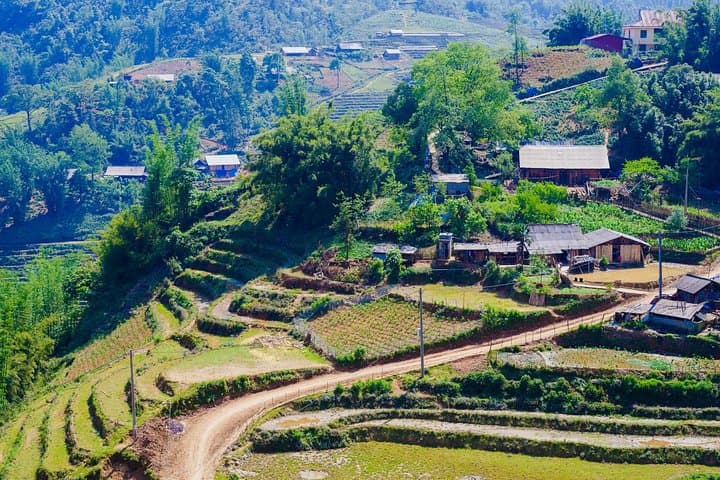

Morning light pins the rice terraces into sharp steps as a luxury limousine eases out of Hanoi toward the Hoang Lien Son range. The road shortens time but not the sense of stepping into a different climate: Sapa sits at roughly 1,600 m, cool and mist-prone, framed by Fansipan—Indochina’s highest peak—rising like a distant, granite-streaked roof.
Morning light pins the rice terraces into sharp steps as a luxury limousine eases out of Hanoi toward the Hoang Lien Son range. The road shortens time but not the sense of stepping into a different climate: Sapa sits at roughly 1,600 m, cool and mist-prone, framed by Fansipan—Indochina’s highest peak—rising like a distant, granite-streaked roof.
Day one moves quickly into local life with a 3.5 km descent to Cat Cat village. The path threads waterfalls, a French-era hydro station, and homes of the Black H'mong; the guide points out traditional indigo textiles and daily routines as you reverse the climb to town. Geologically, you’re walking the edges of the Hoang Lien massif where steep valleys carve terraces into metamorphic slopes and funnel streams that dare you closer for a photo.
On day two the trek lengthens to roughly 12 km through Y Linh Ho, along Muong Hoa stream, and across expansive rice benches to Lao Chai and Ta Van. Villages of Dzay and other ethnic groups reveal layered agricultural practices and communal irrigation systems that shape the landscape.
Practical note: expect 2–5 hours of walking each day on mixed dirt trails, stone steps and occasional wet sections. The tour includes hotel accommodation, meals, an English-speaking guide and round-trip comfortable bus transport—ideal for travelers who want guided immersion without organizing logistics.
Timing, footwear and a light rain layer will shape your comfort; the route emphasizes cultural encounters and landscape more than technical climbing, making this a solid moderate trekking introduction to northern Vietnam.