THE ADVENTURE COLLECTIVE® · Independent discovery and booking for outdoor travel

Explore San Francisco’s Chinatown on a two-hour guided walk through markets, temples, and a fortune cookie factory. Learn neighborhood history, sample traditional foods, and discover hidden architectural details with a local guide.
Explore San Francisco’s Chinatown on a two-hour guided walk through markets, temples, and a fortune cookie factory. Learn neighborhood history, sample traditional foods, and discover hidden architectural details with a local guide.
You step off the sidewalk into a corridor of red lanterns and the muted metallic clatter of market stalls—fog from the bay presses lightly against the rooftops while a breeze dares you to linger. From the meeting point near the Omni at the edge of Union Square, the two-hour route threads through narrow alleys, past painted dragons, and into pockets of life where Cantonese and English share the same sentence.
Verified experiences and guided adventures in the surrounding area.
Operated by Guydeez · San Francisco, California
You step off the sidewalk into a corridor of red lanterns and the muted metallic clatter of market stalls—fog from the bay presses lightly against the rooftops while a breeze dares you to linger. From the meeting point near the Omni at the edge of Union Square, the two-hour route threads through narrow alleys, past painted dragons, and into pockets of life where Cantonese and English share the same sentence.
San Francisco’s Chinatown is the oldest in North America, rebuilt after the 1906 quake and shaped by waves of immigration and exclusionary laws that defined its streets. The neighborhood sits where the city’s original shoreline met filled marshlands; its tight blocks and uphill lanes reflect both urban growth and the city’s layered geology. Culturally, the area blends family-run herbal shops, Buddhist temples on Waverly Place, and lively markets on Stockton Street—places where recipes, remedies, and rituals are passed down in public view.
Expect stops at an herbal pharmacy to learn about traditional remedies, a bustling food market to sample textures and smells, and a fortune cookie factory on Ross Alley to watch machines fold dough into predictions. Guides will point out architectural details, tell stories of community resilience, and explain how modern gentrification is reshaping storefronts.
Practical guidance: wear sturdy walking shoes for uneven curbs, bring cash for small vendors, and plan for crowds—mornings are quieter. The tour is accessible for most fitness levels and offers a compact, sensory introduction to one of San Francisco’s most concentrated cultural zones.
easy.
2 hours.
Light walking ability; suitable for most fitness levels, including seniors and families with strollers.
Yes — the operator indicates the route and meeting point are wheelchair accessible; contact the provider if you need additional accommodations.
Guides typically point out sampling opportunities and may include small tastes at markets or the fortune cookie factory, but personal purchases are usually separate.
The guide meets guests in front of the Omni San Francisco Hotel’s main entrance (look for the white hat) and the tour ends at the same location.
The tour offers guides in English, Spanish, French, and Italian; private or small-group options may allow language customization.
Chinatown grew from mid-19th-century immigration and was largely rebuilt after the 1906 earthquake; its streets reflect both survival and cultural continuity.
Support independent family businesses, avoid single-use plastics at markets, and respect temple spaces and signage to minimize impact.
Guydeez operates guided outdoor trips and adventures with an emphasis on safety, stewardship, and memorable experiences.
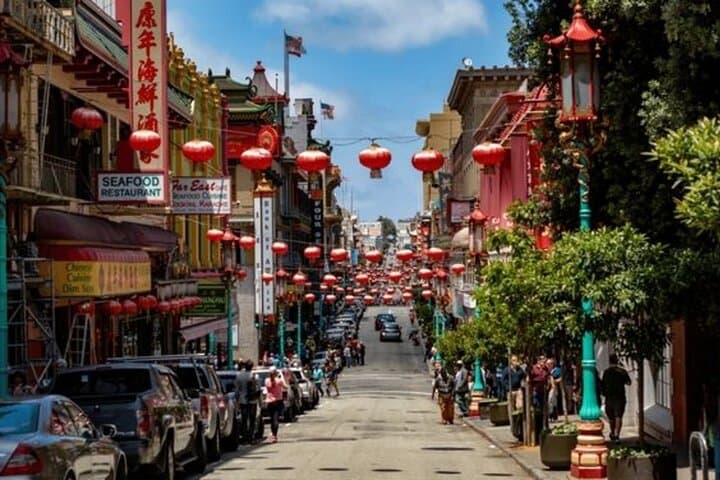
You step off the sidewalk into a corridor of red lanterns and the muted metallic clatter of market stalls—fog from the bay presses lightly against the rooftops while a breeze dares you to linger. From the meeting point near the Omni at the edge of Union Square, the two-hour route threads through narrow alleys, past painted dragons, and into pockets of life where Cantonese and English share the same sentence.
You step off the sidewalk into a corridor of red lanterns and the muted metallic clatter of market stalls—fog from the bay presses lightly against the rooftops while a breeze dares you to linger. From the meeting point near the Omni at the edge of Union Square, the two-hour route threads through narrow alleys, past painted dragons, and into pockets of life where Cantonese and English share the same sentence.
San Francisco’s Chinatown is the oldest in North America, rebuilt after the 1906 quake and shaped by waves of immigration and exclusionary laws that defined its streets. The neighborhood sits where the city’s original shoreline met filled marshlands; its tight blocks and uphill lanes reflect both urban growth and the city’s layered geology. Culturally, the area blends family-run herbal shops, Buddhist temples on Waverly Place, and lively markets on Stockton Street—places where recipes, remedies, and rituals are passed down in public view.
Expect stops at an herbal pharmacy to learn about traditional remedies, a bustling food market to sample textures and smells, and a fortune cookie factory on Ross Alley to watch machines fold dough into predictions. Guides will point out architectural details, tell stories of community resilience, and explain how modern gentrification is reshaping storefronts.
Practical guidance: wear sturdy walking shoes for uneven curbs, bring cash for small vendors, and plan for crowds—mornings are quieter. The tour is accessible for most fitness levels and offers a compact, sensory introduction to one of San Francisco’s most concentrated cultural zones.