THE ADVENTURE COLLECTIVE® · Independent discovery and booking for outdoor travel

Experience Salalah’s coastal charm, frankincense heritage and bustling souks in a focused half-day tour. Visit Al-Baleed Archaeological Park, the Sultan Mosque and local markets with an English-speaking Omani guide.
Experience Salalah’s coastal charm, frankincense heritage and bustling souks in a focused half-day tour. Visit Al-Baleed Archaeological Park, the Sultan Mosque and local markets with an English-speaking Omani guide.
Morning light in Salalah lands on corrugated mosque domes and the slow stretch of the Arabian Sea. A half-day tour threads through the city’s coastal plain: the air carries salt, faint frankincense smoke and the distant cluck of market vendors. Travelers move from the Sultan Qaboos mosque’s white arches to alleyways where frankincense and perfumed oils stall the senses.
Verified experiences and guided adventures in the surrounding area.
Operated by Bin Majid Tourism · Salalah, Dhofar
Morning light in Salalah lands on corrugated mosque domes and the slow stretch of the Arabian Sea. A half-day tour threads through the city’s coastal plain: the air carries salt, faint frankincense smoke and the distant cluck of market vendors. Travelers move from the Sultan Qaboos mosque’s white arches to alleyways where frankincense and perfumed oils stall the senses.
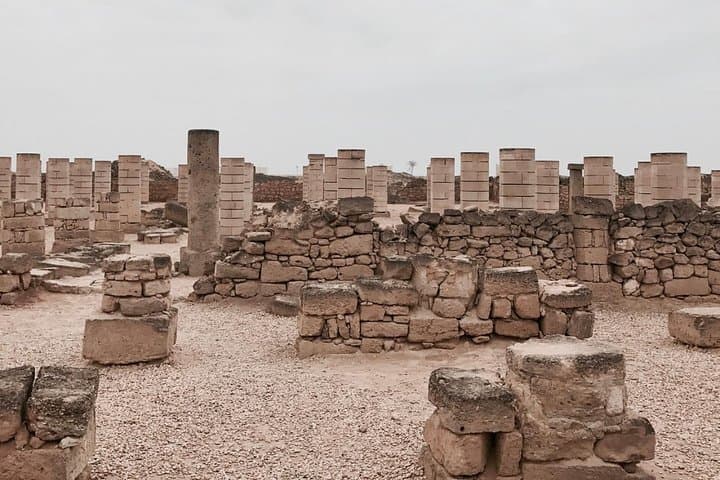
Dhofar’s history is written in resin — frankincense caravans made Salalah part of a maritime trade network that linked Arabia to Rome and India. The Al-Baleed Archaeological Park, a UNESCO site, preserves port ruins and a small lake where migratory birds stop each season. Geologically, Salalah sits on a coastal plain beneath the Dhofar escarpment; in summer the khareef monsoon draws low cloud and converts arid slopes into green folds.
Culturally, the city is pragmatic: markets (souqs) trade dates, myrrh, and carved burners; the Sultan’s palace garden offers a measured civic face. Small coconut farms and fruit stalls provide immediate, edible encounters with local agriculture.
Practical guidance: plan mornings or late afternoons to avoid midday heat outside khareef; modest, breathable clothing is required for religious sites; carry cash for souk purchases and small souvenirs; wear comfortable shoes for short walks on uneven surfaces. Stay hydrated — bottled water is provided on the tour, but bring an extra bottle for the day’s heat. Photography is welcomed at most sites but ask before photographing people and respect restricted areas at the mosque and palace. This half-day loop gives a compact, accessible window into Salalah’s natural rhythms, trade history and daily life.
easy.
5 hours.
Suitable for most travelers; requires short periods of standing and easy walking on uneven surfaces
Yes — the tour notes wheelchair-accessible transportation and sites, though some archaeological paths may be uneven; check specific accessibility needs when booking.
Admission is listed as not applicable; check with the operator for any site fees or museum entries that may require payment on arrival.
Yes — the itinerary includes an experienced Omani guide who can speak English.
Yes — private pick-up and drop-off from Salalah hotels is included in the tour.
Salalah prospered on the frankincense trade; Al-Baleed preserves port ruins that connected the Arabian Peninsula to ancient maritime routes.
Frankincense trees and archaeological sites are protected; visitors should avoid collecting resin or disturbing flora and use local guides to support sustainable tourism.
Bin Majid Tourism operates guided outdoor trips and adventures with an emphasis on safety, stewardship, and memorable experiences.



Morning light in Salalah lands on corrugated mosque domes and the slow stretch of the Arabian Sea. A half-day tour threads through the city’s coastal plain: the air carries salt, faint frankincense smoke and the distant cluck of market vendors. Travelers move from the Sultan Qaboos mosque’s white arches to alleyways where frankincense and perfumed oils stall the senses.
Morning light in Salalah lands on corrugated mosque domes and the slow stretch of the Arabian Sea. A half-day tour threads through the city’s coastal plain: the air carries salt, faint frankincense smoke and the distant cluck of market vendors. Travelers move from the Sultan Qaboos mosque’s white arches to alleyways where frankincense and perfumed oils stall the senses.
Dhofar’s history is written in resin — frankincense caravans made Salalah part of a maritime trade network that linked Arabia to Rome and India. The Al-Baleed Archaeological Park, a UNESCO site, preserves port ruins and a small lake where migratory birds stop each season. Geologically, Salalah sits on a coastal plain beneath the Dhofar escarpment; in summer the khareef monsoon draws low cloud and converts arid slopes into green folds.
Culturally, the city is pragmatic: markets (souqs) trade dates, myrrh, and carved burners; the Sultan’s palace garden offers a measured civic face. Small coconut farms and fruit stalls provide immediate, edible encounters with local agriculture.
Practical guidance: plan mornings or late afternoons to avoid midday heat outside khareef; modest, breathable clothing is required for religious sites; carry cash for souk purchases and small souvenirs; wear comfortable shoes for short walks on uneven surfaces. Stay hydrated — bottled water is provided on the tour, but bring an extra bottle for the day’s heat. Photography is welcomed at most sites but ask before photographing people and respect restricted areas at the mosque and palace. This half-day loop gives a compact, accessible window into Salalah’s natural rhythms, trade history and daily life.