THE ADVENTURE COLLECTIVE® · Independent discovery and booking for outdoor travel

See Riga beyond the cobbles on a guided bike tour that combines Old Town landmarks, Art Nouveau streets, and neighborhood discoveries. This two-hour ride is flat, safe, and led by guides using headsets and reflective vests.
See Riga beyond the cobbles on a guided bike tour that combines Old Town landmarks, Art Nouveau streets, and neighborhood discoveries. This two-hour ride is flat, safe, and led by guides using headsets and reflective vests.
You push off from a city square and the cobbles give way to broad, flat streets; the Daugava river pulls your eye westward, daring you to cross its bridges and see Riga from a different angle. The guide clips a headset to your ear, fits a reflective vest, and the group slips into a steady rhythm — this is city cycling with local context and safety at the fore.
Verified experiences and guided adventures in the surrounding area.
You push off from a city square and the cobbles give way to broad, flat streets; the Daugava river pulls your eye westward, daring you to cross its bridges and see Riga from a different angle. The guide clips a headset to your ear, fits a reflective vest, and the group slips into a steady rhythm — this is city cycling with local context and safety at the fore.
Riga grew around its medieval port and the Old Town still wears Hanseatic brick and narrow alleys, while just beyond you’ll find sweeping Art Nouveau façades from the early 20th century. Geologically the land is low-lying — easy grades and few hills — which is why the city became a cycling-friendly capital. Culture here mixes Baltic, Germanic and Russian layers: you’ll hear stories about trade, Soviet-era rebuilding, and the local markets that pulse on weekends.
Expect short photo stops at landmarks beyond the tight Old Town: quiet wooden quarters, riverside promenades, and neighborhood squares that guidebooks often skip. The tour emphasizes safety — reflective vests and a pro guide system — so commentary is continuous without shouting.
Practical guidance: plan for roughly 8–10 km over two to two-and-a-half hours on mostly paved streets with occasional cobbles; bring a water bottle, closed shoes, and a lightweight rain layer. Aim for morning or late afternoon for cooler air and softer light for photos. Follow the guide’s pace, keep to bike lanes where present, and allow time afterward to explore a café or the Central Market on your own.
easy.
2–2.5 hours.
Suitable for riders with basic cycling fitness; comfortable sitting and pedaling for up to 2–3 hours.
The route is mostly flat and paced for mixed abilities; riders should be comfortable cycling for two hours and able to mount/dismount without assistance.
The operator supplies reflective vests and often helmets, but bringing a personal helmet improves fit and hygiene.
Yes—short stretches and some Old Town approaches have cobbles; the guide advises safe lines and slower speeds there.
Tours commonly proceed in light rain with ponchos or jackets; heavy storms or unsafe conditions may prompt rescheduling or cancellation with notice.
Riga’s Old Town dates to the Hanseatic League; later waves of Art Nouveau construction left one of Europe’s richest collections of early 20th-century façades.
Cycling is a low-impact way to explore Riga; follow local rules, avoid tram tracks, and support small neighborhood businesses rather than single-use plastics.
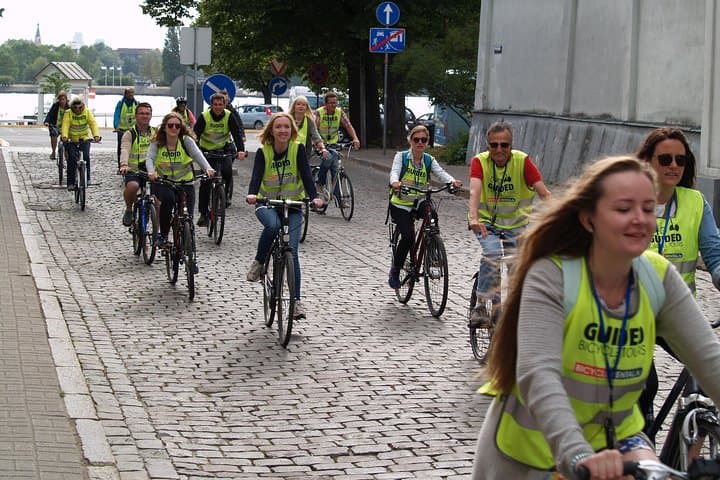
You push off from a city square and the cobbles give way to broad, flat streets; the Daugava river pulls your eye westward, daring you to cross its bridges and see Riga from a different angle. The guide clips a headset to your ear, fits a reflective vest, and the group slips into a steady rhythm — this is city cycling with local context and safety at the fore.
You push off from a city square and the cobbles give way to broad, flat streets; the Daugava river pulls your eye westward, daring you to cross its bridges and see Riga from a different angle. The guide clips a headset to your ear, fits a reflective vest, and the group slips into a steady rhythm — this is city cycling with local context and safety at the fore.
Riga grew around its medieval port and the Old Town still wears Hanseatic brick and narrow alleys, while just beyond you’ll find sweeping Art Nouveau façades from the early 20th century. Geologically the land is low-lying — easy grades and few hills — which is why the city became a cycling-friendly capital. Culture here mixes Baltic, Germanic and Russian layers: you’ll hear stories about trade, Soviet-era rebuilding, and the local markets that pulse on weekends.
Expect short photo stops at landmarks beyond the tight Old Town: quiet wooden quarters, riverside promenades, and neighborhood squares that guidebooks often skip. The tour emphasizes safety — reflective vests and a pro guide system — so commentary is continuous without shouting.
Practical guidance: plan for roughly 8–10 km over two to two-and-a-half hours on mostly paved streets with occasional cobbles; bring a water bottle, closed shoes, and a lightweight rain layer. Aim for morning or late afternoon for cooler air and softer light for photos. Follow the guide’s pace, keep to bike lanes where present, and allow time afterward to explore a café or the Central Market on your own.