THE ADVENTURE COLLECTIVE® · Independent discovery and booking for outdoor travel

Cover Barcelona’s Gaudí highlights in one efficient, scenic day by e-bike. This full-day tour combines guided history, manageable climbs to Park Güell and close-up views of Sagrada Família with practical on-road riding and neighborhood stops.
Cover Barcelona’s Gaudí highlights in one efficient, scenic day by e-bike. This full-day tour combines guided history, manageable climbs to Park Güell and close-up views of Sagrada Família with practical on-road riding and neighborhood stops.
You kick off in a sun-warmed square, motor hum of e-bike beneath you, and Barcelona unfurls—sea-bright avenues below the hills, modernist façades rising like carved stone. The route threads through El Born’s narrow lanes, climbs the tree-lined ramps to Park Güell and stops beneath the soaring, crane-crowned spires of Sagrada Família. The city feels kinetic: traffic parts politely, tramlines glint, and the hill itself dares you uphill, relieved by the e-bike’s push.
Verified experiences and guided adventures in the surrounding area.
You kick off in a sun-warmed square, motor hum of e-bike beneath you, and Barcelona unfurls—sea-bright avenues below the hills, modernist façades rising like carved stone. The route threads through El Born’s narrow lanes, climbs the tree-lined ramps to Park Güell and stops beneath the soaring, crane-crowned spires of Sagrada Família. The city feels kinetic: traffic parts politely, tramlines glint, and the hill itself dares you uphill, relieved by the e-bike’s push.
This ride is as much a history lesson as a loop through neighborhoods. Antoni Gaudí’s modernisme reshaped late-19th-century Barcelona, fusing Catalan craft with organic forms inspired by Mediterranean geology and the nearby Collserola ridge. Park Güell sits on Carmel Hill—formerly estate terraces—now a mosaic of viewpoints and ceramic benches. Paseo de Gràcia showcases bourgeois Barcelona’s turn-of-century wealth in Casa Milà and Casa Batlló’s undulating stone.
Practically, expect a 5–6 hour outing covering roughly 20–25 km with 150–250 m of climbing; the e-bike softens the climbs but you’ll be on mixed pavement, cobbles and short steeper ramps. Guides pause for photos, ticketed entries (Park Güell included) and short walks to viewpoints. Bring a charged phone, closed-toe shoes, sunscreen and a small daypack; hydrate between stops—Barcelona’s Mediterranean sun can be deceptive.
Ride defensively through traffic, follow local helmet rules, and leave time at the end for a relaxed stroll along Passeig de Gràcia. The day balances architecture, neighborhood texture and skyline moments—an efficient, sensory way to meet Gaudí and the city’s layered history.
moderate.
5–6 hours.
Comfortable on a bike for several hours with occasional uphill effort; e-bike assistance reduces strain but basic stamina is needed.
Yes—this tour includes the timed ticket for the monumental area of Park Güell as part of the full-day itinerary.
E-bikes provide electric assistance to reduce effort on climbs; riders still pedal but assistance makes steep sections manageable for most fitness levels.
Most operators supply helmets and require them for safety; check with the tour provider about sizing and fit before departure.
Policies vary—many providers allow older children who can confidently ride a bike; confirm age limits and child seat or e-bike options when booking.
Barcelona’s modernisme movement, led by Gaudí, transformed late-19th and early-20th century urban design, blending craftsmanship with local materials and nature-inspired forms.
Park Güell and central monuments limit visitor access with timed tickets to reduce wear; using e-bikes is a lower-emission way to see the city compared with motorized tours.
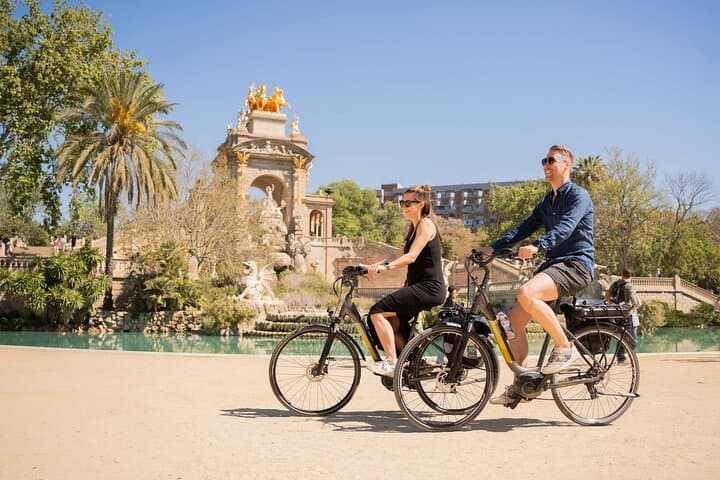
You kick off in a sun-warmed square, motor hum of e-bike beneath you, and Barcelona unfurls—sea-bright avenues below the hills, modernist façades rising like carved stone. The route threads through El Born’s narrow lanes, climbs the tree-lined ramps to Park Güell and stops beneath the soaring, crane-crowned spires of Sagrada Família. The city feels kinetic: traffic parts politely, tramlines glint, and the hill itself dares you uphill, relieved by the e-bike’s push.
You kick off in a sun-warmed square, motor hum of e-bike beneath you, and Barcelona unfurls—sea-bright avenues below the hills, modernist façades rising like carved stone. The route threads through El Born’s narrow lanes, climbs the tree-lined ramps to Park Güell and stops beneath the soaring, crane-crowned spires of Sagrada Família. The city feels kinetic: traffic parts politely, tramlines glint, and the hill itself dares you uphill, relieved by the e-bike’s push.
This ride is as much a history lesson as a loop through neighborhoods. Antoni Gaudí’s modernisme reshaped late-19th-century Barcelona, fusing Catalan craft with organic forms inspired by Mediterranean geology and the nearby Collserola ridge. Park Güell sits on Carmel Hill—formerly estate terraces—now a mosaic of viewpoints and ceramic benches. Paseo de Gràcia showcases bourgeois Barcelona’s turn-of-century wealth in Casa Milà and Casa Batlló’s undulating stone.
Practically, expect a 5–6 hour outing covering roughly 20–25 km with 150–250 m of climbing; the e-bike softens the climbs but you’ll be on mixed pavement, cobbles and short steeper ramps. Guides pause for photos, ticketed entries (Park Güell included) and short walks to viewpoints. Bring a charged phone, closed-toe shoes, sunscreen and a small daypack; hydrate between stops—Barcelona’s Mediterranean sun can be deceptive.
Ride defensively through traffic, follow local helmet rules, and leave time at the end for a relaxed stroll along Passeig de Gràcia. The day balances architecture, neighborhood texture and skyline moments—an efficient, sensory way to meet Gaudí and the city’s layered history.