THE ADVENTURE COLLECTIVE® · Independent discovery and booking for outdoor travel

Head into the dark of Iceland’s countryside for a four-hour northern lights hunt from Reykjavik, with blankets, hot chocolate, and traditional treats. Guides read the sky and help with photography while you wait for the aurora to appear.
Head into the dark of Iceland’s countryside for a four-hour northern lights hunt from Reykjavik, with blankets, hot chocolate, and traditional treats. Guides read the sky and help with photography while you wait for the aurora to appear.
On a clear winter night outside Reykjavik, the sky leans close and the aurora dares you to look up. The guide drives away from the city glare to farm roads and black lava fields where stars feel nearer and the northern lights reveal shifting bands of green and violet.
Verified experiences and guided adventures in the surrounding area.
On a clear winter night outside Reykjavik, the sky leans close and the aurora dares you to look up. The guide drives away from the city glare to farm roads and black lava fields where stars feel nearer and the northern lights reveal shifting bands of green and violet.
Iceland’s skies are written by its geology: the island rides the Mid-Atlantic Ridge, a landscape of recent lava flows and glacial valleys that make for broad, dark horizons ideal for aurora viewing. The tour blends modern science with local culture — guides explain solar wind and magnetism alongside tales from Norse settlement days and the comfort of traditional pastries like kleinur.
Practicalities drive the night: this is a four-hour small-group hunt that relies on cloud cover and geomagnetic activity. Guides bring blankets, hot chocolate and camera advice; guests should expect short stops for photos and stretches, not long hikes. Dress in insulated layers, bring a tripod and spare batteries — cold drains camera gear fast.
Timing is everything: prime months are late autumn through early spring when nights are longest, but clear skies are the deciding factor. If a tour is canceled for weather, operators typically offer refunds or rescheduling; unsuccessful nights often allow a free repeat subject to availability.
For travelers, the experience is equal parts astronomy lesson and outdoor night venture: the aurora pulls and pushes across the sky while guides handle logistics, leaving guests to watch, photograph, and savor a warm pastry under Iceland’s stark, honest sky.
easy.
4 hours.
Low fitness required; you should be able to stand outdoors for 20–40 minute photo stops and walk short, uneven sections.
Chances depend on clear skies and geomagnetic activity; operators use forecasts to choose viewing locations but sightings can’t be guaranteed.
Yes — most guides provide tips on camera settings and framing; they may assist with basic setup but don’t replace a dedicated photography workshop.
Commonly you’ll be offered a full refund or a reschedule; some operators allow a free rejoin if a night is unsuccessful, subject to availability.
Generally yes—minimal walking is involved—but participants should be prepared for cold and occasional uneven ground; notify the operator of mobility concerns in advance.
The region’s human story stretches from early Norse settlement to 20th-century fishing communities; folklore often ties aurora sightings to ancient omens and stories.
Local guides practice light-pollution awareness and encourage leaving no trace; pick-up and drop-off tours minimize road impact by using established access points.
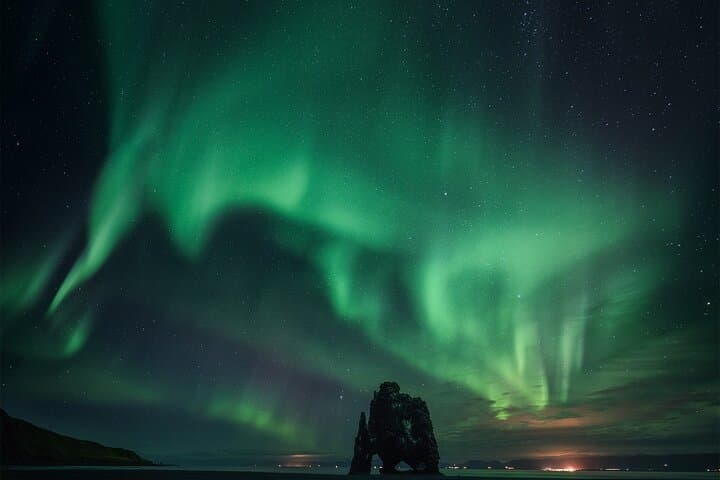
On a clear winter night outside Reykjavik, the sky leans close and the aurora dares you to look up. The guide drives away from the city glare to farm roads and black lava fields where stars feel nearer and the northern lights reveal shifting bands of green and violet.
On a clear winter night outside Reykjavik, the sky leans close and the aurora dares you to look up. The guide drives away from the city glare to farm roads and black lava fields where stars feel nearer and the northern lights reveal shifting bands of green and violet.
Iceland’s skies are written by its geology: the island rides the Mid-Atlantic Ridge, a landscape of recent lava flows and glacial valleys that make for broad, dark horizons ideal for aurora viewing. The tour blends modern science with local culture — guides explain solar wind and magnetism alongside tales from Norse settlement days and the comfort of traditional pastries like kleinur.
Practicalities drive the night: this is a four-hour small-group hunt that relies on cloud cover and geomagnetic activity. Guides bring blankets, hot chocolate and camera advice; guests should expect short stops for photos and stretches, not long hikes. Dress in insulated layers, bring a tripod and spare batteries — cold drains camera gear fast.
Timing is everything: prime months are late autumn through early spring when nights are longest, but clear skies are the deciding factor. If a tour is canceled for weather, operators typically offer refunds or rescheduling; unsuccessful nights often allow a free repeat subject to availability.
For travelers, the experience is equal parts astronomy lesson and outdoor night venture: the aurora pulls and pushes across the sky while guides handle logistics, leaving guests to watch, photograph, and savor a warm pastry under Iceland’s stark, honest sky.