THE ADVENTURE COLLECTIVE® · Independent discovery and booking for outdoor travel

Spend a day diving with a marine biologist off Plakias, Crete—two guided citizen-science dives, hands-on data collection and a field-lab debrief. This small-group program suits certified divers who want to learn and contribute to Mediterranean marine research.
Spend a day diving with a marine biologist off Plakias, Crete—two guided citizen-science dives, hands-on data collection and a field-lab debrief. This small-group program suits certified divers who want to learn and contribute to Mediterranean marine research.
Salt and limestone light spill over the south coast of Crete as the group gathers on a quiet beach near Plakias. The sea here moves with purpose: currents sweep along rocky reefs, nudging sand into gullies where life hides. Under a marine biologist’s briefing you learn to read this language—where to hover, what to photograph, and how to collect simple data without disturbing the reef.
Verified experiences and guided adventures in the surrounding area.
Operated by Dive2gether Crete · Plakias, Crete
Salt and limestone light spill over the south coast of Crete as the group gathers on a quiet beach near Plakias. The sea here moves with purpose: currents sweep along rocky reefs, nudging sand into gullies where life hides. Under a marine biologist’s briefing you learn to read this language—where to hover, what to photograph, and how to collect simple data without disturbing the reef.
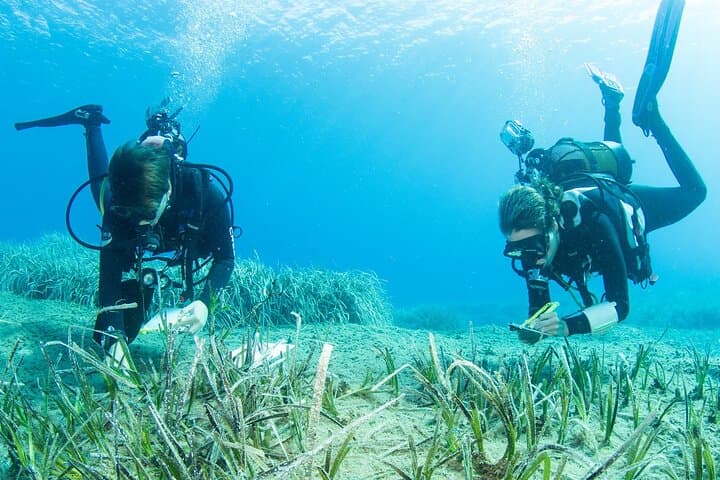
Crete’s shores carry millennia of maritime history, from Minoan sailors to small fishing communities that shaped local coastal knowledge. Geologically, the south coast is carved limestone with offshore rocky outcrops and seagrass meadows that host sponge beds, octopus dens and the occasional loggerhead turtle. The program pairs two supervised dives with shore logistics and an open-air field lab where microscopes and specialised equipment reveal plankton and tiny reef organisms.
Practical guidance is direct: this is for certified divers with moderate fitness and good buoyancy control. Expect two daylight dives tailored to experience level, surface intervals back at the 5-star PADI center, and a debrief at microscopes to analyze samples. Groups are kept small—max four divers—so you’ll get hands-on time with data collection and species ID.
Plan for sunscreen and a wetsuit suited to season (surface temps vary), bring your certification card and a dive computer if you have one, and be prepared to log both observations and photos. Above all, follow the biologist’s instructions: your role is to observe and record, not to touch. The day is equal parts exploration and conservation—sea life does the inviting; you do the careful listening and recording.
moderate.
6–8 hours.
Moderate fitness; comfortable with repeated dives, carrying gear and moving on uneven beach entries.
Yes. This program is strictly for certified divers; the team will ask to see your certification and logbook prior to diving.
Yes. Use of scuba equipment is included, though bringing your own mask and computer is recommended for comfort and accuracy.
Dives are tailored to the group but commonly range 10–30 meters; conditions on the south coast are generally calm in summer but can be changeable—your biologist will brief accordingly.
After dives you'll debrief, examine collected samples under microscopes, record observations and learn species identification techniques used in local research projects.
Plakias developed as a small fishing community on Crete’s historically maritime south coast; the island’s human history stretches back to Minoan seafaring that depended on coastal resources.
The program contributes to citizen-science projects monitoring species and habitats; visitors are encouraged to follow low-impact dive practices and avoid touching or removing samples except under guidance.
Dive2gether Crete operates guided outdoor trips and adventures with an emphasis on safety, stewardship, and memorable experiences.
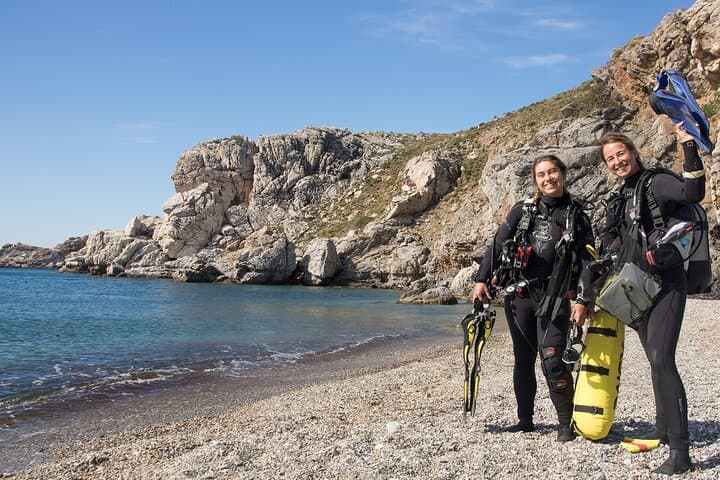
Salt and limestone light spill over the south coast of Crete as the group gathers on a quiet beach near Plakias. The sea here moves with purpose: currents sweep along rocky reefs, nudging sand into gullies where life hides. Under a marine biologist’s briefing you learn to read this language—where to hover, what to photograph, and how to collect simple data without disturbing the reef.
Salt and limestone light spill over the south coast of Crete as the group gathers on a quiet beach near Plakias. The sea here moves with purpose: currents sweep along rocky reefs, nudging sand into gullies where life hides. Under a marine biologist’s briefing you learn to read this language—where to hover, what to photograph, and how to collect simple data without disturbing the reef.
Crete’s shores carry millennia of maritime history, from Minoan sailors to small fishing communities that shaped local coastal knowledge. Geologically, the south coast is carved limestone with offshore rocky outcrops and seagrass meadows that host sponge beds, octopus dens and the occasional loggerhead turtle. The program pairs two supervised dives with shore logistics and an open-air field lab where microscopes and specialised equipment reveal plankton and tiny reef organisms.
Practical guidance is direct: this is for certified divers with moderate fitness and good buoyancy control. Expect two daylight dives tailored to experience level, surface intervals back at the 5-star PADI center, and a debrief at microscopes to analyze samples. Groups are kept small—max four divers—so you’ll get hands-on time with data collection and species ID.
Plan for sunscreen and a wetsuit suited to season (surface temps vary), bring your certification card and a dive computer if you have one, and be prepared to log both observations and photos. Above all, follow the biologist’s instructions: your role is to observe and record, not to touch. The day is equal parts exploration and conservation—sea life does the inviting; you do the careful listening and recording.