THE ADVENTURE COLLECTIVE® · Independent discovery and booking for outdoor travel

Spend a full day following Provence’s famed purple rows from Gordes to Sault. This guided tour pairs hilltop villages and a working distillery with hands‑on lavender insights and multiple picture stops.
Spend a full day following Provence’s famed purple rows from Gordes to Sault. This guided tour pairs hilltop villages and a working distillery with hands‑on lavender insights and multiple picture stops.
You step out of the minivan and a blue horizon greets you: rows of lavender reach like low ridges toward the distant hilltop village of Sault, their fragrance cutting the dry Provençal air and pulling your pace forward.
Verified experiences and guided adventures in the surrounding area.
Operated by Time 4 Provence.H · Gordes, Provence-Alpes-Côte d'Azur
You step out of the minivan and a blue horizon greets you: rows of lavender reach like low ridges toward the distant hilltop village of Sault, their fragrance cutting the dry Provençal air and pulling your pace forward.
The route threads through hilltop Gordes and the 12th‑century Abbaye de Sénanque—an austere Cistercian silhouette that frames floral fields like an old photograph. Roussillon’s ochre cliffs introduce a sudden colour contrast: iron-rich soils that once fueled local dye works now glow under the sun. Geologically, the Luberon is limestone and ochre, folded into terraces that farmers have ploughed and planted for centuries.
Culturally, lavender belongs to the region’s rural identity; distilleries around Sault have turned essential oil production into a living craft. Expect to learn about steam distillation and medicinal uses of lavandin, and to sample lavender‑infused products at a family run distillery.
Practical guidance: the day is long—roughly 8–9 hours with multiple photo stops—so carry sun protection, a refillable water bottle and comfortable shoes for short walks through fields. Lavender attracts bees; move calmly and avoid brushing blooms. Visits are busiest in July when bloom is peak; mornings offer cooler light and fewer crowds. Wear light layers for breezy hilltops and bring a small backpack for purchases like sachets or local honey.
This tour combines easy walking, cultural context and sensory payoff—ideal for anyone who wants a slow day of landscape, scent and Provençal village atmosphere.
easy.
8–9 hours.
Suitable for most fitness levels; requires short walks on uneven paths and standing during photo stops
Peak bloom is typically mid‑June to late July depending on altitude—Sault is later than lower Luberon fields, so July is usually best.
Yes — the itinerary notes stroller access for short distances, though some fields and viewpoints require brief walks on uneven ground.
The tour includes a stop at a local distillery to learn about production, though tastings or purchases may cost extra.
Approximately 8–9 hours; departure is typically from the town tourist office (Avignon/Gordes pickup times confirmed with the operator).
The Abbaye de Sénanque dates to the 12th century and Cistercian monks helped formalize agricultural terraces; lavender cultivation intensified in the 19th and 20th centuries with distillation technology.
Sustainable farming practices and local cooperative distilleries help preserve soil and water; visitors should stick to paths and avoid trampling plants to reduce tourism impact.
Time 4 Provence.H operates guided outdoor trips and adventures with an emphasis on safety, stewardship, and memorable experiences.
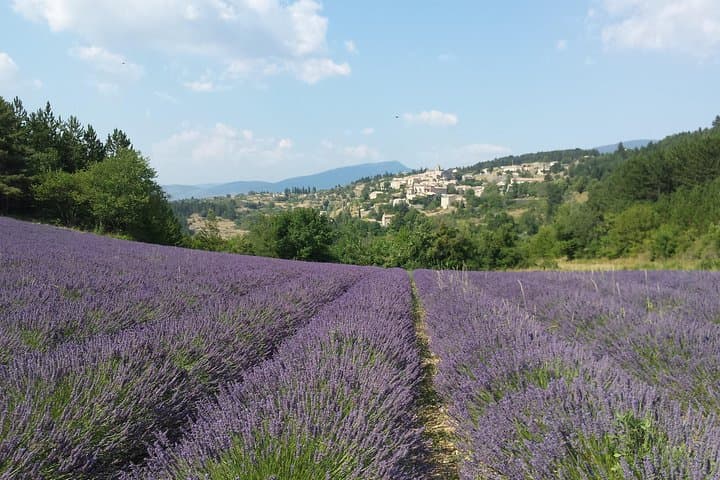
You step out of the minivan and a blue horizon greets you: rows of lavender reach like low ridges toward the distant hilltop village of Sault, their fragrance cutting the dry Provençal air and pulling your pace forward.
You step out of the minivan and a blue horizon greets you: rows of lavender reach like low ridges toward the distant hilltop village of Sault, their fragrance cutting the dry Provençal air and pulling your pace forward.
The route threads through hilltop Gordes and the 12th‑century Abbaye de Sénanque—an austere Cistercian silhouette that frames floral fields like an old photograph. Roussillon’s ochre cliffs introduce a sudden colour contrast: iron-rich soils that once fueled local dye works now glow under the sun. Geologically, the Luberon is limestone and ochre, folded into terraces that farmers have ploughed and planted for centuries.
Culturally, lavender belongs to the region’s rural identity; distilleries around Sault have turned essential oil production into a living craft. Expect to learn about steam distillation and medicinal uses of lavandin, and to sample lavender‑infused products at a family run distillery.
Practical guidance: the day is long—roughly 8–9 hours with multiple photo stops—so carry sun protection, a refillable water bottle and comfortable shoes for short walks through fields. Lavender attracts bees; move calmly and avoid brushing blooms. Visits are busiest in July when bloom is peak; mornings offer cooler light and fewer crowds. Wear light layers for breezy hilltops and bring a small backpack for purchases like sachets or local honey.
This tour combines easy walking, cultural context and sensory payoff—ideal for anyone who wants a slow day of landscape, scent and Provençal village atmosphere.