THE ADVENTURE COLLECTIVE® · Independent discovery and booking for outdoor travel

A full‑day, high‑altitude hike to Vinicunca (Rainbow Mountain) from Cusco that combines geology, Andean culture and panoramic views. Expect a long day, thin air, and bold mineral stripes at roughly 5,000 m.
A full‑day, high‑altitude hike to Vinicunca (Rainbow Mountain) from Cusco that combines geology, Andean culture and panoramic views. Expect a long day, thin air, and bold mineral stripes at roughly 5,000 m.
A thin, cold air cuts like glass as the sun lifts over the high Andes, turning mineral stripes on the slope to color. You arrive before the crowd: a string of walkers and the low calls of herders, then the mountain itself—bands of red, ochre, emerald, and lime—unfurling across a high ridge that seems to have grown its paint from centuries of geology.
Verified experiences and guided adventures in the surrounding area.
Operated by Andina Travel · Cusco, Cusco Region
A thin, cold air cuts like glass as the sun lifts over the high Andes, turning mineral stripes on the slope to color. You arrive before the crowd: a string of walkers and the low calls of herders, then the mountain itself—bands of red, ochre, emerald, and lime—unfurling across a high ridge that seems to have grown its paint from centuries of geology.
The banded ridge is Vinicunca, part of the Ausangate zone shaped by uplift, glacial scraping and iron-and-copper-rich sediments that oxidized into visible stripes. Local Quechua communities have grazed these puna grasslands for generations; Rainbow Mountain only became a global draw in the 2010s, when photographs began circulating online. The terrain is stark and wind-wise: sparse shrubs, pumice-like scree and rumored mineral veins that give the hills their theatrical hues.
Expect a long day: pre-dawn pickup in Cusco, a 3‑hour drive, then a steady 3‑hour ascent to the viewpoint at ~5,000 m (16,400 ft), time to explore and photograph, and a return to Cusco by evening. Altitude dictates the pace—walk slow, hydrate, and let the air decide your speed. Footing alternates between compacted trail and loose volcanic gravel; trekking poles and layered clothing are practical. Guides explain local history, point out herds of llamas and the silhouette of Ausangate, and manage permits and logistics.
For practical planning: acclimatize in Cusco for 48–72 hours if possible, pack sunscreen and insulated layers, and be prepared for rapid weather shifts. The climb rewards persistence with expansive high‑Andean panoramas and a clear, close look at Peru’s living mountain cultures.
moderate.
14–15 hours.
Suitable for travelers with moderate fitness used to sustained uphill walking at high altitude; cardiovascular caution advised.
The main viewpoint sits around 4,900–5,000 meters (about 16,000–16,400 ft), so altitude effects are common.
The walking portion is roughly 6–7 km round trip with about 3 hours uphill and 3 hours down including breaks and time at the viewpoint.
Tours are open to most travelers, but it’s not recommended for pregnant people or those with serious cardiovascular conditions; a moderate fitness level and prior acclimatization are strongly advised.
The mineral bands are real geological features, but colors can be muted by weather, seasonal snow, or recent rain; clear, sunny mornings offer the most vivid views.
Vinicunca sits within traditional Quechua grazing lands; tourism surged in the 2010s after social media exposure, altering local economies and visitor flows.
The puna ecosystem is fragile—stick to trails, pack out waste, and choose operators who support community projects and limit group sizes.
Andina Travel operates guided outdoor trips and adventures with an emphasis on safety, stewardship, and memorable experiences.
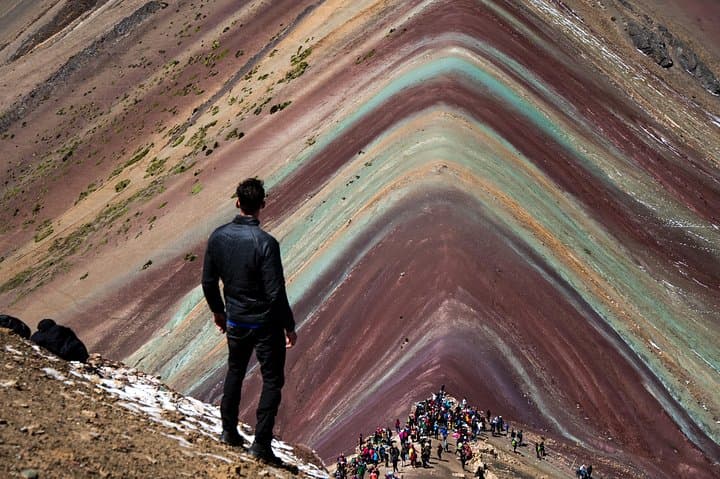


A thin, cold air cuts like glass as the sun lifts over the high Andes, turning mineral stripes on the slope to color. You arrive before the crowd: a string of walkers and the low calls of herders, then the mountain itself—bands of red, ochre, emerald, and lime—unfurling across a high ridge that seems to have grown its paint from centuries of geology.
A thin, cold air cuts like glass as the sun lifts over the high Andes, turning mineral stripes on the slope to color. You arrive before the crowd: a string of walkers and the low calls of herders, then the mountain itself—bands of red, ochre, emerald, and lime—unfurling across a high ridge that seems to have grown its paint from centuries of geology.
The banded ridge is Vinicunca, part of the Ausangate zone shaped by uplift, glacial scraping and iron-and-copper-rich sediments that oxidized into visible stripes. Local Quechua communities have grazed these puna grasslands for generations; Rainbow Mountain only became a global draw in the 2010s, when photographs began circulating online. The terrain is stark and wind-wise: sparse shrubs, pumice-like scree and rumored mineral veins that give the hills their theatrical hues.
Expect a long day: pre-dawn pickup in Cusco, a 3‑hour drive, then a steady 3‑hour ascent to the viewpoint at ~5,000 m (16,400 ft), time to explore and photograph, and a return to Cusco by evening. Altitude dictates the pace—walk slow, hydrate, and let the air decide your speed. Footing alternates between compacted trail and loose volcanic gravel; trekking poles and layered clothing are practical. Guides explain local history, point out herds of llamas and the silhouette of Ausangate, and manage permits and logistics.
For practical planning: acclimatize in Cusco for 48–72 hours if possible, pack sunscreen and insulated layers, and be prepared for rapid weather shifts. The climb rewards persistence with expansive high‑Andean panoramas and a clear, close look at Peru’s living mountain cultures.