THE ADVENTURE COLLECTIVE® · Independent discovery and booking for outdoor travel

Take a private car from Hoi An to My Son Sanctuary for a compact, culturally rich day trip. Explore Champa brick temples in a shallow valley, learn local history, and return via Tra Kieu Church with time to photograph the ruins and landscapes.
Take a private car from Hoi An to My Son Sanctuary for a compact, culturally rich day trip. Explore Champa brick temples in a shallow valley, learn local history, and return via Tra Kieu Church with time to photograph the ruins and landscapes.
The road west from Hoi An narrows as rice paddies give way to low karst ridges and a quiet valley where towers of brick emerge from the trees. Arriving by private car, you step out into a warm, slightly humid air that carries the dusty scent of ancient masonry and tropical vegetation.
Verified experiences and guided adventures in the surrounding area.
Operated by Hoi an local tour · Duy Phu, Quang Nam
The road west from Hoi An narrows as rice paddies give way to low karst ridges and a quiet valley where towers of brick emerge from the trees. Arriving by private car, you step out into a warm, slightly humid air that carries the dusty scent of ancient masonry and tropical vegetation.
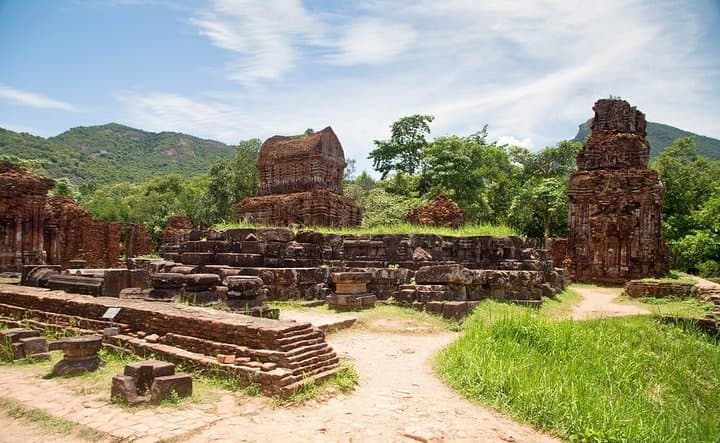
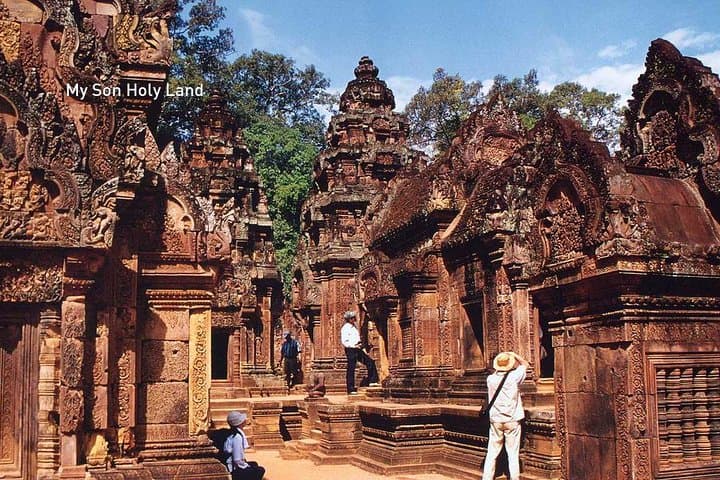
My Son is the ruin-strewn heart of the Champa kingdom, an inland cluster of red-brick Hindu temples built between the 4th and 12th centuries. Geologically the site sits in a two-kilometer valley framed by limestone and volcanic hills; centuries of weathering and wartime damage have left layered walls and freestanding lintels that hint at the original complex. Culturally, the sanctuary was both ritual center and royal necropolis—inscriptions and sculptures reveal a maritime inland kingdom tied to Indian religious forms and Southeast Asian royal cults. On the return, many tours stop at Tra Kieu Church, a later colonial-era landmark that contrasts sharply with the premodern brick architecture at My Son.
Practicalities: the drive from Hoi An is about 45–60 minutes each way (roughly 50 km round trip), and the typical tour lasts about five hours including transfers. Walking around the main ruins involves short, mostly level paths with some uneven stone; wear closed-toe shoes and bring sun protection and water. Respect onsite signage—some structures are off-limits to climbing—and budget time for the visitor center and a short guided talk if available. A private car gives flexibility for timing and photos, making this a straightforward cultural day trip for most travelers.
easy.
4–5 hours.
Suitable for most fitness levels; expect short walks on uneven ground and brief standing periods
The private car takes about 45–60 minutes each way (roughly 25–30 km one way, depending on route and traffic).
Yes—there is a ticket for the My Son Sanctuary site; fees vary for adults and students and are paid at the visitor center.
Climbing on fragile structures is prohibited; casual photography is allowed but commercial shoots may require prior permission.
Basic facilities and small vendors are near the visitor center; consider bringing snacks and water for comfort.
My Son was the religious and political center of the Champa kingdoms from the 4th–12th centuries and served as a royal necropolis and site for state rituals.
Ongoing conservation by Vietnamese authorities and international teams focuses on stabilizing brickwork and managing visitor impact; stick to paths and follow signage to protect fragile ruins.
Hoi an local tour operates guided outdoor trips and adventures with an emphasis on safety, stewardship, and memorable experiences.
The road west from Hoi An narrows as rice paddies give way to low karst ridges and a quiet valley where towers of brick emerge from the trees. Arriving by private car, you step out into a warm, slightly humid air that carries the dusty scent of ancient masonry and tropical vegetation.
The road west from Hoi An narrows as rice paddies give way to low karst ridges and a quiet valley where towers of brick emerge from the trees. Arriving by private car, you step out into a warm, slightly humid air that carries the dusty scent of ancient masonry and tropical vegetation.
My Son is the ruin-strewn heart of the Champa kingdom, an inland cluster of red-brick Hindu temples built between the 4th and 12th centuries. Geologically the site sits in a two-kilometer valley framed by limestone and volcanic hills; centuries of weathering and wartime damage have left layered walls and freestanding lintels that hint at the original complex. Culturally, the sanctuary was both ritual center and royal necropolis—inscriptions and sculptures reveal a maritime inland kingdom tied to Indian religious forms and Southeast Asian royal cults. On the return, many tours stop at Tra Kieu Church, a later colonial-era landmark that contrasts sharply with the premodern brick architecture at My Son.
Practicalities: the drive from Hoi An is about 45–60 minutes each way (roughly 50 km round trip), and the typical tour lasts about five hours including transfers. Walking around the main ruins involves short, mostly level paths with some uneven stone; wear closed-toe shoes and bring sun protection and water. Respect onsite signage—some structures are off-limits to climbing—and budget time for the visitor center and a short guided talk if available. A private car gives flexibility for timing and photos, making this a straightforward cultural day trip for most travelers.