THE ADVENTURE COLLECTIVE® · Independent discovery and booking for outdoor travel

Explore Aswan’s Unfinished Obelisk and the island temple of Philae on a private, customizable half-day tour. Early departures maximize light and minimize crowds for photography and quiet exploration.
Explore Aswan’s Unfinished Obelisk and the island temple of Philae on a private, customizable half-day tour. Early departures maximize light and minimize crowds for photography and quiet exploration.
A morning in Aswan begins with warm air and granite underfoot: stepping out of an air-conditioned vehicle at the quarry feels like crossing from the modern city into a workspace of the pharaohs. The Unfinished Obelisk sits on its bed of bedrock, a hulking, half-cut column that quietly reveals ancient tool marks and a quarrying technique abandoned when a crack appeared in the stone.
Verified experiences and guided adventures in the surrounding area.
Operated by Eyes of Egypt · Aswan, Aswan Governorate
A morning in Aswan begins with warm air and granite underfoot: stepping out of an air-conditioned vehicle at the quarry feels like crossing from the modern city into a workspace of the pharaohs. The Unfinished Obelisk sits on its bed of bedrock, a hulking, half-cut column that quietly reveals ancient tool marks and a quarrying technique abandoned when a crack appeared in the stone.
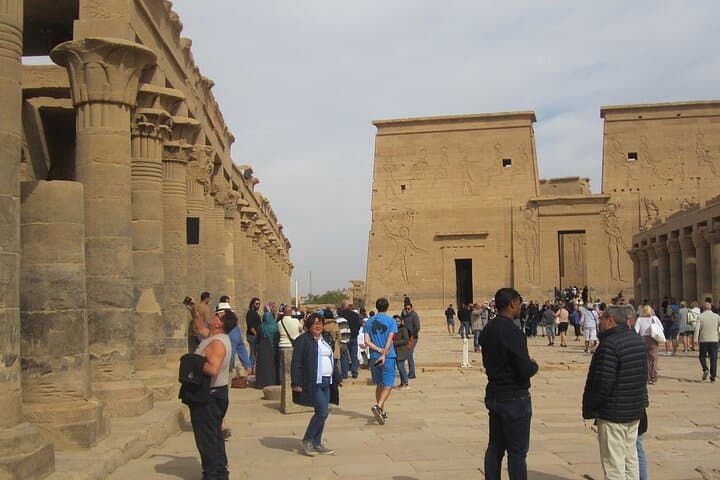
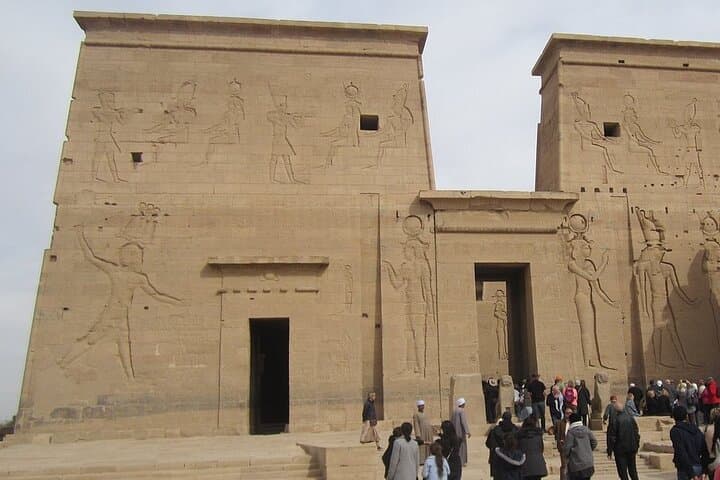
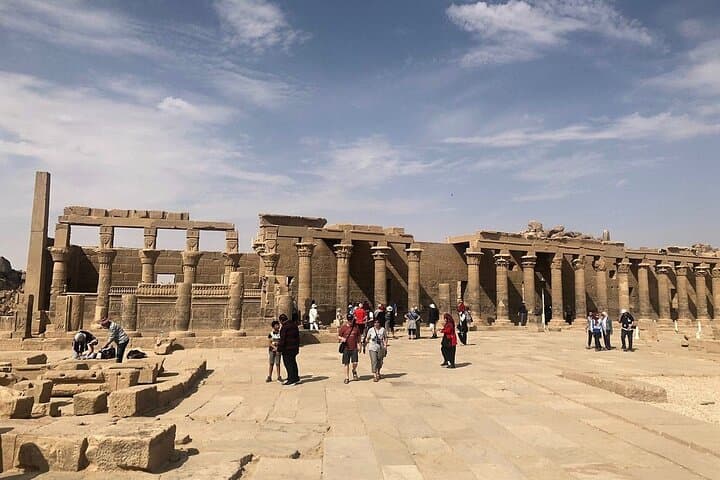
From there the tour slips toward the Nile, a short drive to a marina where a motorboat carries visitors across calm water to Philae’s island complex. The temple’s reliefs and colonnades gleam differently from the water; hieroglyphs, Roman-era additions and later Coptic crosses layer the site’s long life.
Geology and history come together here: Aswan’s red granite provided the raw material for obelisks and temple blocks; Philae itself was dismantled and relocated in the 1960s to Agilkia Island to save it from the High Dam reservoir, a UNESCO-engineered conservation success.
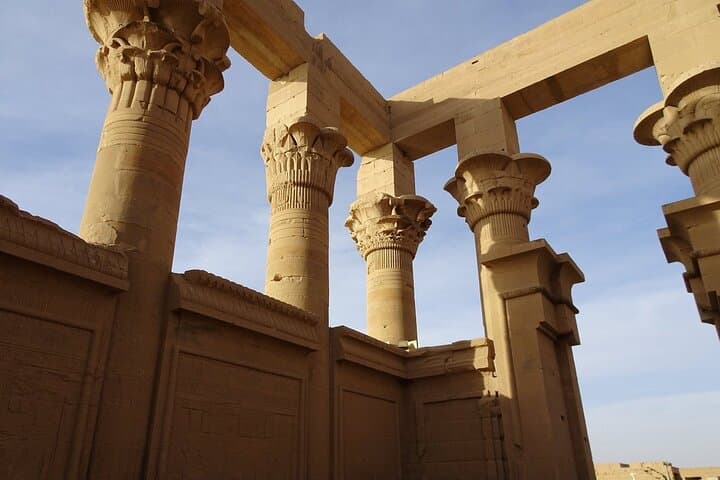
Culturally, the site traces worship of Isis, imperial Roman touches and Egypt’s Coptic era—each era leaving readable stones. Guides typically pause at the Nilometer, the Mammisi and the Kiosk of Trajan to explain ritual and engineering.
Practical guidance: plan for five hours, aim for early departures to avoid heat and tour groups, and expect some stairs and uneven surfaces. Bring sun protection, drinkable water and a camera with wide-angle capability for colonnades seen from the boat. The private format makes it simple to linger over inscriptions or shorten transits—use that flexibility to match pace and photographic light.
easy.
5 hours.
Light walking ability and ability to climb short flights of stairs; suitable for most fitness levels.
Entrance fees are not always included—select an all-inclusive option or confirm with your operator; the private tour can be booked with or without entrance tickets.
Yes—motorboat transfer to Philae Temple is included in the tour options for island access.
Many parts of the tour and transport are wheelchair accessible, but the temple island has uneven surfaces and some steps; check specifics with the operator for tailored assistance.
Yes—this private tour is flexible and can be adjusted to spend more time photographing inscriptions or to shorten transit times.
Philae was dismantled and moved to Agilkia Island in the 1960s under a UNESCO-led project to protect it from the rising waters of the Aswan High Dam; the Unfinished Obelisk reveals quarrying techniques used for Egypt’s largest monoliths.
The relocation of Philae is a landmark conservation effort—visitors should avoid touching reliefs, stay on paths and carry out waste to protect fragile stone and archaeological contexts.
Eyes of Egypt operates guided outdoor trips and adventures with an emphasis on safety, stewardship, and memorable experiences.
A morning in Aswan begins with warm air and granite underfoot: stepping out of an air-conditioned vehicle at the quarry feels like crossing from the modern city into a workspace of the pharaohs. The Unfinished Obelisk sits on its bed of bedrock, a hulking, half-cut column that quietly reveals ancient tool marks and a quarrying technique abandoned when a crack appeared in the stone.
A morning in Aswan begins with warm air and granite underfoot: stepping out of an air-conditioned vehicle at the quarry feels like crossing from the modern city into a workspace of the pharaohs. The Unfinished Obelisk sits on its bed of bedrock, a hulking, half-cut column that quietly reveals ancient tool marks and a quarrying technique abandoned when a crack appeared in the stone.
From there the tour slips toward the Nile, a short drive to a marina where a motorboat carries visitors across calm water to Philae’s island complex. The temple’s reliefs and colonnades gleam differently from the water; hieroglyphs, Roman-era additions and later Coptic crosses layer the site’s long life.
Geology and history come together here: Aswan’s red granite provided the raw material for obelisks and temple blocks; Philae itself was dismantled and relocated in the 1960s to Agilkia Island to save it from the High Dam reservoir, a UNESCO-engineered conservation success.
Culturally, the site traces worship of Isis, imperial Roman touches and Egypt’s Coptic era—each era leaving readable stones. Guides typically pause at the Nilometer, the Mammisi and the Kiosk of Trajan to explain ritual and engineering.
Practical guidance: plan for five hours, aim for early departures to avoid heat and tour groups, and expect some stairs and uneven surfaces. Bring sun protection, drinkable water and a camera with wide-angle capability for colonnades seen from the boat. The private format makes it simple to linger over inscriptions or shorten transits—use that flexibility to match pace and photographic light.