THE ADVENTURE COLLECTIVE® · Independent discovery and booking for outdoor travel

Sail a private catamaran into the shallow lagoons of south‑east Mauritius, anchor off Île aux Aigrettes, and watch the sun drop behind island peaks while learning about local ecology and maritime history.
Sail a private catamaran into the shallow lagoons of south‑east Mauritius, anchor off Île aux Aigrettes, and watch the sun drop behind island peaks while learning about local ecology and maritime history.
The catamaran slips out of the harbor as the afternoon light thins, billowing its sails across a shallow, jade lagoon. On deck the breeze carries the salt-and-spice scent of coastal scrub while the crew plots a slow arc toward Île aux Aigrettes, an exposed coral outcrop that guards a pocket of endemic life. You’ll anchor off a tiny beach and watch the western sky flare red against the island’s low silhouette—mountain ridgelines on the mainland forming a dark, steady backstop.
Verified experiences and guided adventures in the surrounding area.
Operated by Catamaran Cruises Mauritius · Mahebourg, Grand Port
The catamaran slips out of the harbor as the afternoon light thins, billowing its sails across a shallow, jade lagoon. On deck the breeze carries the salt-and-spice scent of coastal scrub while the crew plots a slow arc toward Île aux Aigrettes, an exposed coral outcrop that guards a pocket of endemic life. You’ll anchor off a tiny beach and watch the western sky flare red against the island’s low silhouette—mountain ridgelines on the mainland forming a dark, steady backstop.
This stretch of coast remembers conflict and shipwreck: pass by the shoals near Île de la Passe where the 1810 Battle of Grand Port unfolded, and, on certain tides, see the shallow remains of the Dalbair (1902) marked on local charts. Geologically the area is a fringing reef lagoon carved from ancient volcanic foundations; the water reads clear and shallow until it drops away at the reef edge.
Île aux Aigrettes is now a restoration reserve managed to protect rare birds and reptiles; a guided stop gives a chance to spot endemic species and learn conservation work up close. Culturally, the south-east reflects Mauritian fishing‑village rhythms—soft reggae on the radio, fresh catch at shore markets.
Practical: cruises run about two hours, routes depend on tide and wind, and snorkeling equipment is usually provided. Bring reef-safe sunscreen, a light wind jacket, secure footwear for the shallow beach, and your camera for the low-angle sunset. Book a private cruise to tailor catering or add a guided nature stop; cancelations often depend on weather and sea state.
easy.
2 hours.
Suitable for most fitness levels; requires ability to step on/off a low beach and move around a boat.
Yes—food and drinks are allowed; operators can arrange catering for an extra fee if you prefer not to bring your own.
Snorkelling equipment is typically provided according to the listing; actual snorkel stops depend on tide and wind conditions.
Most south‑east sunset cruises depart near Mahebourg or nearby marinas; your booking confirmation will list the exact meeting point.
Yes—this is a gentle, private cruise suitable for all ages, but mobility limitations should be noted in advance to assist boarding and shore access.
The southeast coast passes key Napoleonic‑era sites like Île de la Passe and the Battle of Grand Port (1810); nearby shoals also hold wreckage like the Dalbair (1902).
Île aux Aigrettes is managed as a restoration reserve protecting endemic flora and fauna—visitors are encouraged to follow strict no‑take and reef‑safe practices.
Catamaran Cruises Mauritius operates guided outdoor trips and adventures with an emphasis on safety, stewardship, and memorable experiences.

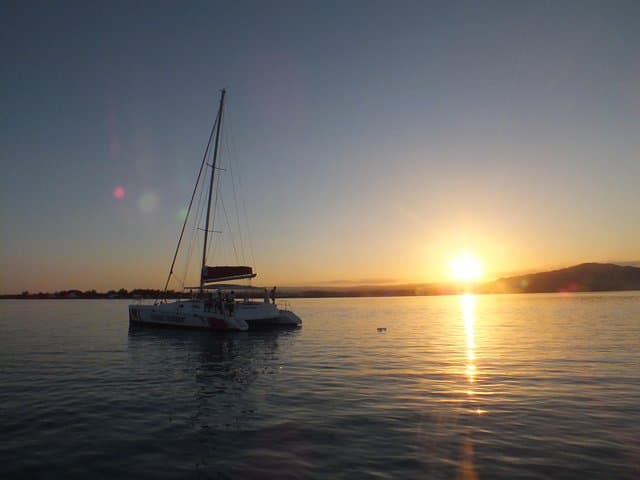


The catamaran slips out of the harbor as the afternoon light thins, billowing its sails across a shallow, jade lagoon. On deck the breeze carries the salt-and-spice scent of coastal scrub while the crew plots a slow arc toward Île aux Aigrettes, an exposed coral outcrop that guards a pocket of endemic life. You’ll anchor off a tiny beach and watch the western sky flare red against the island’s low silhouette—mountain ridgelines on the mainland forming a dark, steady backstop.
The catamaran slips out of the harbor as the afternoon light thins, billowing its sails across a shallow, jade lagoon. On deck the breeze carries the salt-and-spice scent of coastal scrub while the crew plots a slow arc toward Île aux Aigrettes, an exposed coral outcrop that guards a pocket of endemic life. You’ll anchor off a tiny beach and watch the western sky flare red against the island’s low silhouette—mountain ridgelines on the mainland forming a dark, steady backstop.
This stretch of coast remembers conflict and shipwreck: pass by the shoals near Île de la Passe where the 1810 Battle of Grand Port unfolded, and, on certain tides, see the shallow remains of the Dalbair (1902) marked on local charts. Geologically the area is a fringing reef lagoon carved from ancient volcanic foundations; the water reads clear and shallow until it drops away at the reef edge.
Île aux Aigrettes is now a restoration reserve managed to protect rare birds and reptiles; a guided stop gives a chance to spot endemic species and learn conservation work up close. Culturally, the south-east reflects Mauritian fishing‑village rhythms—soft reggae on the radio, fresh catch at shore markets.
Practical: cruises run about two hours, routes depend on tide and wind, and snorkeling equipment is usually provided. Bring reef-safe sunscreen, a light wind jacket, secure footwear for the shallow beach, and your camera for the low-angle sunset. Book a private cruise to tailor catering or add a guided nature stop; cancelations often depend on weather and sea state.