THE ADVENTURE COLLECTIVE® · Independent discovery and booking for outdoor travel

Skip the crowds on a private half-day car transfer from London to Stonehenge. Choose between a self-guided visit with skip‑the‑line entry or a 5‑star private guide to unpack the site’s history and alignments.
Skip the crowds on a private half-day car transfer from London to Stonehenge. Choose between a self-guided visit with skip‑the‑line entry or a 5‑star private guide to unpack the site’s history and alignments.
You pull away from London’s hum and the countryside opens into patchwork fields. The car eases onto lanes framed by hawthorns; the air on the plain carries a cool, elemental hush. Stonehenge appears ahead — hulking silhouettes of sarsens and lintels set against wide sky — an ancient arrangement that seems to hold the wind in place.
Verified experiences and guided adventures in the surrounding area.
Operated by UK Tours & Activites · Amesbury, Wiltshire
You pull away from London’s hum and the countryside opens into patchwork fields. The car eases onto lanes framed by hawthorns; the air on the plain carries a cool, elemental hush. Stonehenge appears ahead — hulking silhouettes of sarsens and lintels set against wide sky — an ancient arrangement that seems to hold the wind in place.
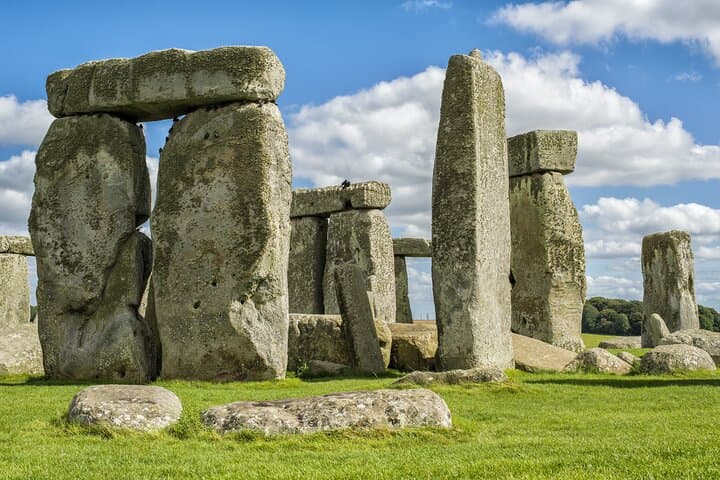
The circle dates back more than 4,500 years, a Neolithic and Bronze Age complex whose builders left few written records. Geologically, the larger sarsen stones are local and the smaller bluestones trace back to Wales, evidence of organized transport and ritual significance. Culturally, the site has served as burial ground, solar marker and magnet for folklore; modern visitors still debate its meaning while feeling the deliberate geometry of its design.
Expect a measured visit: skip-the-line access shortens waiting, and a private guide (if chosen) will thread dates, excavation finds and astronomical alignments into a concise narrative. The terrain around the monument is flat short grass and compacted paths; some mild uphill approaches to viewing points. Weather moves quickly on Salisbury Plain — wind and rain can turn conversation brisk and clothing damp.
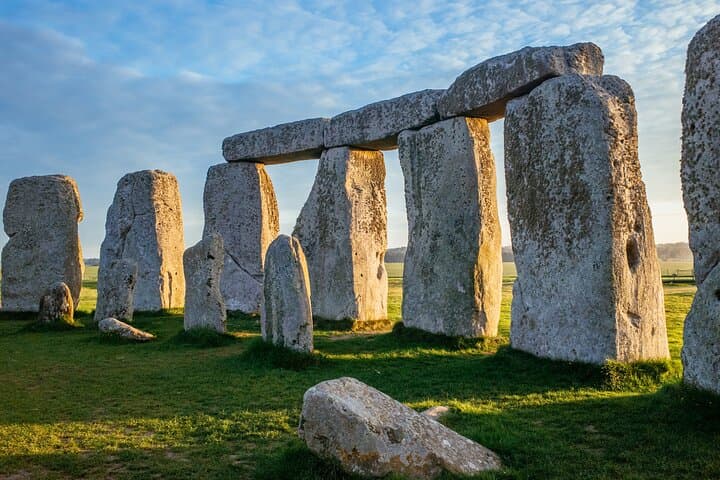
Practical tips: arrive warm, layer for wind, and save your camera for low sun when shadows reveal the stones’ relief. Allow 3–3.5 hours on-site including transfers, and ask your provider about mobility access and timing to avoid peak coach arrivals. Whether you choose self-guided reflection or guided context, the site rewards patience: the stones don’t speak, but the horizon does — and it will push you to ask your own questions.
easy.
6–6.5 hours.
Suitable for most fitness levels; involves short walks on flat, sometimes uneven grass paths and standing during interpretation.
Typical door‑to‑door time is 1.5–2 hours each way depending on traffic; the full tour option runs about 6–6.5 hours including transport and site time.
General admission does not allow touching the main stones to protect the monument; occasional special-access tours occur but are separate and restricted.
Paths around the visitor center and several viewpoints are wheelchair accessible; check with your operator ahead to confirm vehicle and mobility arrangements.
The tour typically runs in most weather; cancellations for full refund apply if you cancel at least 24 hours before departure per policy.
Stonehenge is part of a wider prehistoric landscape of barrows and ceremonial sites dating back to the Neolithic; its construction reflects long‑distance movement of materials and evolving ritual practice.
English Heritage manages visitor impact via designated paths and timed entry; staying on paths and using the visitor center reduces erosion and preserves archaeological deposits.
UK Tours & Activites operates guided outdoor trips and adventures with an emphasis on safety, stewardship, and memorable experiences.
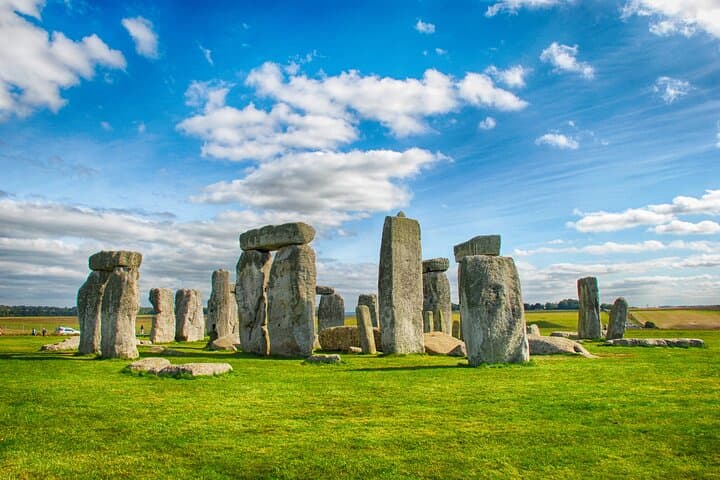

You pull away from London’s hum and the countryside opens into patchwork fields. The car eases onto lanes framed by hawthorns; the air on the plain carries a cool, elemental hush. Stonehenge appears ahead — hulking silhouettes of sarsens and lintels set against wide sky — an ancient arrangement that seems to hold the wind in place.
You pull away from London’s hum and the countryside opens into patchwork fields. The car eases onto lanes framed by hawthorns; the air on the plain carries a cool, elemental hush. Stonehenge appears ahead — hulking silhouettes of sarsens and lintels set against wide sky — an ancient arrangement that seems to hold the wind in place.
The circle dates back more than 4,500 years, a Neolithic and Bronze Age complex whose builders left few written records. Geologically, the larger sarsen stones are local and the smaller bluestones trace back to Wales, evidence of organized transport and ritual significance. Culturally, the site has served as burial ground, solar marker and magnet for folklore; modern visitors still debate its meaning while feeling the deliberate geometry of its design.
Expect a measured visit: skip-the-line access shortens waiting, and a private guide (if chosen) will thread dates, excavation finds and astronomical alignments into a concise narrative. The terrain around the monument is flat short grass and compacted paths; some mild uphill approaches to viewing points. Weather moves quickly on Salisbury Plain — wind and rain can turn conversation brisk and clothing damp.
Practical tips: arrive warm, layer for wind, and save your camera for low sun when shadows reveal the stones’ relief. Allow 3–3.5 hours on-site including transfers, and ask your provider about mobility access and timing to avoid peak coach arrivals. Whether you choose self-guided reflection or guided context, the site rewards patience: the stones don’t speak, but the horizon does — and it will push you to ask your own questions.