THE ADVENTURE COLLECTIVE® · Independent discovery and booking for outdoor travel

A private, guided tour from Bath delivers Stonehenge’s stones, stories, and Salisbury Plain in a single easy half-day. Expect a short walk around the circle, expert interpretation, and air-conditioned transport back to Bath.
A private, guided tour from Bath delivers Stonehenge’s stones, stories, and Salisbury Plain in a single easy half-day. Expect a short walk around the circle, expert interpretation, and air-conditioned transport back to Bath.
The coach leaves Bath behind and the Somerset hills flatten into the broad sweep of Salisbury Plain. A low wind pushes across grassland, and as you step from the vehicle the stone circle rises—weathered and blunt-edged—like a group of old guardians holding court against the sky.
Verified experiences and guided adventures in the surrounding area.
Operated by STONEHENGE AND BEYOND · Amesbury, Wiltshire
The coach leaves Bath behind and the Somerset hills flatten into the broad sweep of Salisbury Plain. A low wind pushes across grassland, and as you step from the vehicle the stone circle rises—weathered and blunt-edged—like a group of old guardians holding court against the sky.
Stonehenge is a late Neolithic to Bronze Age monument (c. 2500 BCE) built from locally quarried sarsen sandstone and the far-travelled bluestones from Pembrokeshire. Archaeology shows repeated construction phases, cremation burials, and alignments with summer solstice sunrise; folklore and Victorian-era antiquarians layered myth onto the stones, making them both scientific site and cultural icon.
The site sits on chalk downland; the visitor center houses finds and reconstructions that explain the engineering behind lintelled stones. Culture here mixes rural Wiltshire life with global pilgrimage—school groups, solstice-watchers and day-trippers converge in shifts.
Practical guidance: the tour runs about 4–5 hours round-trip from Bath with air-conditioned transport and admission included. Expect a mostly flat, accessible path of roughly 1–2 km around the monument; some short grassy slopes and exposed ground are common. Weather can change fast—bring layered outerwear and sun protection. Photography is excellent in low light; access inside the ring is rare and only on special access events, so plan expectations accordingly. Arrive early to avoid mid-day crowds and allow time at the exhibition for context; the guide’s local stories and geology notes make the stones easier to read. This trip is low-impact but historically dense—respect ropes and follow English Heritage guidance to keep the place intact for next visitors.
easy.
4–5 hours.
Suitable for most fitness levels; involves short, mostly flat walks with brief standing periods.
Yes—entrance fees are included in the tour price, covering access to the visitor center and the designated perimeter path.
Standard visits follow a roped path around the circle; close access inside the ring is rare and only available during special English Heritage access events.
The visitor center and much of the site are wheelchair accessible, with level paths to viewing areas; contact the operator ahead for specific assistance or pickup details.
Typical stop time is around 1.5–2 hours, including the visitor center, exhibition, and the walk around the stones.
Stonehenge was built in stages from roughly 3000–1500 BCE and served funerary and ceremonial functions; its stones were transported and precisely arranged in ways that reflect complex prehistoric engineering and social organization.
English Heritage manages visitor impact with roped access and a visitor center to concentrate facilities; stay on paths and follow site rules to protect archaeology and chalk grassland habitat.
STONEHENGE AND BEYOND operates guided outdoor trips and adventures with an emphasis on safety, stewardship, and memorable experiences.


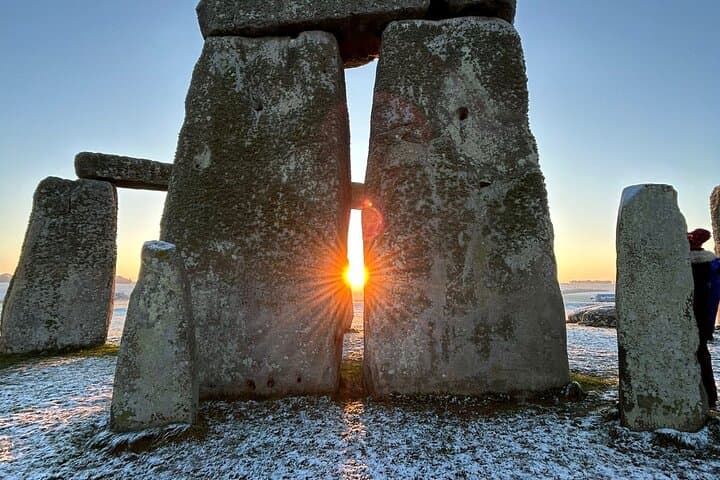
The coach leaves Bath behind and the Somerset hills flatten into the broad sweep of Salisbury Plain. A low wind pushes across grassland, and as you step from the vehicle the stone circle rises—weathered and blunt-edged—like a group of old guardians holding court against the sky.
The coach leaves Bath behind and the Somerset hills flatten into the broad sweep of Salisbury Plain. A low wind pushes across grassland, and as you step from the vehicle the stone circle rises—weathered and blunt-edged—like a group of old guardians holding court against the sky.
Stonehenge is a late Neolithic to Bronze Age monument (c. 2500 BCE) built from locally quarried sarsen sandstone and the far-travelled bluestones from Pembrokeshire. Archaeology shows repeated construction phases, cremation burials, and alignments with summer solstice sunrise; folklore and Victorian-era antiquarians layered myth onto the stones, making them both scientific site and cultural icon.
The site sits on chalk downland; the visitor center houses finds and reconstructions that explain the engineering behind lintelled stones. Culture here mixes rural Wiltshire life with global pilgrimage—school groups, solstice-watchers and day-trippers converge in shifts.
Practical guidance: the tour runs about 4–5 hours round-trip from Bath with air-conditioned transport and admission included. Expect a mostly flat, accessible path of roughly 1–2 km around the monument; some short grassy slopes and exposed ground are common. Weather can change fast—bring layered outerwear and sun protection. Photography is excellent in low light; access inside the ring is rare and only on special access events, so plan expectations accordingly. Arrive early to avoid mid-day crowds and allow time at the exhibition for context; the guide’s local stories and geology notes make the stones easier to read. This trip is low-impact but historically dense—respect ropes and follow English Heritage guidance to keep the place intact for next visitors.