THE ADVENTURE COLLECTIVE® · Independent discovery and booking for outdoor travel

Operate like a covert team across Scottsdale’s streets and parking structures in a four-hour private spy mission. Learn real surveillance and counter-surveillance techniques in a safe, guided urban scenario.
Operate like a covert team across Scottsdale’s streets and parking structures in a four-hour private spy mission. Learn real surveillance and counter-surveillance techniques in a safe, guided urban scenario.
The meeting point is deceptively ordinary: a mall center with a kids' water play area, the hiss of fountains covering whispered briefings. Within an hour that public square dissolves into a working crime-scene classroom—teams split, vehicles roll, and operators teach how to move unseen through parking lots, alleys and the low-slung blocks of Scottsdale. The sun leans in like an evaluator; shadows and reflections become part of the lesson.
Verified experiences and guided adventures in the surrounding area.
The meeting point is deceptively ordinary: a mall center with a kids' water play area, the hiss of fountains covering whispered briefings. Within an hour that public square dissolves into a working crime-scene classroom—teams split, vehicles roll, and operators teach how to move unseen through parking lots, alleys and the low-slung blocks of Scottsdale. The sun leans in like an evaluator; shadows and reflections become part of the lesson.
This program adapts tactical training used by law enforcement and private investigators and repackages it for civilians: observation, counter-surveillance, tradecraft and legal limits. Scottsdale sits on the northern edge of the Phoenix metro, where Sonoran Desert scrub meets urban sprawl; city history runs from cattle ranching to an arts-driven resort economy, which makes for a mix of quiet residential lanes and bustling commercial strips ideal for staged surveillance. Expect urban terrain—pavement, mid-rise parking structures, and occasional desert viewpoints—rather than wilderness travel.
Practical guidance: the private mission runs about four hours and requires at least one vehicle (two preferred) and two smartphones per team. Participants must complete a one-hour online onboarding before the live mission. Organizers supply binoculars, covert cameras, radios and optional night/thermal gear for evening ops. Bring a fully charged phone, water, sun protection and closed-toe shoes; wear low-profile clothing and be ready to move on foot, in and out of vehicles, and sometimes through congested lots.
Safety and legality are emphasized—do not attempt real surveillance outside the guided scenario. Plan for Phoenix heat, traffic, and parking; schedule morning or evening slots in summer to avoid the peak temperature test.
moderate.
4 hours.
Light to moderate mobility required—participants should be able to walk 1–2 miles across urban terrain and get in/out of vehicles repeatedly.
Booking collects age bands; participants are typically adults—confirm with the operator, and note that parental consent or age restrictions may apply.
No—participants complete a mandatory one-hour onboarding and receive instruction from covert ops professionals during the mission.
Yes—missions require vehicle use and organizers recommend two vehicles per team; participants should have valid driver’s licenses and be comfortable driving in city traffic.
The tour does not automatically cancel for typical weather; however, instructors will adjust plans for extreme heat or unsafe conditions—check cancellation policy for refunds.
The program’s techniques are rooted in law-enforcement and private-investigator tradecraft; Scottsdale itself developed from ranching and citrus farming into a modern urban-resort center.
Operate with low impact: avoid disturbing desert patches at staging areas, dispose of trash properly and follow instructors’ guidance to respect private property and community privacy.
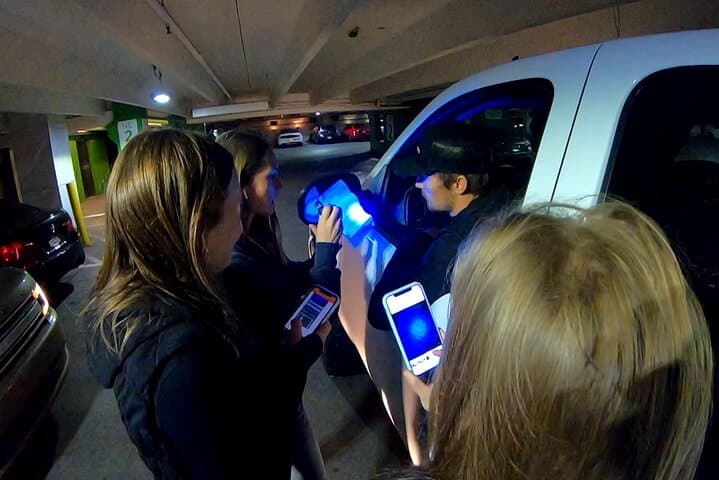
The meeting point is deceptively ordinary: a mall center with a kids' water play area, the hiss of fountains covering whispered briefings. Within an hour that public square dissolves into a working crime-scene classroom—teams split, vehicles roll, and operators teach how to move unseen through parking lots, alleys and the low-slung blocks of Scottsdale. The sun leans in like an evaluator; shadows and reflections become part of the lesson.
The meeting point is deceptively ordinary: a mall center with a kids' water play area, the hiss of fountains covering whispered briefings. Within an hour that public square dissolves into a working crime-scene classroom—teams split, vehicles roll, and operators teach how to move unseen through parking lots, alleys and the low-slung blocks of Scottsdale. The sun leans in like an evaluator; shadows and reflections become part of the lesson.
This program adapts tactical training used by law enforcement and private investigators and repackages it for civilians: observation, counter-surveillance, tradecraft and legal limits. Scottsdale sits on the northern edge of the Phoenix metro, where Sonoran Desert scrub meets urban sprawl; city history runs from cattle ranching to an arts-driven resort economy, which makes for a mix of quiet residential lanes and bustling commercial strips ideal for staged surveillance. Expect urban terrain—pavement, mid-rise parking structures, and occasional desert viewpoints—rather than wilderness travel.
Practical guidance: the private mission runs about four hours and requires at least one vehicle (two preferred) and two smartphones per team. Participants must complete a one-hour online onboarding before the live mission. Organizers supply binoculars, covert cameras, radios and optional night/thermal gear for evening ops. Bring a fully charged phone, water, sun protection and closed-toe shoes; wear low-profile clothing and be ready to move on foot, in and out of vehicles, and sometimes through congested lots.
Safety and legality are emphasized—do not attempt real surveillance outside the guided scenario. Plan for Phoenix heat, traffic, and parking; schedule morning or evening slots in summer to avoid the peak temperature test.