THE ADVENTURE COLLECTIVE® · Independent discovery and booking for outdoor travel

Trace the route of the Mormon pioneers and stand where Brigham Young first declared “This is the place.” This private five‑hour tour blends stops at Emigration Canyon, Temple Square, the State Capitol and historic rail sites with practical tips for timing, photography and accessibility.
Trace the route of the Mormon pioneers and stand where Brigham Young first declared “This is the place.” This private five‑hour tour blends stops at Emigration Canyon, Temple Square, the State Capitol and historic rail sites with practical tips for timing, photography and accessibility.
You step out of an air‑conditioned van onto cool stone beside a low, white fence and the city opens like a map. The Wasatch Range stands like a patient border at the valley’s rim; gulls from the distant Great Salt Lake wheel overhead as if keeping watch. Your guide folds a faded map into their pocket and tells the story that will stitch this five‑hour route together—the descent through Emigration Canyon, the hush around Temple Square, the civic pride that built a capital out of desert.
Verified experiences and guided adventures in the surrounding area.
Operated by Utah Travel Paradise · Salt Lake City, Utah
You step out of an air‑conditioned van onto cool stone beside a low, white fence and the city opens like a map. The Wasatch Range stands like a patient border at the valley’s rim; gulls from the distant Great Salt Lake wheel overhead as if keeping watch. Your guide folds a faded map into their pocket and tells the story that will stitch this five‑hour route together—the descent through Emigration Canyon, the hush around Temple Square, the civic pride that built a capital out of desert.
The tour follows a clear chronology. In July 1847, a handful of Mormon pioneers climbed from the canyon and surveyed a salt‑crusted basin where irrigation and faith would remake the landscape. Geological forces tell a parallel story: the Salt Lake Valley is the remnant of ancient Lake Bonneville, a broad inland sea whose retreat left beaches, terraces, and the salt that gives the area its name. The city’s grid, the neoclassical rise of the Utah State Capitol, and the compact blocks of the Avenues neighborhood are chapters of both civic design and survival in a semi‑arid basin.
Culturally, Salt Lake City is defined by the influence of the Church of Jesus Christ of Latter‑day Saints—Temple Square, the Tabernacle and the Conference Center remain focal points—and by the pragmatic energy of a frontier that became a hub for rail and commerce. The tour pauses for stories: Brigham Young’s declaration—"This is the place"—echoes at the overlook where pioneers first saw the valley. You’ll pass the old Union Pacific depot, a reminder that the transcontinental railroad reshaped Utah’s economy and tourism.
Local insights that don’t always make guidebooks: take five minutes on Ensign Peak for a compact hike with a 250‑foot climb and sweeping valley views; wander Memory Grove Park beside the Capitol for quiet monuments and cottonwood shade. Be mindful of how the climate shaped settlement—water management and irrigation were as crucial as sermons.
Practically: the tour is private and paced for mixed groups—expect about 4–5 hours with a mix of short walks and vehicle time, and plan on 2–3 miles of walking broken into intervals. Wear comfortable walking shoes and layers; Salt Lake’s sun is intense and weather can flip from warm valley heat to cool foothill breezes. Photography is welcomed at most stops, but remember some religious interiors and private residences limit pictures—ask your guide. Hydrate: bottled water is provided, but bring a refillable bottle. If you want fewer crowds, book a morning slot—Temple Square and the Capitol are most peaceful before lunchtime.
This tour is equal parts narrative and orientation: it gives visitors not just landmarks, but the why behind them—the geological arrests, the civic ambition, and the cultural choices that turned a basin of salt and sage into Utah’s capital.
easy.
4–5 hours.
Suitable for most fitness levels; involves several short walks and one brief uphill viewpoint (≈250 ft gain).
The private tour lasts about 4–5 hours and includes 2–3 miles of walking spread across several stops, plus short stair sections at some historic sites.
Yes—private transportation and hotel pickup are included; the operator confirms driver details the evening before your tour.
Photography is allowed in many outdoor areas, but interiors and certain events restrict photos—your guide will advise on site-specific rules.
Yes—this tour is suitable for families and all fitness levels; infant seats are available on request.
The vehicle and most stops are accessible, but some historic buildings have stairs; notify the operator ahead of time about mobility needs.
For a full refund cancel at least 24 hours before the scheduled departure; cancellations within 24 hours are non‑refundable.
Salt Lake City was founded by Mormon pioneers in 1847; Utah became a U.S. state in 1896, with the Capitol symbolizing that transition.
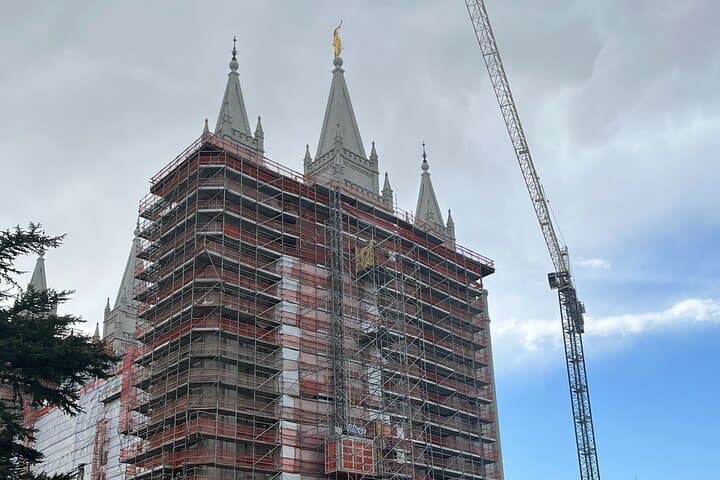
Water scarcity shapes local planning—respect irrigation systems and carry reusable bottles; many historic structures are under preservation efforts, including the Temple reconstruction.
Utah Travel Paradise operates guided outdoor trips and adventures with an emphasis on safety, stewardship, and memorable experiences.
You step out of an air‑conditioned van onto cool stone beside a low, white fence and the city opens like a map. The Wasatch Range stands like a patient border at the valley’s rim; gulls from the distant Great Salt Lake wheel overhead as if keeping watch. Your guide folds a faded map into their pocket and tells the story that will stitch this five‑hour route together—the descent through Emigration Canyon, the hush around Temple Square, the civic pride that built a capital out of desert.
You step out of an air‑conditioned van onto cool stone beside a low, white fence and the city opens like a map. The Wasatch Range stands like a patient border at the valley’s rim; gulls from the distant Great Salt Lake wheel overhead as if keeping watch. Your guide folds a faded map into their pocket and tells the story that will stitch this five‑hour route together—the descent through Emigration Canyon, the hush around Temple Square, the civic pride that built a capital out of desert.
The tour follows a clear chronology. In July 1847, a handful of Mormon pioneers climbed from the canyon and surveyed a salt‑crusted basin where irrigation and faith would remake the landscape. Geological forces tell a parallel story: the Salt Lake Valley is the remnant of ancient Lake Bonneville, a broad inland sea whose retreat left beaches, terraces, and the salt that gives the area its name. The city’s grid, the neoclassical rise of the Utah State Capitol, and the compact blocks of the Avenues neighborhood are chapters of both civic design and survival in a semi‑arid basin.
Culturally, Salt Lake City is defined by the influence of the Church of Jesus Christ of Latter‑day Saints—Temple Square, the Tabernacle and the Conference Center remain focal points—and by the pragmatic energy of a frontier that became a hub for rail and commerce. The tour pauses for stories: Brigham Young’s declaration—"This is the place"—echoes at the overlook where pioneers first saw the valley. You’ll pass the old Union Pacific depot, a reminder that the transcontinental railroad reshaped Utah’s economy and tourism.
Local insights that don’t always make guidebooks: take five minutes on Ensign Peak for a compact hike with a 250‑foot climb and sweeping valley views; wander Memory Grove Park beside the Capitol for quiet monuments and cottonwood shade. Be mindful of how the climate shaped settlement—water management and irrigation were as crucial as sermons.
Practically: the tour is private and paced for mixed groups—expect about 4–5 hours with a mix of short walks and vehicle time, and plan on 2–3 miles of walking broken into intervals. Wear comfortable walking shoes and layers; Salt Lake’s sun is intense and weather can flip from warm valley heat to cool foothill breezes. Photography is welcomed at most stops, but remember some religious interiors and private residences limit pictures—ask your guide. Hydrate: bottled water is provided, but bring a refillable bottle. If you want fewer crowds, book a morning slot—Temple Square and the Capitol are most peaceful before lunchtime.
This tour is equal parts narrative and orientation: it gives visitors not just landmarks, but the why behind them—the geological arrests, the civic ambition, and the cultural choices that turned a basin of salt and sage into Utah’s capital.