THE ADVENTURE COLLECTIVE® · Independent discovery and booking for outdoor travel

Witness artisans hand-paint iconic Delft Blue and explore the only surviving 17th-century Delftware factory on this private transfer from Rotterdam. Expect museum displays, live demonstrations, and a chance to shop authentic, hand-painted pieces.
Witness artisans hand-paint iconic Delft Blue and explore the only surviving 17th-century Delftware factory on this private transfer from Rotterdam. Expect museum displays, live demonstrations, and a chance to shop authentic, hand-painted pieces.
Stepping out of the air-conditioned vehicle, the visitor is met first by a low, blue-sketched horizon of Dutch roofs and the steady presence of a factory chimney—Royal Delft’s workshop quietly asserting itself like an older neighbor in a 21st-century town. Inside the museum and adjoining factory, swirls of cobalt on white porcelain catch the light; artisans at easels move with practiced economy, each brushstroke a conversation with the past.
Verified experiences and guided adventures in the surrounding area.
Operated by TourGuys · Delft, South Holland
Stepping out of the air-conditioned vehicle, the visitor is met first by a low, blue-sketched horizon of Dutch roofs and the steady presence of a factory chimney—Royal Delft’s workshop quietly asserting itself like an older neighbor in a 21st-century town. Inside the museum and adjoining factory, swirls of cobalt on white porcelain catch the light; artisans at easels move with practiced economy, each brushstroke a conversation with the past.
Royal Delft traces a concrete arc through Dutch cultural history. Founded in 1653 amid attempts to imitate Eastern porcelain, the factory outlived dozens of contemporaries and was honored with the “Royal” title in 1919 after a late-19th-century revival led by Joost Thooft. Geologically, Delft’s clay sources and the Netherlands’ riverine silt played into the specific earthenware texture that made Delftware distinct from true porcelain.
The visit balances museum interpretation—historic kilns, company archives—and live craft: painted tiles, tourable production spaces, and a museum shop with limited artist series. Locals prize the place not only for its ceramics but for the way it fixes a colonial-era craft into modern civic life; the canals nearby nudge visitors toward other quiet cultural stops.
Practical guidance: allow 2–3 hours for the round-trip private transfer and museum time, book in advance to secure a demonstration slot, and expect firm, indoor flooring and step-free access for most areas. Photography may be restricted during live demonstrations; check with guides. Wear comfortable shoes for light walking around exhibits and shop browsing.
easy.
2–3 hours.
Suitable for all fitness levels; requires only light walking and standing during demonstrations
The private transfer and museum experience is planned for about 2–3 hours, including demonstrations and time in the museum shop.
Yes—visitor areas and the transfer options are wheelchair accessible; indicate any mobility needs when booking.
Photography policies vary by demonstration; casual photography in galleries is usually allowed but ask staff before photographing live demonstrations.
Admission to Royal Delft is included on this private tour; light refreshments and bottled water are provided during transport.
Founded in 1653, Royal Delft is the last surviving earthenware factory from Delft’s 17th-century potteries; Joost Thooft revived the company’s fortunes in the late 19th century and it received the royal designation in 1919.
The museum emphasizes preservation of traditional techniques and minimizes impact by educating visitors on proper handling and responsible purchasing of authentic pieces.
TourGuys operates guided outdoor trips and adventures with an emphasis on safety, stewardship, and memorable experiences.
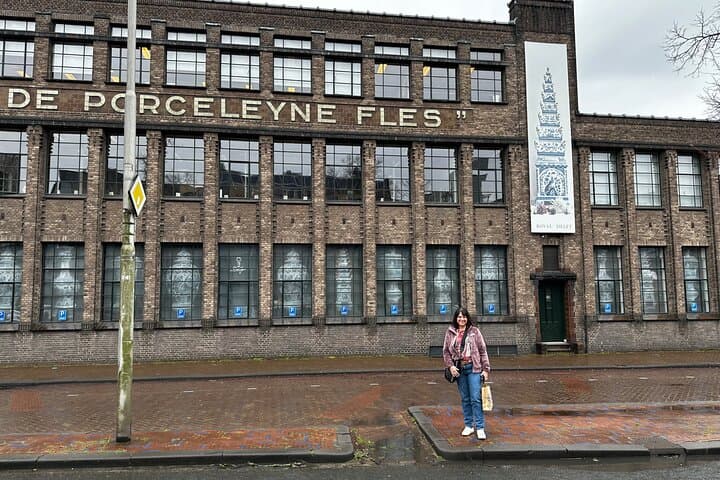

Stepping out of the air-conditioned vehicle, the visitor is met first by a low, blue-sketched horizon of Dutch roofs and the steady presence of a factory chimney—Royal Delft’s workshop quietly asserting itself like an older neighbor in a 21st-century town. Inside the museum and adjoining factory, swirls of cobalt on white porcelain catch the light; artisans at easels move with practiced economy, each brushstroke a conversation with the past.
Stepping out of the air-conditioned vehicle, the visitor is met first by a low, blue-sketched horizon of Dutch roofs and the steady presence of a factory chimney—Royal Delft’s workshop quietly asserting itself like an older neighbor in a 21st-century town. Inside the museum and adjoining factory, swirls of cobalt on white porcelain catch the light; artisans at easels move with practiced economy, each brushstroke a conversation with the past.
Royal Delft traces a concrete arc through Dutch cultural history. Founded in 1653 amid attempts to imitate Eastern porcelain, the factory outlived dozens of contemporaries and was honored with the “Royal” title in 1919 after a late-19th-century revival led by Joost Thooft. Geologically, Delft’s clay sources and the Netherlands’ riverine silt played into the specific earthenware texture that made Delftware distinct from true porcelain.
The visit balances museum interpretation—historic kilns, company archives—and live craft: painted tiles, tourable production spaces, and a museum shop with limited artist series. Locals prize the place not only for its ceramics but for the way it fixes a colonial-era craft into modern civic life; the canals nearby nudge visitors toward other quiet cultural stops.
Practical guidance: allow 2–3 hours for the round-trip private transfer and museum time, book in advance to secure a demonstration slot, and expect firm, indoor flooring and step-free access for most areas. Photography may be restricted during live demonstrations; check with guides. Wear comfortable shoes for light walking around exhibits and shop browsing.