THE ADVENTURE COLLECTIVE® · Independent discovery and booking for outdoor travel

Spend a day tracing the drama of AD 79: walk Pompeii’s broad avenues, enter Herculaneum’s intimate villas, and climb to Vesuvius’s crater rim. This private tour from Naples blends archaeology and geology with door-to-door comfort.
Spend a day tracing the drama of AD 79: walk Pompeii’s broad avenues, enter Herculaneum’s intimate villas, and climb to Vesuvius’s crater rim. This private tour from Naples blends archaeology and geology with door-to-door comfort.
You step out of the air-conditioned car into sunlight that throws hard shadows across stone and ash. The driver slides the door closed and the guide points toward streets where plaster and frescoes still cling to walls—Pompeii’s wide Forum ahead, Herculaneum’s narrow lanes remembered in the curve of a marble threshold, and the cone of Vesuvius, which watches the bay like an old, restless guardian.
Verified experiences and guided adventures in the surrounding area.
Operated by Di Sarno Car Service - Tours & Excursions · Naples, Campania
You step out of the air-conditioned car into sunlight that throws hard shadows across stone and ash. The driver slides the door closed and the guide points toward streets where plaster and frescoes still cling to walls—Pompeii’s wide Forum ahead, Herculaneum’s narrow lanes remembered in the curve of a marble threshold, and the cone of Vesuvius, which watches the bay like an old, restless guardian.
These three sites are chapters of the same story. Pompeii sprawls across a grid of streets and public buildings frozen by the AD 79 eruption; Herculaneum, buried by a faster, hotter pyroclastic surge, preserves wooden beams and household details in startling clarity. Vesuvius itself is a stratovolcano whose layered slopes record repeated eruptions; the short trail to the crater offers panoramic views across the Gulf of Naples and a tactile sense of volcanic geology beneath your boots.
Culture here is as present as ruins—local cafés serve espresso close to centuries-old olive groves, and artisans in nearby towns continue stone and coral work inspired by antiquity.
Practicalities: the full private itinerary runs about 8–9 hours, with 1–2 hours walking in Herculaneum, 2–3 in Pompeii and roughly 1–1.5 km of uphill trail at Vesuvius with ~250–300 m elevation change. Expect uneven terrain, cobbles, and brief steep sections; bring sturdy shoes, sun protection, and 1–2 liters of water. Pickup and drop-off in Naples simplify logistics; admissions are usually paid on-site. Plan for an early start to avoid peak heat and cruise crowds—morning light also makes frescoes and volcanic rock more vivid.
moderate.
8–9 hours.
Moderate fitness; able to walk several kilometers over uneven ground and handle short uphill stretches
Admissions are typically not included in the base tour price; visitors usually pay entry at each site, though private arrangements can sometimes be made—confirm when booking.
The vehicle and parts of the itinerary can accommodate wheelchairs, but ancient sites have uneven surfaces and steps; contact the operator to discuss specific accessibility needs and adjustments.
There are cafes and rest stops near the sites and at the Vesuvius visitor area; bringing snacks is practical since on-site options can be limited during peak times.
The tour operates in most conditions, but severe weather or volcanic-related restrictions may alter access—check with the operator for last-minute changes and refund policies.
Pompeii and Herculaneum were buried during Vesuvius’s eruption in AD 79; the different burial styles—ash fall versus pyroclastic flow—explain why Herculaneum’s organic materials survive in unusual detail.
Archaeological sites are fragile—stay on marked paths, avoid touching frescoes, and support conservation efforts by using official entrances and guides.
Di Sarno Car Service - Tours & Excursions operates guided outdoor trips and adventures with an emphasis on safety, stewardship, and memorable experiences.


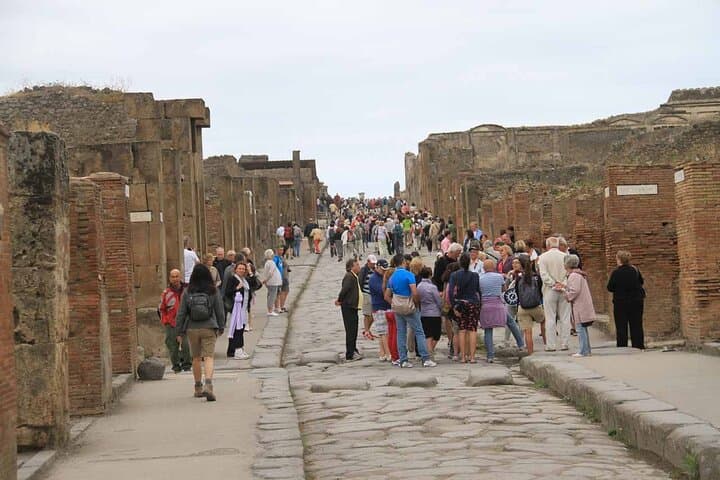
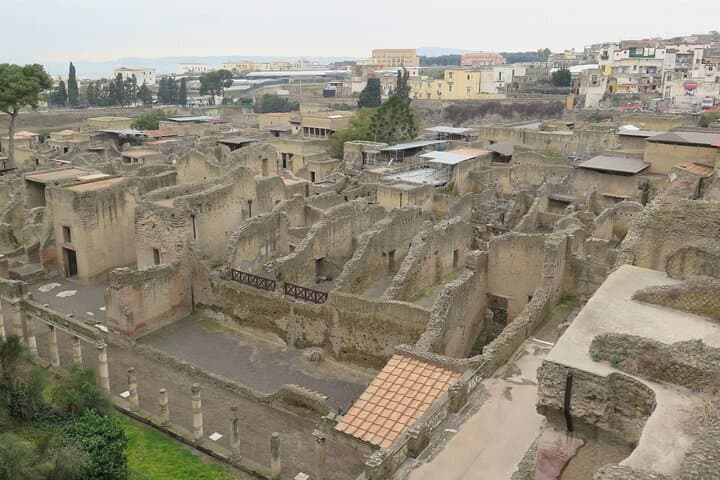
You step out of the air-conditioned car into sunlight that throws hard shadows across stone and ash. The driver slides the door closed and the guide points toward streets where plaster and frescoes still cling to walls—Pompeii’s wide Forum ahead, Herculaneum’s narrow lanes remembered in the curve of a marble threshold, and the cone of Vesuvius, which watches the bay like an old, restless guardian.
You step out of the air-conditioned car into sunlight that throws hard shadows across stone and ash. The driver slides the door closed and the guide points toward streets where plaster and frescoes still cling to walls—Pompeii’s wide Forum ahead, Herculaneum’s narrow lanes remembered in the curve of a marble threshold, and the cone of Vesuvius, which watches the bay like an old, restless guardian.
These three sites are chapters of the same story. Pompeii sprawls across a grid of streets and public buildings frozen by the AD 79 eruption; Herculaneum, buried by a faster, hotter pyroclastic surge, preserves wooden beams and household details in startling clarity. Vesuvius itself is a stratovolcano whose layered slopes record repeated eruptions; the short trail to the crater offers panoramic views across the Gulf of Naples and a tactile sense of volcanic geology beneath your boots.
Culture here is as present as ruins—local cafés serve espresso close to centuries-old olive groves, and artisans in nearby towns continue stone and coral work inspired by antiquity.
Practicalities: the full private itinerary runs about 8–9 hours, with 1–2 hours walking in Herculaneum, 2–3 in Pompeii and roughly 1–1.5 km of uphill trail at Vesuvius with ~250–300 m elevation change. Expect uneven terrain, cobbles, and brief steep sections; bring sturdy shoes, sun protection, and 1–2 liters of water. Pickup and drop-off in Naples simplify logistics; admissions are usually paid on-site. Plan for an early start to avoid peak heat and cruise crowds—morning light also makes frescoes and volcanic rock more vivid.