THE ADVENTURE COLLECTIVE® · Independent discovery and booking for outdoor travel

Launch from Sarangkot and skim thermals over Fewa Lake with sweeping views of the Annapurna range. This private cross-country tandem blends long airtime with pilot-led safety—ideal for travelers who want a dramatic aerial perspective of Pokhara.
Launch from Sarangkot and skim thermals over Fewa Lake with sweeping views of the Annapurna range. This private cross-country tandem blends long airtime with pilot-led safety—ideal for travelers who want a dramatic aerial perspective of Pokhara.
Sunlight cuts across the ridgeline at Sarangkot as a tandem wing catches the early thermals and lifts away from the hill. Below, Fewa Lake flashes like a wound mirror and the Annapurna massif pins the horizon; for 35–55 minutes passengers trade earth for sky and watch valleys rearrange themselves under a gliding silhouette.
Verified experiences and guided adventures in the surrounding area.
Operated by Cloudbase Paragliding Nepal · Pokhara, Gandaki Province
Sunlight cuts across the ridgeline at Sarangkot as a tandem wing catches the early thermals and lifts away from the hill. Below, Fewa Lake flashes like a wound mirror and the Annapurna massif pins the horizon; for 35–55 minutes passengers trade earth for sky and watch valleys rearrange themselves under a gliding silhouette.
The high ridges around Pokhara are young Himalaya — fractured, rising rock formed by the slow collision of the Indian and Eurasian plates — and local villages grew where trails and rivers allowed trade. Paragliding here sits at the intersection of that geology and a tourism culture that began with trekking in the 1970s. Pilots use predictable lee- and ridge-lift off Sarangkot to send tandems across long lines, and cross-country runs take advantage of seasonal thermals that push wings farther over terraced fields and pine-clad slopes.
Expect panoramic angles of Annapurna South, Machapuchare’s knife-edge peak, and the mosaic of lakeside Pokhara. The company provides private transfers and a certified pilot; passengers sit forward in the harness while the pilot manages takeoff, navigation and landing. Cloudbase flights push higher than standard tandems — be ready for greater airtime and intermittent G-forces during active lift.
Practical notes: flights run best at dawn or late afternoon for stable air and visibility; monsoon months often suspend operations. Bring sturdy shoes for the short hill run at launch, a windproof layer, sun protection, and a secure camera strap. Inform operators of exact weight and any mobility concerns in advance; basic health and the ability to run a short step for takeoff make the experience smooth. This is a high-reward, low-technical way to cross-country fly above one of Nepal’s most scenic valleys.
easy.
3 hours (total); 35–55 minutes in-flight.
Suitable for most fitness levels; riders should be able to walk a short distance and follow pilot instructions.
In-sky time typically runs 35–55 minutes for cross-country tandems; total excursion time including transfers is about three hours.
Operators require accurate weights for safety; most companies set upper weight limits and accept children in tandem seats with parental consent—check specific limits when booking.
Flights are canceled for unsafe conditions (heavy rain, low cloud or strong winds); you’re usually entitled to a full refund if canceled 24 hours before departure.
No prior experience is needed—this is a tandem flight with a certified pilot who manages takeoff, steering and landing.
Pokhara grew as a trade and pilgrimage hub and later as the gateway to Annapurna trekking; Sarangkot developed into a launch site as tourism shifted toward adventure sports.
Operators increasingly emphasize certified pilots and leave-no-trace landings; avoid dropping litter and follow pilot directions to minimize disturbance to birds and local farms.
Cloudbase Paragliding Nepal operates guided outdoor trips and adventures with an emphasis on safety, stewardship, and memorable experiences.
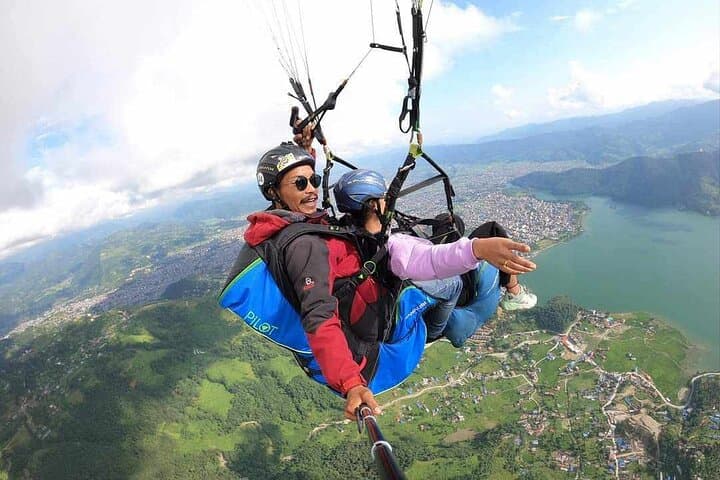


Sunlight cuts across the ridgeline at Sarangkot as a tandem wing catches the early thermals and lifts away from the hill. Below, Fewa Lake flashes like a wound mirror and the Annapurna massif pins the horizon; for 35–55 minutes passengers trade earth for sky and watch valleys rearrange themselves under a gliding silhouette.
Sunlight cuts across the ridgeline at Sarangkot as a tandem wing catches the early thermals and lifts away from the hill. Below, Fewa Lake flashes like a wound mirror and the Annapurna massif pins the horizon; for 35–55 minutes passengers trade earth for sky and watch valleys rearrange themselves under a gliding silhouette.
The high ridges around Pokhara are young Himalaya — fractured, rising rock formed by the slow collision of the Indian and Eurasian plates — and local villages grew where trails and rivers allowed trade. Paragliding here sits at the intersection of that geology and a tourism culture that began with trekking in the 1970s. Pilots use predictable lee- and ridge-lift off Sarangkot to send tandems across long lines, and cross-country runs take advantage of seasonal thermals that push wings farther over terraced fields and pine-clad slopes.
Expect panoramic angles of Annapurna South, Machapuchare’s knife-edge peak, and the mosaic of lakeside Pokhara. The company provides private transfers and a certified pilot; passengers sit forward in the harness while the pilot manages takeoff, navigation and landing. Cloudbase flights push higher than standard tandems — be ready for greater airtime and intermittent G-forces during active lift.
Practical notes: flights run best at dawn or late afternoon for stable air and visibility; monsoon months often suspend operations. Bring sturdy shoes for the short hill run at launch, a windproof layer, sun protection, and a secure camera strap. Inform operators of exact weight and any mobility concerns in advance; basic health and the ability to run a short step for takeoff make the experience smooth. This is a high-reward, low-technical way to cross-country fly above one of Nepal’s most scenic valleys.