THE ADVENTURE COLLECTIVE® · Independent discovery and booking for outdoor travel

A private full-day shore excursion from Kusadasi that pairs Pamukkale’s surreal white travertine pools with the ancient ruins of Hierapolis. Expect a 2.5-hour transfer, barefoot walking on terraces, and a day rich in geology and Roman-era history.
A private full-day shore excursion from Kusadasi that pairs Pamukkale’s surreal white travertine pools with the ancient ruins of Hierapolis. Expect a 2.5-hour transfer, barefoot walking on terraces, and a day rich in geology and Roman-era history.
You step off the minibus into a wide, sun-stung plain and the cliff-face ahead appears to be carved from salt: sheets of white calcite climb and pool, catching steam like a slow exhale.
Verified experiences and guided adventures in the surrounding area.
Operated by Turkey Tours Company · Pamukkale, Denizli
You step off the minibus into a wide, sun-stung plain and the cliff-face ahead appears to be carved from salt: sheets of white calcite climb and pool, catching steam like a slow exhale.
This private day tour carries you from Kusadasi port across Anatolia to Pamukkale and the adjacent ruins of Hierapolis. Geologically, the terraces are living travertine—calcium-rich thermal waters depositing layer upon layer over millennia—while Hierapolis began as a Hellenistic settlement in the 2nd century BC and grew into a Roman spa city famed for its baths and marble colonnades.
Walk the archaeological zones past the theatre, bath complexes and marble sarcophagi; stand where pilgrims once came for healing and notice how the warm springs still direct the landscape’s shape. Local culture blends Aegean agricultural life with a long spa tradition—small vendors by the site sell Turkish tea and onyx crafts, reminders of the area’s living economy.
Practically, expect a 2.5-hour transfer from Kusadasi, a full-day outing (roughly 9–11 hours total), and an entry fee currently around €30; Cleopatra’s Pool is extra. The site requires barefoot walking on terraces, so bring quick-dry shorts, a towel, and a lightweight daypack. Midday sun is strong—hydration and shade matter. Guides commonly manage skip-the-line tickets and timed routing to reduce crowds but plan for sustained walking on uneven, sometimes slippery limestone.
This excursion balances dramatic natural features with layered human history—an accessible full-day adventure that rewards simple preparation and steady curiosity.
easy.
9–11 hours.
Suitable for travelers with basic walking fitness; expect 2–3 hours of on-foot exploration over uneven surfaces
Yes—site rules require no shoes on the white terraces to protect the formations; wear sandals to and from the entrance and bring a towel.
The drive is about 2.5 hours each way by air-conditioned van or minibus, making the overall tour roughly 9–11 hours including site time.
No—Cleopatra’s Pool has a separate entrance fee (paid onsite or through the guide) and is currently subject to restoration schedules and extra charges.
Much of the terraces and archaeological areas include uneven steps and walking on limestone; those with mobility limitations should check with the operator about alternate routes or assistance.
Hierapolis grew from a 2nd-century BC Hellenistic foundation into a Roman spa town prized for its thermal waters and marble architecture.
Pamukkale is a UNESCO World Heritage Site with active water management—follow walkway rules, avoid soaps or lotions in pools, and support local preservation fees.
Turkey Tours Company operates guided outdoor trips and adventures with an emphasis on safety, stewardship, and memorable experiences.



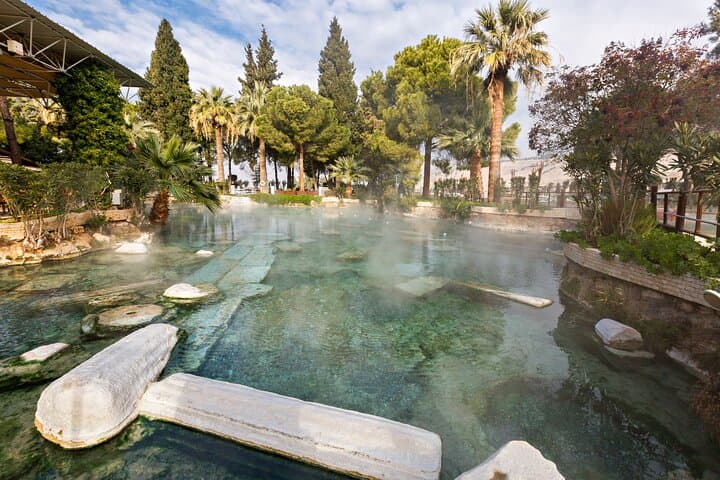
You step off the minibus into a wide, sun-stung plain and the cliff-face ahead appears to be carved from salt: sheets of white calcite climb and pool, catching steam like a slow exhale.
You step off the minibus into a wide, sun-stung plain and the cliff-face ahead appears to be carved from salt: sheets of white calcite climb and pool, catching steam like a slow exhale.
This private day tour carries you from Kusadasi port across Anatolia to Pamukkale and the adjacent ruins of Hierapolis. Geologically, the terraces are living travertine—calcium-rich thermal waters depositing layer upon layer over millennia—while Hierapolis began as a Hellenistic settlement in the 2nd century BC and grew into a Roman spa city famed for its baths and marble colonnades.
Walk the archaeological zones past the theatre, bath complexes and marble sarcophagi; stand where pilgrims once came for healing and notice how the warm springs still direct the landscape’s shape. Local culture blends Aegean agricultural life with a long spa tradition—small vendors by the site sell Turkish tea and onyx crafts, reminders of the area’s living economy.
Practically, expect a 2.5-hour transfer from Kusadasi, a full-day outing (roughly 9–11 hours total), and an entry fee currently around €30; Cleopatra’s Pool is extra. The site requires barefoot walking on terraces, so bring quick-dry shorts, a towel, and a lightweight daypack. Midday sun is strong—hydration and shade matter. Guides commonly manage skip-the-line tickets and timed routing to reduce crowds but plan for sustained walking on uneven, sometimes slippery limestone.
This excursion balances dramatic natural features with layered human history—an accessible full-day adventure that rewards simple preparation and steady curiosity.