THE ADVENTURE COLLECTIVE® · Independent discovery and booking for outdoor travel

Explore Marrakech on foot with a certified private guide who connects the minaret-lined skyline to palace courtyards and souk lanes. This 3+ hour walking tour unpacks dynasties, design, and local tips while moving through the medina’s busiest sights.
Explore Marrakech on foot with a certified private guide who connects the minaret-lined skyline to palace courtyards and souk lanes. This 3+ hour walking tour unpacks dynasties, design, and local tips while moving through the medina’s busiest sights.
You meet at Argana café on the square and the city announces itself: vendors calling, spice-scented air, and the minaret of the Koutoubia rising above ochre rooftops like a cartographer's mark.
Verified experiences and guided adventures in the surrounding area.
Operated by Rachid · Marrakech, Marrakech-Safi
You meet at Argana café on the square and the city announces itself: vendors calling, spice-scented air, and the minaret of the Koutoubia rising above ochre rooftops like a cartographer's mark.
The walk moves from that open pulse into narrower lanes, where the guide layers history into place — the Koutoubia’s 12th-century Almohad fabric, its role in city planning, and the evolution of minaret design. Walking toward Bahia Palace, the tour shifts to 19th-century court life: courtyards, carved cedar ceilings, and rooms arranged around power and privacy. The geology underfoot is simple — the flat Haouz plain — but the Atlas Mountains frame the horizon and explain why Marrakech became a crossroads between desert, mountain, and coast.
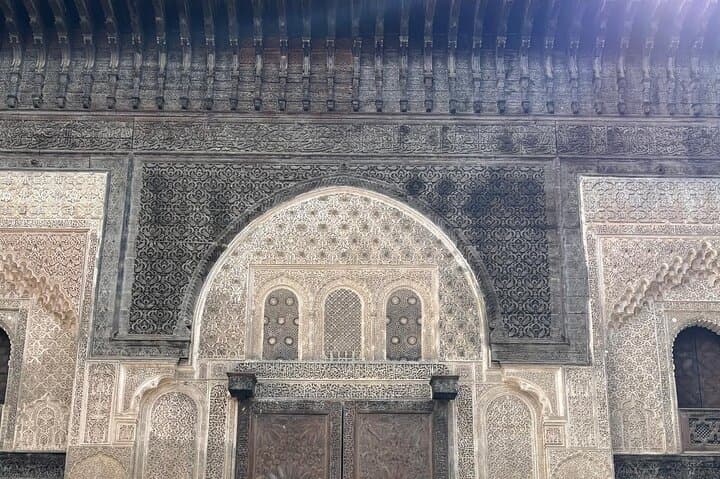
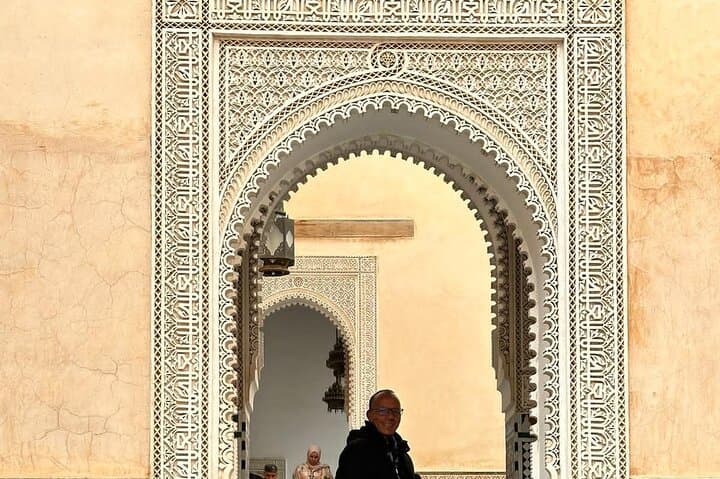
Along the route the guide decodes decorative systems — zellij tilework, stucco muqarnas, and courtyard hydraulics — tying craft to culture and colonial-era changes to modern urban life. Local insights include where to find rooftop views, which souk lanes specialize in metalwork, and how prayer times shape the city’s rhythm.
Practical guidance is straightforward: the tour lasts about 3 hours 15 minutes and requires moderate fitness for walking and standing. Bahia Palace entry is typically not included and costs around 100 MAD; bring cash or card depending on the operator. Dress respectfully for religious sites, carry a reusable water bottle, and schedule morning or late-afternoon starts to avoid peak heat. The experience is primarily cultural walking — expect tight lanes, lively crowds, and a guide who turns architecture and ritual into clear, memorable stories.
moderate.
3–3.5 hours.
Requires moderate walking endurance and ability to stand during explanations; some uneven surfaces and narrow alleys.
Meet near Argana café on Jemaa el-Fnaa; arrive 10–15 minutes early to check in and avoid delays in a busy square.
Admission to Bahia Palace is typically not included in the tour price and costs around 100 MAD per person—confirm with the operator before booking.
The operator lists wheelchair and stroller accessibility for parts of the route, but expect uneven surfaces and limited access inside some historical rooms.
Guides are certified and usually provide commentary in major languages—confirm language availability at booking to ensure a match.
Koutoubia traces to the 12th-century Almohad dynasty while Bahia Palace dates to the late 19th century, reflecting Morocco’s imperial and later colonial-era shifts.
Respect historic sites by avoiding flash photography in sensitive rooms and limiting single-use plastics; local guides often encourage supporting artisans directly.
Rachid operates guided outdoor trips and adventures with an emphasis on safety, stewardship, and memorable experiences.
You meet at Argana café on the square and the city announces itself: vendors calling, spice-scented air, and the minaret of the Koutoubia rising above ochre rooftops like a cartographer's mark.
You meet at Argana café on the square and the city announces itself: vendors calling, spice-scented air, and the minaret of the Koutoubia rising above ochre rooftops like a cartographer's mark.
The walk moves from that open pulse into narrower lanes, where the guide layers history into place — the Koutoubia’s 12th-century Almohad fabric, its role in city planning, and the evolution of minaret design. Walking toward Bahia Palace, the tour shifts to 19th-century court life: courtyards, carved cedar ceilings, and rooms arranged around power and privacy. The geology underfoot is simple — the flat Haouz plain — but the Atlas Mountains frame the horizon and explain why Marrakech became a crossroads between desert, mountain, and coast.
Along the route the guide decodes decorative systems — zellij tilework, stucco muqarnas, and courtyard hydraulics — tying craft to culture and colonial-era changes to modern urban life. Local insights include where to find rooftop views, which souk lanes specialize in metalwork, and how prayer times shape the city’s rhythm.
Practical guidance is straightforward: the tour lasts about 3 hours 15 minutes and requires moderate fitness for walking and standing. Bahia Palace entry is typically not included and costs around 100 MAD; bring cash or card depending on the operator. Dress respectfully for religious sites, carry a reusable water bottle, and schedule morning or late-afternoon starts to avoid peak heat. The experience is primarily cultural walking — expect tight lanes, lively crowds, and a guide who turns architecture and ritual into clear, memorable stories.