THE ADVENTURE COLLECTIVE® · Independent discovery and booking for outdoor travel

A private 2-hour helicopter flight that puts Annapurna Base Camp within sight in minutes. Circle the Annapurna massif, land briefly near Base Camp, and walk among towering ridgelines without days of trekking.
A private 2-hour helicopter flight that puts Annapurna Base Camp within sight in minutes. Circle the Annapurna massif, land briefly near Base Camp, and walk among towering ridgelines without days of trekking.
You lift from Kathmandu and the city contracts below until the Himalaya claim the horizon. The chopper threads a corridor of terraced fields and tiny villages, then the peaks arrive: Machhapuchhre’s knife edge, Annapurna I’s immense flank, Dhaulagiri yawning white. The rotor’s hum becomes a backdrop to a panorama that seems to rearrange scale — mountains that once felt impossible now loom within arm’s reach.
Verified experiences and guided adventures in the surrounding area.
You lift from Kathmandu and the city contracts below until the Himalaya claim the horizon. The chopper threads a corridor of terraced fields and tiny villages, then the peaks arrive: Machhapuchhre’s knife edge, Annapurna I’s immense flank, Dhaulagiri yawning white. The rotor’s hum becomes a backdrop to a panorama that seems to rearrange scale — mountains that once felt impossible now loom within arm’s reach.
The Annapurna massif has long drawn explorers and trekkers; Annapurna I was the first 8,000m peak climbed in 1950, opening Himalayan mountaineering lore. Geologically the range is a young collision zone where the Indian plate thrusts under Eurasia, producing steep relief, glaciated cirques, and a sudden climate gradient from subtropical valleys to alpine wasteland. Culturally the valleys below are Gurung and Magar country — villages of stone houses, prayer flags, and terraced rice carved into steep slopes.
On a private heli tour you typically circle the Annapurna Sanctuary and land near Base Camp for 20–40 minutes, enough time to walk a short moraine, feel the thin air, and photograph colossal ridgelines. Weather dictates the plan: mornings are usually more stable; afternoons can cloud in quickly.
Practical points: carry warm layers, sunglasses, and a camera with fast shutter speeds; helicopter landings at high altitude are bouncy and brief. Check for altitude or medical restrictions before booking, and factor in photo permits or park fees if the operator requires them. This is a high-impact, high-reward way to see Annapurna’s heart without days of trekking — brief, unforgettable, and logistically simple if you prepare for cold, wind, and quick transitions.
easy.
2 hours.
Minimal fitness required for the flight and a short walk at landing; be able to climb over uneven moraine.
Landings typically last 20–40 minutes to allow photos and a short walk; exact time depends on the operator and weather conditions.
Because you’re flying in and out within hours, full acclimatization usually isn’t necessary, but anyone with altitude sensitivity should consult a physician before booking.
Many operators run flights from Kathmandu or Pokhara; confirm the departure point and transfer logistics with your provider.
Yes — Machhapuchhre is a prominent feature seen clearly on most approach corridors to Annapurna Base Camp.
Annapurna I’s 1950 ascent helped establish organized expeditions in the Himalaya; the Annapurna Sanctuary has been a trekking destination since the mid-20th century.
The Annapurna Conservation Area Project (ACAP) manages trails and limits impacts; helicopter flights are regulated seasonally to minimize disturbance and carbon footprint.
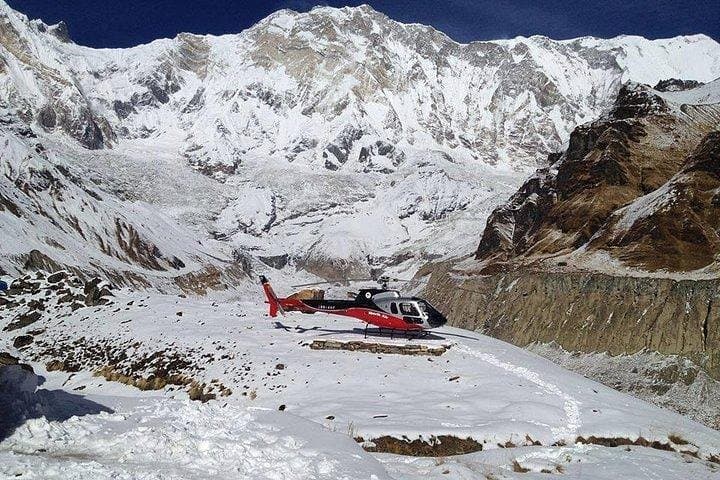
You lift from Kathmandu and the city contracts below until the Himalaya claim the horizon. The chopper threads a corridor of terraced fields and tiny villages, then the peaks arrive: Machhapuchhre’s knife edge, Annapurna I’s immense flank, Dhaulagiri yawning white. The rotor’s hum becomes a backdrop to a panorama that seems to rearrange scale — mountains that once felt impossible now loom within arm’s reach.
You lift from Kathmandu and the city contracts below until the Himalaya claim the horizon. The chopper threads a corridor of terraced fields and tiny villages, then the peaks arrive: Machhapuchhre’s knife edge, Annapurna I’s immense flank, Dhaulagiri yawning white. The rotor’s hum becomes a backdrop to a panorama that seems to rearrange scale — mountains that once felt impossible now loom within arm’s reach.
The Annapurna massif has long drawn explorers and trekkers; Annapurna I was the first 8,000m peak climbed in 1950, opening Himalayan mountaineering lore. Geologically the range is a young collision zone where the Indian plate thrusts under Eurasia, producing steep relief, glaciated cirques, and a sudden climate gradient from subtropical valleys to alpine wasteland. Culturally the valleys below are Gurung and Magar country — villages of stone houses, prayer flags, and terraced rice carved into steep slopes.
On a private heli tour you typically circle the Annapurna Sanctuary and land near Base Camp for 20–40 minutes, enough time to walk a short moraine, feel the thin air, and photograph colossal ridgelines. Weather dictates the plan: mornings are usually more stable; afternoons can cloud in quickly.
Practical points: carry warm layers, sunglasses, and a camera with fast shutter speeds; helicopter landings at high altitude are bouncy and brief. Check for altitude or medical restrictions before booking, and factor in photo permits or park fees if the operator requires them. This is a high-impact, high-reward way to see Annapurna’s heart without days of trekking — brief, unforgettable, and logistically simple if you prepare for cold, wind, and quick transitions.