THE ADVENTURE COLLECTIVE® · Independent discovery and booking for outdoor travel

Explore Taroudant’s red earthen walls, organized souks and traditional ateliers on a private half-day from Agadir. This accessible cultural trip combines a short rampart walk with focused time in the medina for shopping and photography.
Explore Taroudant’s red earthen walls, organized souks and traditional ateliers on a private half-day from Agadir. This accessible cultural trip combines a short rampart walk with focused time in the medina for shopping and photography.
You arrive at the red earth gate as the city holds its breath: a low, muscular wall stretches in both directions, punctuated by square towers and the slow rhythm of farmers' carts passing in the distance. The ramparts of Taroudant invite a short climb — step up and the medina unfurls below, an orderly maze of souk lanes, copper shops and small patios where life moves at a measured pace.
Verified experiences and guided adventures in the surrounding area.
Operated by Agharass Tours · Taroudant, Souss-Massa
You arrive at the red earth gate as the city holds its breath: a low, muscular wall stretches in both directions, punctuated by square towers and the slow rhythm of farmers' carts passing in the distance. The ramparts of Taroudant invite a short climb — step up and the medina unfurls below, an orderly maze of souk lanes, copper shops and small patios where life moves at a measured pace.
Taroudant’s current form dates largely to the Saadian era in the 16th century when it served as a regional capital; the eight kilometres of earthen walls are a direct line to that period of fortified trade and agrarian wealth. Geologically the town sits on the fertile Souss plain, where alluvial soils feed olive and citrus groves and the distant Anti-Atlas rises like a low, stony horizon. Culturally the medina still follows traditional craft zoning: leatherworkers, metalworkers, and silversmiths occupy distinct quarters, each producing skills passed down generations.
Practical guidance: this private half-day tour from Agadir runs about 4–6 hours with hotel pickup in an air-conditioned vehicle and an English- or French-speaking driver. Wear comfortable walking shoes for uneven cobbles and a sun hat—shade is limited inside the souks. Bring local currency for small purchases and bargaining; plan 60–90 minutes to explore the main souk and another 20–30 minutes to walk a section of the walls for views. If you want photos with softer light, request an early-morning or late-afternoon departure. Respect private patios and mosque precincts—photograph openly traded goods and ask before shooting people. This is a compact cultural day trip that pairs accessible walking with rich sensory detail: the grit of leather, the ring of the hammer on copper, and the slow, watchful presence of the city walls.
easy.
4–6 hours.
Suitable for most fitness levels; moderate mobility required for short wall climbs and walking through crowded souks.
Drive time is roughly 1–1.5 hours each way depending on traffic; expect a total outing of 4–6 hours including time in the medina.
The walking tour of the medina and ramparts is public and does not require entry fees; organized visits to private sites may cost extra—confirm with your operator.
The itinerary notes stroller accessibility and infant seats are available, but cobblestones and narrow lanes may make navigation slower with a stroller.
No—the driver guides speak English, French and German, and basic bargaining can be managed with gestures and common phrases.
Taroudant rose in prominence under the Saadian dynasty in the 16th century; its earthen fortifications reflect an agricultural trade hub that connected inland produce to coastal markets.
Buy argan and leather goods responsibly from reputable stalls; the Souss plain faces pressure from development, so support local artisans who follow sustainable harvesting and traditional methods.
Agharass Tours operates guided outdoor trips and adventures with an emphasis on safety, stewardship, and memorable experiences.
You arrive at the red earth gate as the city holds its breath: a low, muscular wall stretches in both directions, punctuated by square towers and the slow rhythm of farmers' carts passing in the distance. The ramparts of Taroudant invite a short climb — step up and the medina unfurls below, an orderly maze of souk lanes, copper shops and small patios where life moves at a measured pace.
You arrive at the red earth gate as the city holds its breath: a low, muscular wall stretches in both directions, punctuated by square towers and the slow rhythm of farmers' carts passing in the distance. The ramparts of Taroudant invite a short climb — step up and the medina unfurls below, an orderly maze of souk lanes, copper shops and small patios where life moves at a measured pace.
Taroudant’s current form dates largely to the Saadian era in the 16th century when it served as a regional capital; the eight kilometres of earthen walls are a direct line to that period of fortified trade and agrarian wealth. Geologically the town sits on the fertile Souss plain, where alluvial soils feed olive and citrus groves and the distant Anti-Atlas rises like a low, stony horizon. Culturally the medina still follows traditional craft zoning: leatherworkers, metalworkers, and silversmiths occupy distinct quarters, each producing skills passed down generations.
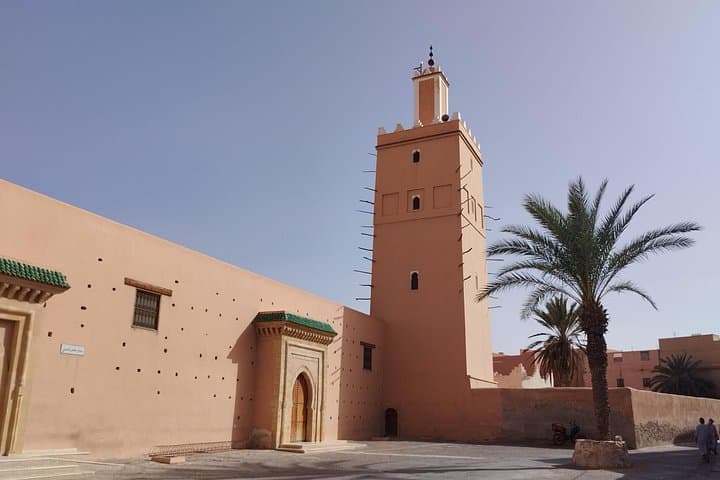
Practical guidance: this private half-day tour from Agadir runs about 4–6 hours with hotel pickup in an air-conditioned vehicle and an English- or French-speaking driver. Wear comfortable walking shoes for uneven cobbles and a sun hat—shade is limited inside the souks. Bring local currency for small purchases and bargaining; plan 60–90 minutes to explore the main souk and another 20–30 minutes to walk a section of the walls for views. If you want photos with softer light, request an early-morning or late-afternoon departure. Respect private patios and mosque precincts—photograph openly traded goods and ask before shooting people. This is a compact cultural day trip that pairs accessible walking with rich sensory detail: the grit of leather, the ring of the hammer on copper, and the slow, watchful presence of the city walls.