THE ADVENTURE COLLECTIVE® · Independent discovery and booking for outdoor travel

Experience the Giza Plateau on a private half-day guided tour that brings you face-to-face with the Great Pyramid, the Sphinx and the Valley Temple. Ideal for travelers who want focused history, an Egyptologist-led narrative, and optional camel views without a large group.
Experience the Giza Plateau on a private half-day guided tour that brings you face-to-face with the Great Pyramid, the Sphinx and the Valley Temple. Ideal for travelers who want focused history, an Egyptologist-led narrative, and optional camel views without a large group.
You arrive on the Giza Plateau as the sun lifts over ochre stone; heat shimmers off ancient blocks and the scale of the Great Pyramid makes the city fall away.
Verified experiences and guided adventures in the surrounding area.
Operated by Egypt Daily Tours · Giza, Cairo Governorate
You arrive on the Giza Plateau as the sun lifts over ochre stone; heat shimmers off ancient blocks and the scale of the Great Pyramid makes the city fall away.
A private Egyptologist meets you and guides the group past the shoulder-to-shoulder tourists to the three main pyramids — Khufu (Cheops), Khafre (Chephren) and Menkaure (Mykerinus) — and the carved limestone of the Sphinx that stares eastward. The plateau is a plain of wind-worked sand and dressed limestone where burial practices, cosmology and state power are written in sheer geometry.
Geologically the stones are local Nubian and Mokattam limestone and Giza’s profile reflects millions of years of Nile deposits and tectonic uplift. Culturally, the site anchors millennia of Egyptian belief: funerary temples, solar alignments and processional causeways tie the pyramids to the Valley Temple and the Nile’s life-giving floodplain.
Practical guidance: this private half-day runs about four hours with hotel pickup in Cairo, an air-conditioned vehicle and a qualified guide. Expect a moderate amount of walking on uneven, sandy ground and low, loose stone; appropriate footwear and sun protection are essential. The optional 30-minute camel ride circles the plateau and offers a different vantage, but camels can be uncomfortable for some riders.
Timing matters — early morning or late afternoon light improves photos and lowers temperatures. Respect site rules: no climbing on monuments, follow your guide’s route, and bring cash for modest tips or museum entry fees if you plan to enter the interior chambers.
easy.
4 hours.
Suitable for most fitness levels; involves walking on uneven, sandy terrain and short climbs over low stones.
The experience runs about four hours total, including hotel pickup and return from central Cairo.
Standard tour inclusions vary; interior chamber access often requires an additional ticket—confirm with your operator ahead of time.
An optional 30-minute camel ride around the plateau is typically offered; it’s not mandatory and may incur an extra charge.
Yes—children can join but must be accompanied by an adult; consider stroller limitations on uneven ground.
The Giza complex was built during Egypt’s Fourth Dynasty (c. 2600–2500 BCE) and served as monumental tombs linked to solar and funerary cults.
Visitor pressure and erosion are ongoing concerns—follow restricted paths, avoid touching masonry, and support licensed guides who promote preservation.
Egypt Daily Tours operates guided outdoor trips and adventures with an emphasis on safety, stewardship, and memorable experiences.


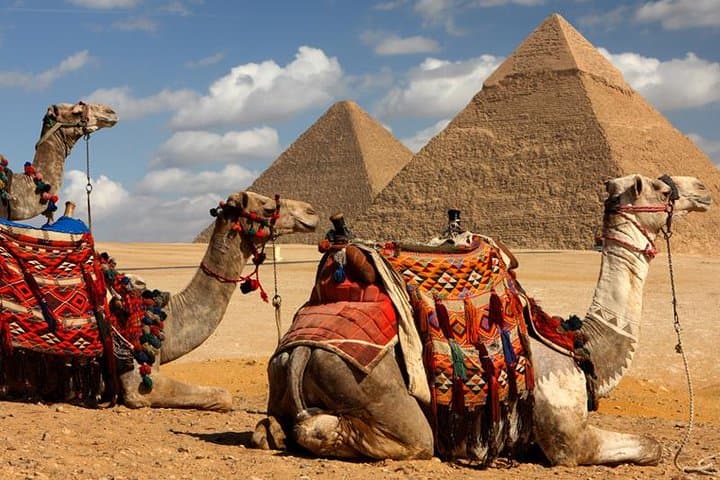
You arrive on the Giza Plateau as the sun lifts over ochre stone; heat shimmers off ancient blocks and the scale of the Great Pyramid makes the city fall away.
You arrive on the Giza Plateau as the sun lifts over ochre stone; heat shimmers off ancient blocks and the scale of the Great Pyramid makes the city fall away.
A private Egyptologist meets you and guides the group past the shoulder-to-shoulder tourists to the three main pyramids — Khufu (Cheops), Khafre (Chephren) and Menkaure (Mykerinus) — and the carved limestone of the Sphinx that stares eastward. The plateau is a plain of wind-worked sand and dressed limestone where burial practices, cosmology and state power are written in sheer geometry.
Geologically the stones are local Nubian and Mokattam limestone and Giza’s profile reflects millions of years of Nile deposits and tectonic uplift. Culturally, the site anchors millennia of Egyptian belief: funerary temples, solar alignments and processional causeways tie the pyramids to the Valley Temple and the Nile’s life-giving floodplain.
Practical guidance: this private half-day runs about four hours with hotel pickup in Cairo, an air-conditioned vehicle and a qualified guide. Expect a moderate amount of walking on uneven, sandy ground and low, loose stone; appropriate footwear and sun protection are essential. The optional 30-minute camel ride circles the plateau and offers a different vantage, but camels can be uncomfortable for some riders.
Timing matters — early morning or late afternoon light improves photos and lowers temperatures. Respect site rules: no climbing on monuments, follow your guide’s route, and bring cash for modest tips or museum entry fees if you plan to enter the interior chambers.