THE ADVENTURE COLLECTIVE® · Independent discovery and booking for outdoor travel

See Nha Trang’s defining sites in four hours: a leading marine museum, bizarre coastal rocks, ancient Cham towers and a Gothic‑style stone church. This private half‑day tour pairs local history with practical logistics for an efficient shore‑to‑city introduction.
See Nha Trang’s defining sites in four hours: a leading marine museum, bizarre coastal rocks, ancient Cham towers and a Gothic‑style stone church. This private half‑day tour pairs local history with practical logistics for an efficient shore‑to‑city introduction.
You step out of a low-slung minivan and the salt-sweet air of Nha Trang folds around you—the South China Sea daring you to look further. On a four-hour private tour, the coastline and city trade places with history: a research museum that houses an 18‑meter whale skeleton; a clutch of rocks that looks like a giant hand pointing to the sea; stoic Cham towers with weathered sandstone; and a concrete church whose bell tower pierces the skyline. The day moves fast, but each stop is distinct, like chapters of the same coastal story.
Verified experiences and guided adventures in the surrounding area.
Operated by Vietnam Fantastic · Nha Trang, Khanh Hoa
You step out of a low-slung minivan and the salt-sweet air of Nha Trang folds around you—the South China Sea daring you to look further. On a four-hour private tour, the coastline and city trade places with history: a research museum that houses an 18‑meter whale skeleton; a clutch of rocks that looks like a giant hand pointing to the sea; stoic Cham towers with weathered sandstone; and a concrete church whose bell tower pierces the skyline. The day moves fast, but each stop is distinct, like chapters of the same coastal story.
The Museum of Oceanography anchors the route with scientific heft. Built as a research institute and display space, it conserves more than 20,000 specimens—coral, hundreds of fish species, and that whale skeleton that compels a second look. From there the tour slips to Hon Chong Promontory, where the ocean sculpts basalt and granite into improbable shapes; local lore names the larger outcrop “Husband” and a smaller one “Wife,” and a five‑fingered fissure in a boulder becomes impossible to forget.
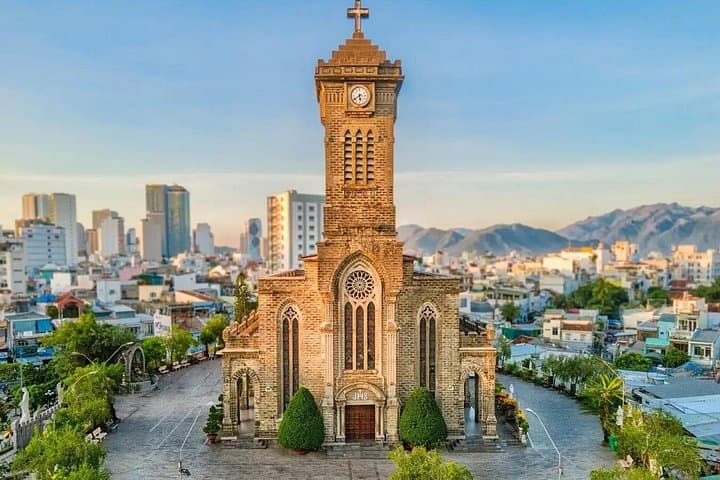
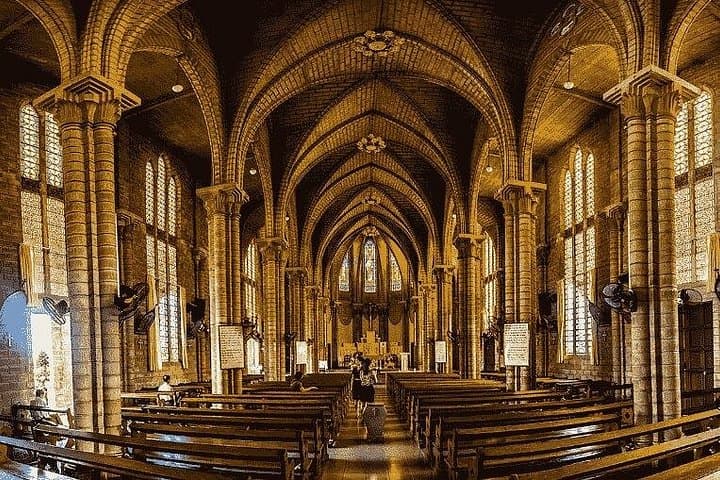
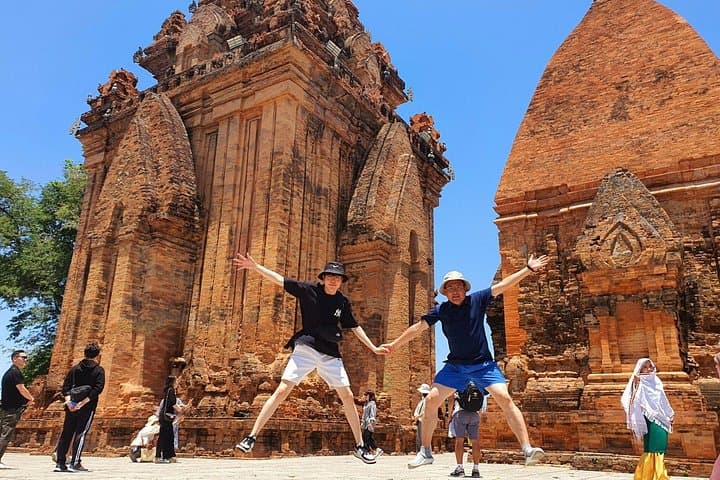
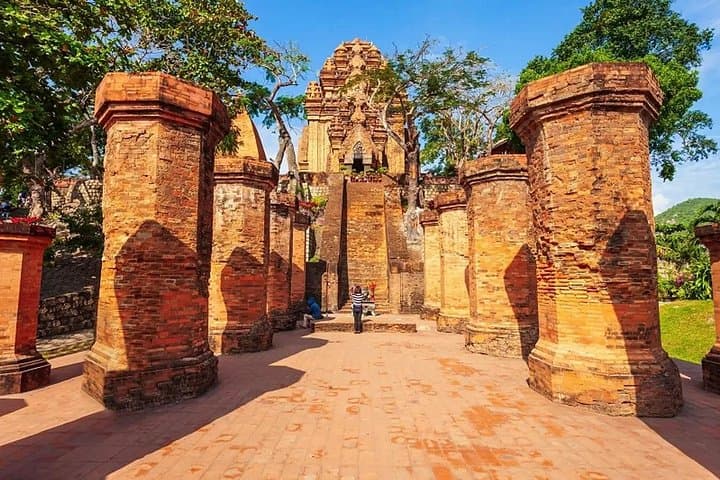
Higher in the itinerary are human histories. The Po Nagar Towers—Cham brickwork erected centuries before 781 A.D.—stand on a raised mound overlooking the river mouth. Cham artisans stacked bricks without mortar, and the towers’ reliefs and stairways reveal a kingdom that traded widely across Southeast Asia. Not far off, Nha Trang Stone Church presents a 20th‑century Gothic vocabulary in reinforced concrete, its 38‑meter bell tower an angular reply to the curves of the sea.
Culture here is public and tactile: incense smoke at Po Nagar, fishermen hauling nets at the harbor, and the low hum of vendors selling sugarcane juice. Guides on this private tour translate that texture—pointing to architectural details, explaining Cham cosmology, and walking you through displays at the museum.
Practicalities matter on a tight half‑day. The operator provides hotel pickup across Nha Trang (confirm meeting point if you’re outside the city center) and includes entrance fees, bottled water, lunch, and an English‑speaking guide. Expect about 45 minutes at the Oceanography Museum, 30 at Hon Chong, 45 at Po Nagar and 30 at Stone Church; the route is mostly flat with short stair sections at the Po Nagar complex.
For comfort, start early to avoid midday heat, wear sturdy walking shoes for slick rock at Hon Chong, and bring sunscreen and a hat. Respect religious sites—cover shoulders and knees—and keep small bills for market snacks and donations. The tour compresses coastal geology, Cham history, and colonial‑era architecture into a single, readable half‑day—ideal for travelers who want context as well as scenery.
easy.
4 hours.
Suitable for light fitness — mostly walking on flat surfaces with short stair sections.
Yes — pickup and drop‑off in Nha Trang city center are included; if you stay outside the center you may be asked to meet at Agarwood Tower or Nha Trang Port.
Entrance fees to the listed attractions and lunch are included, as well as one bottle of drinking water per person.
Yes — the tour is listed as stroller accessible and suitable for all fitness levels; some sites have steps where an adult may need to carry an infant.
Typical times are ~45 minutes at the Oceanography Museum, 30 minutes at Hon Chong, 30 minutes at the Stone Church, and 45 minutes at Po Nagar Towers.
An English‑speaking guide is provided; check availability if you need another language.
Full refund if cancelled at least 24 hours before departure; no refund within 24 hours.
The Po Nagar Towers predate 781 A.D. and reflect the Cham Kingdom’s maritime trade and sculptural tradition across coastal Vietnam.
The Oceanography Museum plays a key role in regional marine conservation and education; visitors are encouraged to avoid single‑use plastics and respect coral‑related displays.
Vietnam Fantastic operates guided outdoor trips and adventures with an emphasis on safety, stewardship, and memorable experiences.
You step out of a low-slung minivan and the salt-sweet air of Nha Trang folds around you—the South China Sea daring you to look further. On a four-hour private tour, the coastline and city trade places with history: a research museum that houses an 18‑meter whale skeleton; a clutch of rocks that looks like a giant hand pointing to the sea; stoic Cham towers with weathered sandstone; and a concrete church whose bell tower pierces the skyline. The day moves fast, but each stop is distinct, like chapters of the same coastal story.
You step out of a low-slung minivan and the salt-sweet air of Nha Trang folds around you—the South China Sea daring you to look further. On a four-hour private tour, the coastline and city trade places with history: a research museum that houses an 18‑meter whale skeleton; a clutch of rocks that looks like a giant hand pointing to the sea; stoic Cham towers with weathered sandstone; and a concrete church whose bell tower pierces the skyline. The day moves fast, but each stop is distinct, like chapters of the same coastal story.
The Museum of Oceanography anchors the route with scientific heft. Built as a research institute and display space, it conserves more than 20,000 specimens—coral, hundreds of fish species, and that whale skeleton that compels a second look. From there the tour slips to Hon Chong Promontory, where the ocean sculpts basalt and granite into improbable shapes; local lore names the larger outcrop “Husband” and a smaller one “Wife,” and a five‑fingered fissure in a boulder becomes impossible to forget.
Higher in the itinerary are human histories. The Po Nagar Towers—Cham brickwork erected centuries before 781 A.D.—stand on a raised mound overlooking the river mouth. Cham artisans stacked bricks without mortar, and the towers’ reliefs and stairways reveal a kingdom that traded widely across Southeast Asia. Not far off, Nha Trang Stone Church presents a 20th‑century Gothic vocabulary in reinforced concrete, its 38‑meter bell tower an angular reply to the curves of the sea.
Culture here is public and tactile: incense smoke at Po Nagar, fishermen hauling nets at the harbor, and the low hum of vendors selling sugarcane juice. Guides on this private tour translate that texture—pointing to architectural details, explaining Cham cosmology, and walking you through displays at the museum.
Practicalities matter on a tight half‑day. The operator provides hotel pickup across Nha Trang (confirm meeting point if you’re outside the city center) and includes entrance fees, bottled water, lunch, and an English‑speaking guide. Expect about 45 minutes at the Oceanography Museum, 30 at Hon Chong, 45 at Po Nagar and 30 at Stone Church; the route is mostly flat with short stair sections at the Po Nagar complex.
For comfort, start early to avoid midday heat, wear sturdy walking shoes for slick rock at Hon Chong, and bring sunscreen and a hat. Respect religious sites—cover shoulders and knees—and keep small bills for market snacks and donations. The tour compresses coastal geology, Cham history, and colonial‑era architecture into a single, readable half‑day—ideal for travelers who want context as well as scenery.