THE ADVENTURE COLLECTIVE® · Independent discovery and booking for outdoor travel

See the Great Pyramid, Khafre and Menkaure, plus the Great Sphinx, on a private half-day tour from Cairo. Get practical timing, entry and photography tips to make the most of the visit.
See the Great Pyramid, Khafre and Menkaure, plus the Great Sphinx, on a private half-day tour from Cairo. Get practical timing, entry and photography tips to make the most of the visit.
Morning light slides across the desert and the Great Pyramid lifts out of the haze like an ancient muscle memory of the Earth. A private car eases through Cairo traffic, and the limestone plateau of Giza opens: three geometric giants, a crouching Sphinx, and the stone apron of the Valley Temple.
Verified experiences and guided adventures in the surrounding area.
Operated by Cairo Tours · Giza, Giza Governorate
Morning light slides across the desert and the Great Pyramid lifts out of the haze like an ancient muscle memory of the Earth. A private car eases through Cairo traffic, and the limestone plateau of Giza opens: three geometric giants, a crouching Sphinx, and the stone apron of the Valley Temple.
These monuments date to Egypt's Old Kingdom (the Fourth Dynasty, roughly 2600–2500 BCE). The Great Pyramid (Khufu/Cheops) dominates the site, with Khafre’s slightly smaller pyramid and Menkaure’s limestone-capped structure nearby. The Sphinx, carved from the bedrock, faces eastward—its human head and lion body a cultural icon whose purpose mixes ritual, funerary architecture, and the ancient pharaoh cult.
Geologically, the plateau is a raised limestone platform with windswept sand between tombs and causeways. Local life is visible at the edges—vendors, Bedouin guides, and camel handlers—adding a modern human rhythm to millennia-old stone.
Practically, a half-day private tour covers pickup and drop-off in an air-conditioned vehicle, guided time at the pyramids, the Sphinx, and the Valley Temple within about 4–5 hours. Expect short walks across uneven stone and sand, intermittent stairs, and busy public areas. Bring sun protection, carry your passport for ticketing, and plan early mornings or late afternoons to avoid peak heat and crowds. The guide often doubles as a photographer and will steer you toward strong compositions and quieter viewpoints. With a private guide and transport, this half-day option concentrates the essentials—history, scale, and photo opportunities—without the logistical friction of independent navigation.
easy.
4–5 hours.
Suitable for most fitness levels; involves moderate walking on uneven, sandy, and stepped surfaces
Yes — this private half-day itinerary lists admission as included, so standard site tickets are covered.
Access inside the Great Pyramid is limited, often requires a separate ticket and can be subject to site regulations; ask your guide in advance to confirm availability.
Yes — the tour is described as suitable for all fitness levels, but be aware of uneven walking surfaces and bring assistance if mobility is limited.
A typical private half-day visit allocates several short stops across the plateau—roughly 2–3 hours on-site within a 4–5 hour total window including transport and briefing.
The Giza necropolis was developed during Egypt's Fourth Dynasty; Khufu (Cheops), Khafre, and Menkaure commissioned the primary pyramids as monumental royal tombs and cult centers.
Visitor numbers and urban expansion exert pressure on the site; stay on marked paths, avoid touching delicate stonework, and follow your guide to minimize impact.
Cairo Tours operates guided outdoor trips and adventures with an emphasis on safety, stewardship, and memorable experiences.


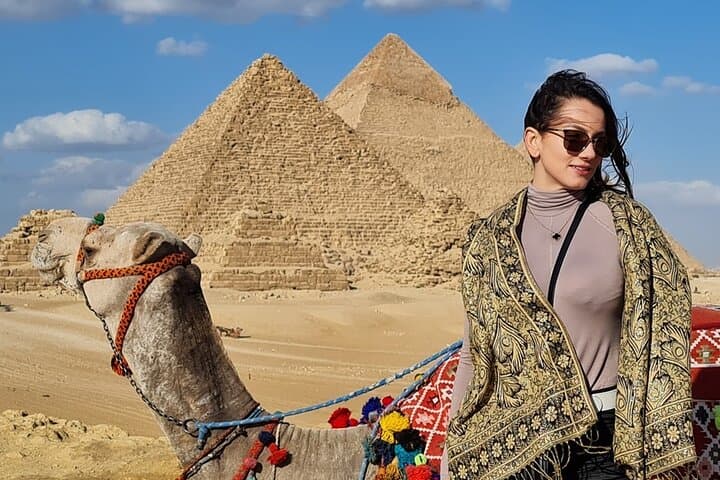

Morning light slides across the desert and the Great Pyramid lifts out of the haze like an ancient muscle memory of the Earth. A private car eases through Cairo traffic, and the limestone plateau of Giza opens: three geometric giants, a crouching Sphinx, and the stone apron of the Valley Temple.
Morning light slides across the desert and the Great Pyramid lifts out of the haze like an ancient muscle memory of the Earth. A private car eases through Cairo traffic, and the limestone plateau of Giza opens: three geometric giants, a crouching Sphinx, and the stone apron of the Valley Temple.
These monuments date to Egypt's Old Kingdom (the Fourth Dynasty, roughly 2600–2500 BCE). The Great Pyramid (Khufu/Cheops) dominates the site, with Khafre’s slightly smaller pyramid and Menkaure’s limestone-capped structure nearby. The Sphinx, carved from the bedrock, faces eastward—its human head and lion body a cultural icon whose purpose mixes ritual, funerary architecture, and the ancient pharaoh cult.
Geologically, the plateau is a raised limestone platform with windswept sand between tombs and causeways. Local life is visible at the edges—vendors, Bedouin guides, and camel handlers—adding a modern human rhythm to millennia-old stone.
Practically, a half-day private tour covers pickup and drop-off in an air-conditioned vehicle, guided time at the pyramids, the Sphinx, and the Valley Temple within about 4–5 hours. Expect short walks across uneven stone and sand, intermittent stairs, and busy public areas. Bring sun protection, carry your passport for ticketing, and plan early mornings or late afternoons to avoid peak heat and crowds. The guide often doubles as a photographer and will steer you toward strong compositions and quieter viewpoints. With a private guide and transport, this half-day option concentrates the essentials—history, scale, and photo opportunities—without the logistical friction of independent navigation.