THE ADVENTURE COLLECTIVE® · Independent discovery and booking for outdoor travel

Spend a full day with a private Egyptologist exploring the Grand Egyptian Museum, then cross the Giza Plateau to stand before Khufu, Khafre and Menkaure. This guided itinerary blends modern galleries and open-air archaeology with skip-the-line access and practical local insights.
Spend a full day with a private Egyptologist exploring the Grand Egyptian Museum, then cross the Giza Plateau to stand before Khufu, Khafre and Menkaure. This guided itinerary blends modern galleries and open-air archaeology with skip-the-line access and practical local insights.
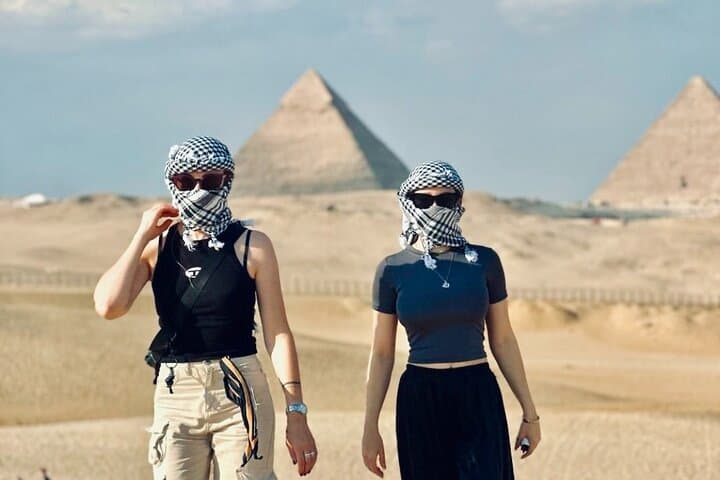
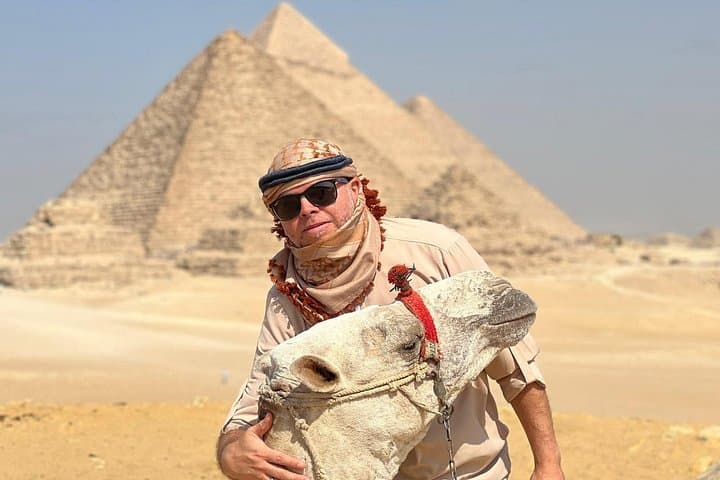
You arrive on the Giza Plateau before the crowd, the desert wind nudging the sand as the three pyramids loom like great stone ships on a pale sea. The Sphinx watches, patient and oversized, its limestone face catching morning light while your guide sketches lines of power, labor and astronomy into the air.
Verified experiences and guided adventures in the surrounding area.
Operated by Blue Nile Tours · Giza, Giza Governorate
You arrive on the Giza Plateau before the crowd, the desert wind nudging the sand as the three pyramids loom like great stone ships on a pale sea. The Sphinx watches, patient and oversized, its limestone face catching morning light while your guide sketches lines of power, labor and astronomy into the air.
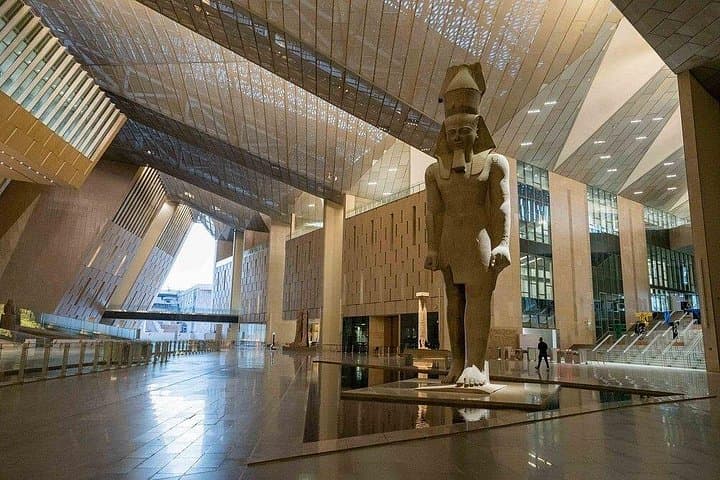
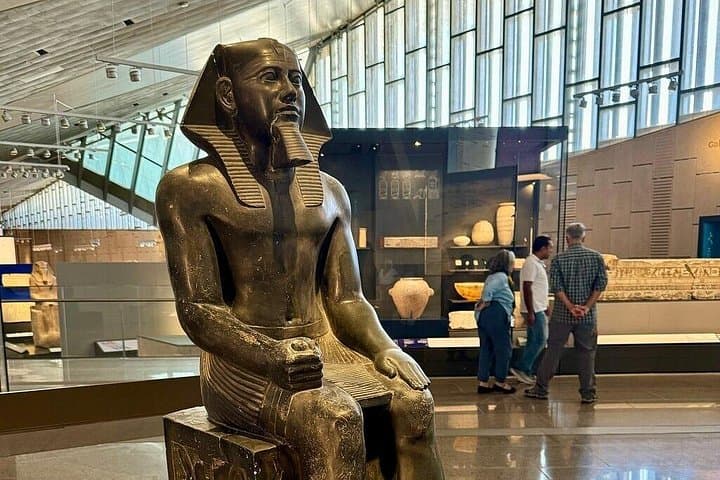
Begin at the Grand Egyptian Museum’s open court — a modern forecourt to an ancient story — where colossal red-granite statues and the first hanging obelisk hint at 5,000 years of civilization. From there a short transfer places you at the foot of Khufu, Khafre and Menkaure. Walk paved paths and compact sand across roughly 2–4 km of mostly flat terrain with minimal elevation change; expect intermittent steps and ramps in the museum.
Geology is simple here: limestone bedrock capped by quarried blocks, eroded by wind and time. Culturally, this place ties funerary practice, religious authority and astronomical calculation into built form; your Egyptologist will parse those connections as you move between tomb, temple and valley.
Practical notes: this is a full-day private tour (about 7–8 hours) with skip-the-line access, bottled water, lunch (option dependent) and hotel transfer included. Wear sturdy closed-toe shoes for sandy approaches, a hat and sunscreen, and plan for long periods of standing and photography stops. Sunrise or late afternoon light improves photos and temperature; summer brings intense heat, so early starts and hydration are essential. The tour is family-friendly and largely accessible, but ask ahead about mobility needs or exploring interior chambers.
easy.
7–8 hours.
Suitable for most fitness levels; requires the ability to walk 2–4 km and stand for extended periods.
The tour includes entry fees based on the option you book; confirm at checkout which sites are covered.
Access to interior chambers is sometimes limited; ask your guide in advance and be prepared for additional ticketing or restrictions.
Yes — the tour is family-friendly and rated easy, though interior climbs and lengthy standing may be challenging for some; request mobility accommodations when booking.
Photography is generally allowed in outdoor areas; restrictions apply inside some museum galleries and archaeological interiors—your guide will advise on site rules.
The Giza complex dates to the Fourth Dynasty (c. 2600–2500 BCE); the Great Pyramid once rose to about 146 m and remained the tallest human-made structure for millennia.
Visitor impact is managed via designated paths and controlled access; minimize touching ancient stone and use marked walkways to protect fragile surfaces.
Blue Nile Tours operates guided outdoor trips and adventures with an emphasis on safety, stewardship, and memorable experiences.
You arrive on the Giza Plateau before the crowd, the desert wind nudging the sand as the three pyramids loom like great stone ships on a pale sea. The Sphinx watches, patient and oversized, its limestone face catching morning light while your guide sketches lines of power, labor and astronomy into the air.
You arrive on the Giza Plateau before the crowd, the desert wind nudging the sand as the three pyramids loom like great stone ships on a pale sea. The Sphinx watches, patient and oversized, its limestone face catching morning light while your guide sketches lines of power, labor and astronomy into the air.
Begin at the Grand Egyptian Museum’s open court — a modern forecourt to an ancient story — where colossal red-granite statues and the first hanging obelisk hint at 5,000 years of civilization. From there a short transfer places you at the foot of Khufu, Khafre and Menkaure. Walk paved paths and compact sand across roughly 2–4 km of mostly flat terrain with minimal elevation change; expect intermittent steps and ramps in the museum.
Geology is simple here: limestone bedrock capped by quarried blocks, eroded by wind and time. Culturally, this place ties funerary practice, religious authority and astronomical calculation into built form; your Egyptologist will parse those connections as you move between tomb, temple and valley.
Practical notes: this is a full-day private tour (about 7–8 hours) with skip-the-line access, bottled water, lunch (option dependent) and hotel transfer included. Wear sturdy closed-toe shoes for sandy approaches, a hat and sunscreen, and plan for long periods of standing and photography stops. Sunrise or late afternoon light improves photos and temperature; summer brings intense heat, so early starts and hydration are essential. The tour is family-friendly and largely accessible, but ask ahead about mobility needs or exploring interior chambers.