THE ADVENTURE COLLECTIVE® · Independent discovery and booking for outdoor travel

Spend five hours exploring the Giza Plateau with a private guide — see the Great Pyramids, the Sphinx and take a 30-minute horse-and-carriage ride for a panoramic perspective. Practical advice on timing, sun protection and what entry options to expect.
Spend five hours exploring the Giza Plateau with a private guide — see the Great Pyramids, the Sphinx and take a 30-minute horse-and-carriage ride for a panoramic perspective. Practical advice on timing, sun protection and what entry options to expect.
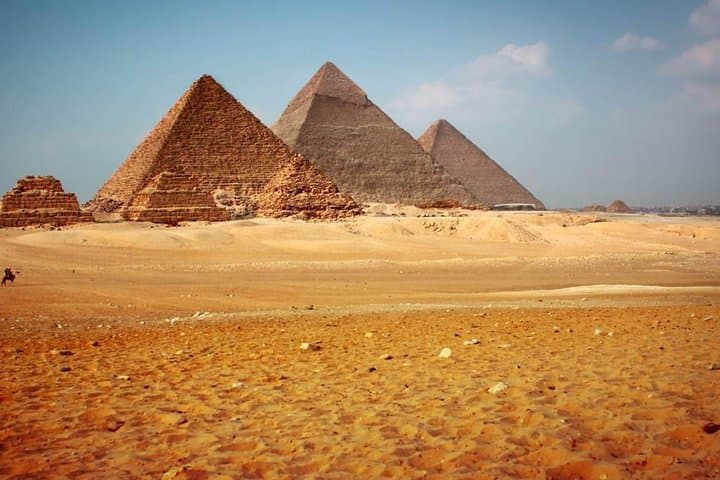
You step out of the air-conditioned vehicle and the plateau opens: sand and stone radiate heat while the three pyramids loom, geometric and patient, daring you to close the distance.
Verified experiences and guided adventures in the surrounding area.
Operated by Egypt Tours Online · Giza, Cairo
You step out of the air-conditioned vehicle and the plateau opens: sand and stone radiate heat while the three pyramids loom, geometric and patient, daring you to close the distance.
This private full-day tour threads the Great Pyramids of Khufu, Khafre and Menkaure with the enigmatic Great Sphinx, pausing for a 30-minute horse-and-carriage ride that gives the monuments a slower, more cinematic scale. The Giza Plateau sits on a limestone shelf created by ancient marine deposition; the blocks themselves tell a geological story of sedimentation and quarrying that began millennia ago.
Historically this is a royal necropolis—Khufu’s complex (c. 26th century BCE) anchors an area that evolved through the Old Kingdom and beyond. Culturally, the site remains a living part of Cairo’s identity: vendors, camel handlers and guides animate the edges of a place both sacrosanct and commercial.
Practicalities guide the second half of the day. Expect significant walking on uneven, compacted sand and limestone pavements, strong sun and sudden gusts of wind. Bring a hat, sunscreen and a full water bottle; footwear should offer ankle support and good tread. Confirm what entrance fees are included in your booking and carry small cash for gratuities and carriage drivers.
Timing matters: mornings and late afternoons offer cooler light and thinner crowds. Follow your guide’s route to minimize backtracking and respect conservation rules—no climbing on the monuments, and avoid touching masonry where signage restricts access. With preparation the plateau rewards patience: broad horizons, stone geometry and a sense of human scale across four and a half millennia.
easy.
5 hours.
Suitable for travelers with general fitness—expect several hours of walking on uneven sandy and rocky surfaces; bring mobility aids if needed
Some options include basic area entry; interior pyramid access and museum entries may be optional—confirm when booking.
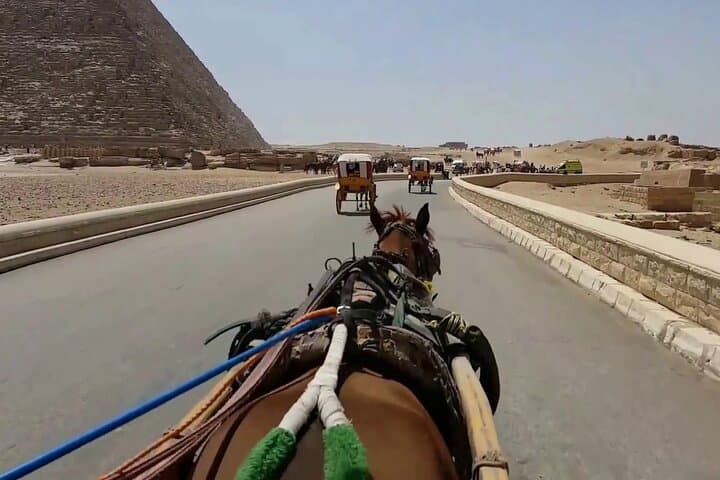
The listed carriage segment is 30 minutes; routes typically circle parts of the plateau for panoramic photos.
This tour is not recommended for travelers with severe spinal issues or pregnancy due to uneven surfaces and potential jostling.
Interior access depends on ticket options and daily quotas—ask your provider in advance and be prepared for narrow, steep passages.
Giza’s monuments date to the Old Kingdom (c. 2600–2500 BCE) as royal tomb complexes; the Sphinx is commonly attributed to Khafre’s reign.
Ongoing restoration and site management limit access to vulnerable areas—follow guide instructions, don’t touch masonry, and use marked paths to reduce erosion.
Egypt Tours Online operates guided outdoor trips and adventures with an emphasis on safety, stewardship, and memorable experiences.
You step out of the air-conditioned vehicle and the plateau opens: sand and stone radiate heat while the three pyramids loom, geometric and patient, daring you to close the distance.
You step out of the air-conditioned vehicle and the plateau opens: sand and stone radiate heat while the three pyramids loom, geometric and patient, daring you to close the distance.
This private full-day tour threads the Great Pyramids of Khufu, Khafre and Menkaure with the enigmatic Great Sphinx, pausing for a 30-minute horse-and-carriage ride that gives the monuments a slower, more cinematic scale. The Giza Plateau sits on a limestone shelf created by ancient marine deposition; the blocks themselves tell a geological story of sedimentation and quarrying that began millennia ago.
Historically this is a royal necropolis—Khufu’s complex (c. 26th century BCE) anchors an area that evolved through the Old Kingdom and beyond. Culturally, the site remains a living part of Cairo’s identity: vendors, camel handlers and guides animate the edges of a place both sacrosanct and commercial.
Practicalities guide the second half of the day. Expect significant walking on uneven, compacted sand and limestone pavements, strong sun and sudden gusts of wind. Bring a hat, sunscreen and a full water bottle; footwear should offer ankle support and good tread. Confirm what entrance fees are included in your booking and carry small cash for gratuities and carriage drivers.
Timing matters: mornings and late afternoons offer cooler light and thinner crowds. Follow your guide’s route to minimize backtracking and respect conservation rules—no climbing on the monuments, and avoid touching masonry where signage restricts access. With preparation the plateau rewards patience: broad horizons, stone geometry and a sense of human scale across four and a half millennia.