THE ADVENTURE COLLECTIVE® · Independent discovery and booking for outdoor travel

A private full-day trip from Marrakech puts you at Ouzoud’s 100‑plus‑meter cascades within a single, well-paced day. This guide explains what to expect on the walk, boat ride, and village lunch—plus the gear and timing that make the visit smooth.
A private full-day trip from Marrakech puts you at Ouzoud’s 100‑plus‑meter cascades within a single, well-paced day. This guide explains what to expect on the walk, boat ride, and village lunch—plus the gear and timing that make the visit smooth.
You turn off the highway and the city’s heat loosens its grip. Olive groves take over, their silvery leaves flicking in a breeze that seems to know the route to water. After roughly 2½ hours behind tinted windows and a guide’s short intro to Berber life, the road opens and the falls reveal themselves: tiers of water breaking against red rock and throwing mist into the air like a slow, cool rainfall. The path to the lip is worn by feet and time; voices fall to a hush as the main cataract—one of North Africa’s highest—drops in a series of sheets into a green pool below.
Verified experiences and guided adventures in the surrounding area.
Operated by Exotic Lines Travels · Ouzoud, Beni Mellal-Khenifra
You turn off the highway and the city’s heat loosens its grip. Olive groves take over, their silvery leaves flicking in a breeze that seems to know the route to water. After roughly 2½ hours behind tinted windows and a guide’s short intro to Berber life, the road opens and the falls reveal themselves: tiers of water breaking against red rock and throwing mist into the air like a slow, cool rainfall. The path to the lip is worn by feet and time; voices fall to a hush as the main cataract—one of North Africa’s highest—drops in a series of sheets into a green pool below.
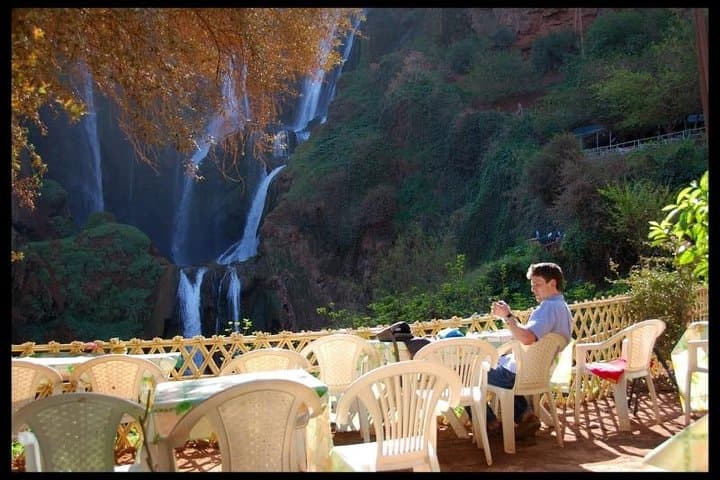
Ouzoud’s geology is straightforward and dramatic. The falls cut through Miocene-era sandstone and conglomerate; over millennia, running water has sculpted cliffs and pools, while human hands built terraces and mills alongside. The name Ouzoud comes from the Amazigh word for olive, and olive groves around the canyon are both a working landscape and a quiet frame for the view. Locally, small Berber villages retain a rhythm keyed to the seasons—sheep, olive harvest, and river fishing—and restaurants built on cliff edges trade panoramic tables for fresh tagines and grilled trout.
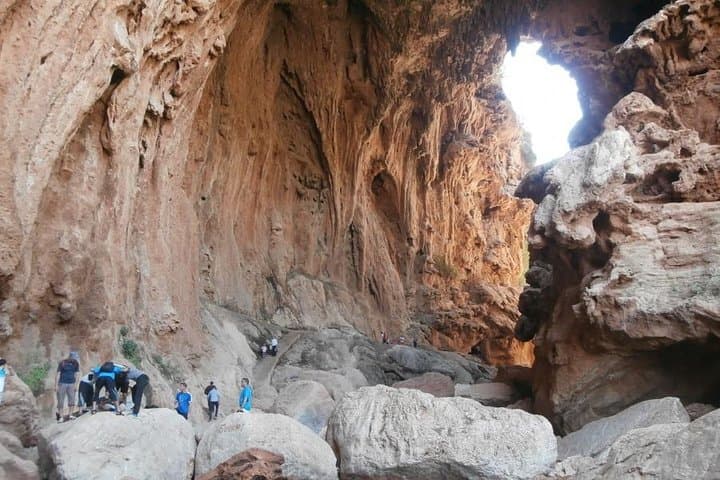
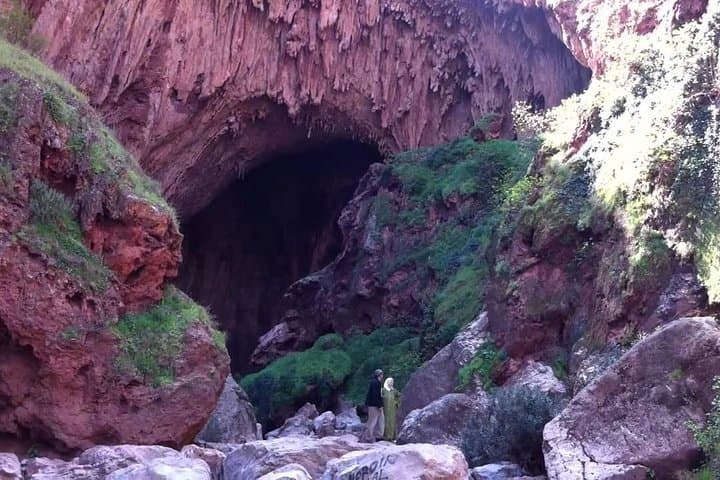
A knowledgeable local guide leads the walking loop (about one hour for the upper path) and arranges a short, flat-bottomed boat trip to the base when conditions allow. At the lip, you can peer into the amphitheater; down below, water claws at the rock, pulling loose mineral streaks and brightening the oranges and reds of the canyon face. Monkeys—Barbary macaques—thrive in the trees around the falls and add a playful, sometimes grabby character to the afternoon.
Practicalities matter. The program includes private pickup from Marrakech in an air-conditioned 4×4 or minivan, water, lunch at a falls-side restaurant, and a local guide for the walking section. Expect uneven stone steps, sections of narrow trail, and damp rock near the base. Footwear with good grip and a light layer for mist are worth bringing. Boats operate on calm days; they get close enough for dramatic shots but will soak you if you edge too near the spray.
Timing is everything: arrive early to avoid tour buses, or late afternoon for warmer light and fewer people. Bring cash—many villages and small eateries don't accept cards—and a reusable bottle to refill. Respect local wildlife: avoid feeding monkeys and keep a safe distance on the boat.
For travelers based in Marrakech, the trip is a compact immersion into Morocco’s rural topography—olive-scalloped hills, ancient mills, and a waterfall that keeps insisting you slow down long enough to watch it work.
easy.
8–10 hours.
Suitable for travelers in average fitness—walking is short but includes stairs and uneven surfaces.
Expect about 2.5 hours each way depending on traffic and route—total trip time is typically 8–10 hours.
Boat rides to the base are usually included but operate only when river conditions are safe; confirm with the operator on the day.
Yes—infant seats are available and the excursion is labeled stroller-accessible, but prepare for stairs and uneven ground at viewpoints.
Lunch and bottled water are included; meals are typically served at a restaurant with views of the falls.
You’ll likely see Barbary macaques and various birds; do not feed the monkeys and keep a respectful distance.
The walking portion is short and the operator notes it’s suitable for all fitness levels, but the site has stairs and uneven terrain that can be challenging for some mobility limitations.
Local Berber communities have worked the Ouzoud valley for centuries; historical water mills along the falls once powered local olive and grain processing.
Visitors are encouraged to avoid single-use plastics and to hire local guides—both support conservation and provide income to communities protecting the site.
Exotic Lines Travels operates guided outdoor trips and adventures with an emphasis on safety, stewardship, and memorable experiences.
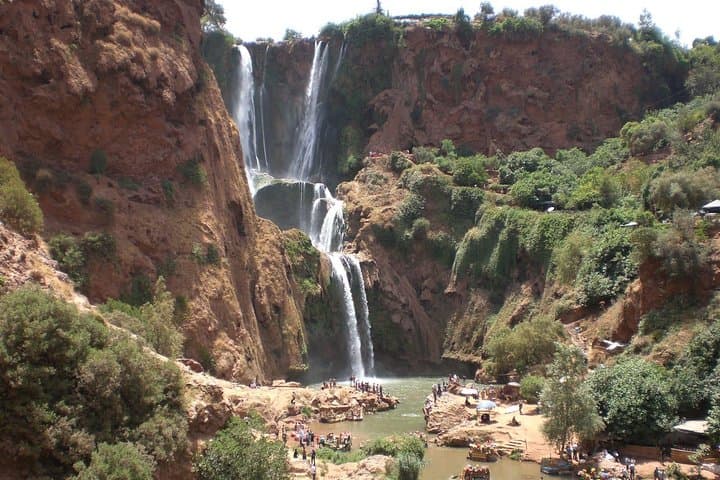
You turn off the highway and the city’s heat loosens its grip. Olive groves take over, their silvery leaves flicking in a breeze that seems to know the route to water. After roughly 2½ hours behind tinted windows and a guide’s short intro to Berber life, the road opens and the falls reveal themselves: tiers of water breaking against red rock and throwing mist into the air like a slow, cool rainfall. The path to the lip is worn by feet and time; voices fall to a hush as the main cataract—one of North Africa’s highest—drops in a series of sheets into a green pool below.
You turn off the highway and the city’s heat loosens its grip. Olive groves take over, their silvery leaves flicking in a breeze that seems to know the route to water. After roughly 2½ hours behind tinted windows and a guide’s short intro to Berber life, the road opens and the falls reveal themselves: tiers of water breaking against red rock and throwing mist into the air like a slow, cool rainfall. The path to the lip is worn by feet and time; voices fall to a hush as the main cataract—one of North Africa’s highest—drops in a series of sheets into a green pool below.
Ouzoud’s geology is straightforward and dramatic. The falls cut through Miocene-era sandstone and conglomerate; over millennia, running water has sculpted cliffs and pools, while human hands built terraces and mills alongside. The name Ouzoud comes from the Amazigh word for olive, and olive groves around the canyon are both a working landscape and a quiet frame for the view. Locally, small Berber villages retain a rhythm keyed to the seasons—sheep, olive harvest, and river fishing—and restaurants built on cliff edges trade panoramic tables for fresh tagines and grilled trout.
A knowledgeable local guide leads the walking loop (about one hour for the upper path) and arranges a short, flat-bottomed boat trip to the base when conditions allow. At the lip, you can peer into the amphitheater; down below, water claws at the rock, pulling loose mineral streaks and brightening the oranges and reds of the canyon face. Monkeys—Barbary macaques—thrive in the trees around the falls and add a playful, sometimes grabby character to the afternoon.
Practicalities matter. The program includes private pickup from Marrakech in an air-conditioned 4×4 or minivan, water, lunch at a falls-side restaurant, and a local guide for the walking section. Expect uneven stone steps, sections of narrow trail, and damp rock near the base. Footwear with good grip and a light layer for mist are worth bringing. Boats operate on calm days; they get close enough for dramatic shots but will soak you if you edge too near the spray.
Timing is everything: arrive early to avoid tour buses, or late afternoon for warmer light and fewer people. Bring cash—many villages and small eateries don't accept cards—and a reusable bottle to refill. Respect local wildlife: avoid feeding monkeys and keep a safe distance on the boat.
For travelers based in Marrakech, the trip is a compact immersion into Morocco’s rural topography—olive-scalloped hills, ancient mills, and a waterfall that keeps insisting you slow down long enough to watch it work.