THE ADVENTURE COLLECTIVE® · Independent discovery and booking for outdoor travel

Explore Karnak’s forest of columns and the ceremonial sweep of Luxor Temple on a focused private East Bank tour. This guided visit combines concentrated history, manageable walking, and practical tips for beating the heat and seeing the highlights.
Explore Karnak’s forest of columns and the ceremonial sweep of Luxor Temple on a focused private East Bank tour. This guided visit combines concentrated history, manageable walking, and practical tips for beating the heat and seeing the highlights.
The sun cuts across sandstone columns as you step into Karnak’s hypostyle hall, light slanting through clerestory windows and dust motes moving like slow, ancient traffic. The walk from Karnak to Luxor on the East Bank strings together colossal pylons, carved reliefs and the long shadow of an avenue of sphinxes that once linked two living temples.
Verified experiences and guided adventures in the surrounding area.
The sun cuts across sandstone columns as you step into Karnak’s hypostyle hall, light slanting through clerestory windows and dust motes moving like slow, ancient traffic. The walk from Karnak to Luxor on the East Bank strings together colossal pylons, carved reliefs and the long shadow of an avenue of sphinxes that once linked two living temples.
These monuments sit on the site of ancient Thebes, a riverine capital whose wealth shaped pharaonic religion and architecture. Karnak grew over 1,500 years—additions by Thutmose III, Hatshepsut and Ramses II stack like geological strata of power—while Luxor Temple anchors rituals tied to royal procession and the Nile’s cycles. Cultural layers remain visible: Coptic graffiti, Ottoman-era repairs and local vendors echoing centuries of human use.
Expect wide courtyards, uneven stone underfoot, and intense sun by midday; stone retains heat and shade is sparse. A private East Bank tour typically moves at a calm pace, stopping at key pylons, the sacred lake, the hypostyle hall, and the Luxor Temple colonnades, with time for explanations about iconography, hieroglyphic inscriptions and restoration work.
Practical guidance: wear sturdy, closed-toe shoes and a brimmed hat, carry at least 1–2 liters of water, and plan morning or late-afternoon visits to avoid peak heat. Photography is allowed in most areas but avoid tripods in crowded sections. Respect barriers and inscriptions—these monuments are fragile and conservation-dependent. With a compact four-hour window you’ll get context, scale and the kind of close viewing that large groups rarely enjoy.
moderate.
4 hours.
Light to moderate walking ability; comfortable standing and moving on uneven surfaces for several hours in warm conditions
Private East Bank tours are typically about four hours and involve moderate walking across uneven temple grounds and courtyards.
Entrance fees for Karnak and Luxor temples are commonly required; some private tours include them but check the booking details before you go.
Parts of the complexes have ramps and level sections, but many areas involve steps and uneven stone; accessibility varies and should be confirmed with the operator.
Photography is generally allowed without flash; tripods and commercial filming may be restricted—follow local signage and guide instructions.
Karnak and Luxor were central to Thebes, Egypt’s New Kingdom capital; successive pharaohs expanded Karnak into a massive cult complex while Luxor Temple hosted royal rituals tied to the Nile.
High foot traffic and sun exposure stress carved surfaces; visitors should avoid touching reliefs, use minimal sunscreen that washes off easily, and minimize plastic waste to support conservation efforts.
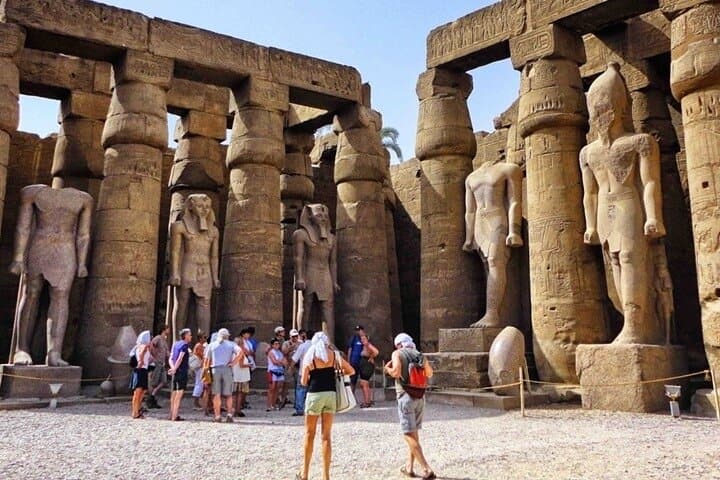
The sun cuts across sandstone columns as you step into Karnak’s hypostyle hall, light slanting through clerestory windows and dust motes moving like slow, ancient traffic. The walk from Karnak to Luxor on the East Bank strings together colossal pylons, carved reliefs and the long shadow of an avenue of sphinxes that once linked two living temples.
The sun cuts across sandstone columns as you step into Karnak’s hypostyle hall, light slanting through clerestory windows and dust motes moving like slow, ancient traffic. The walk from Karnak to Luxor on the East Bank strings together colossal pylons, carved reliefs and the long shadow of an avenue of sphinxes that once linked two living temples.
These monuments sit on the site of ancient Thebes, a riverine capital whose wealth shaped pharaonic religion and architecture. Karnak grew over 1,500 years—additions by Thutmose III, Hatshepsut and Ramses II stack like geological strata of power—while Luxor Temple anchors rituals tied to royal procession and the Nile’s cycles. Cultural layers remain visible: Coptic graffiti, Ottoman-era repairs and local vendors echoing centuries of human use.
Expect wide courtyards, uneven stone underfoot, and intense sun by midday; stone retains heat and shade is sparse. A private East Bank tour typically moves at a calm pace, stopping at key pylons, the sacred lake, the hypostyle hall, and the Luxor Temple colonnades, with time for explanations about iconography, hieroglyphic inscriptions and restoration work.
Practical guidance: wear sturdy, closed-toe shoes and a brimmed hat, carry at least 1–2 liters of water, and plan morning or late-afternoon visits to avoid peak heat. Photography is allowed in most areas but avoid tripods in crowded sections. Respect barriers and inscriptions—these monuments are fragile and conservation-dependent. With a compact four-hour window you’ll get context, scale and the kind of close viewing that large groups rarely enjoy.