THE ADVENTURE COLLECTIVE® · Independent discovery and booking for outdoor travel

Spend a private day exploring Dendera’s painted Hathor halls and Karnak’s vast temple complex with a licensed local guide. This full-day tour from Luxor pairs focused storytelling with on-site logistics for a relaxed, in-depth encounter with ancient Egypt.
Spend a private day exploring Dendera’s painted Hathor halls and Karnak’s vast temple complex with a licensed local guide. This full-day tour from Luxor pairs focused storytelling with on-site logistics for a relaxed, in-depth encounter with ancient Egypt.
Morning light slides across the Nile as a private car eases out of Luxor and north toward Dendera — a flat, sun-baked plain giving way to a cluster of sandstone columns and painted ceilings. At Dendera the guide pauses at the ticket counter; inside, columns crowned with Hathor heads rise like watchful figures while a near-intact zodiac on the ceiling pulls visitors’ eyes upward. The rooftop chapels reward a quiet panorama of the surrounding countryside.
Verified experiences and guided adventures in the surrounding area.
Operated by Eyes of Egypt · Luxor, Luxor
Morning light slides across the Nile as a private car eases out of Luxor and north toward Dendera — a flat, sun-baked plain giving way to a cluster of sandstone columns and painted ceilings. At Dendera the guide pauses at the ticket counter; inside, columns crowned with Hathor heads rise like watchful figures while a near-intact zodiac on the ceiling pulls visitors’ eyes upward. The rooftop chapels reward a quiet panorama of the surrounding countryside.
Later, arriving back in Luxor at Karnak shifts the scale: an accumulation of millennia where obelisks and hypostyle halls create a deliberate theatricality. Construction here began in the Middle Kingdom and swelled under New Kingdom pharaohs; the site reads as layers of ambition etched in stone. Walkways funnel you past colossal statues, ram-headed sphinx avenues, and graffiti left by Roman soldiers — human traces layered atop religious dedication.
Culturally, both sites reflect Egypt’s long continuity: Dendera’s Ptolemaic and Roman-era decoration contrasts with Karnak’s millennia of royal additions. Geologically, the temples sit on Nile alluvium and local limestone, their colors preserved by arid air.
Practical guidance: expect 6–7 hours total including drives; wear sun protection and closed shoes for uneven surfaces; bring local currency for entrance if needed (tickets may be bought on site); and follow your licensed guide’s route to protect fragile reliefs. The tour balances intimacy — a private vehicle and guide — with the scale and quiet authority of ancient ritual architecture.
easy.
6–7 hours.
Light walking over uneven ground; suitable for most fitness levels but expect stepping and short climbs.
Tickets to Dendera and Karnak are included in the tour price as stated; confirm any updates with your operator before departure.
Yes — private pickup and drop-off from East or West Bank hotels in Luxor are provided.
The tour notes wheelchair-accessible options for transport and many site paths, but some temple areas have steps or uneven surfaces; check specifics with the operator.
Yes — the private format allows adjustments to pacing, emphasis, and time spent at each site based on your interests.
Karnak grew over centuries from the Middle Kingdom into the New Kingdom and later periods; Dendera’s present temple reflects strong Ptolemaic and Roman-era decoration centered on the goddess Hathor.
Both sites are subject to conservation efforts that limit access to vulnerable reliefs; follow guide instructions, avoid touching surfaces, and support local preservation via respectful tourism.
Eyes of Egypt operates guided outdoor trips and adventures with an emphasis on safety, stewardship, and memorable experiences.
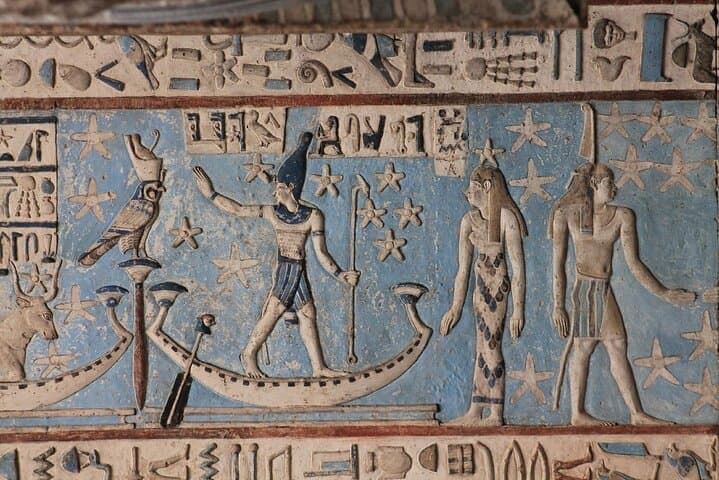
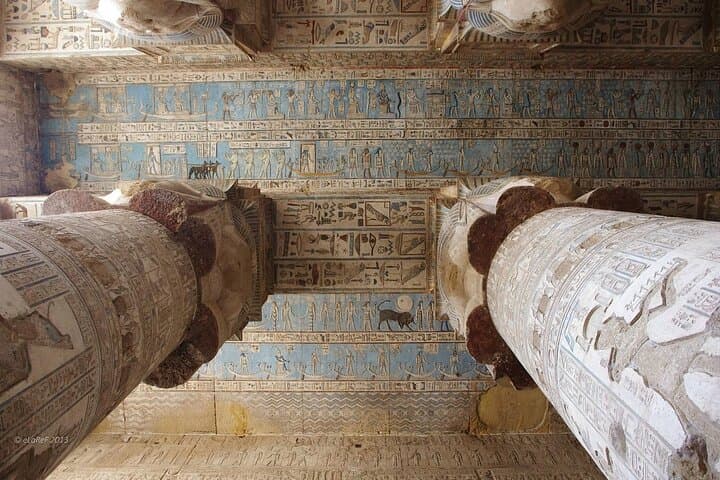
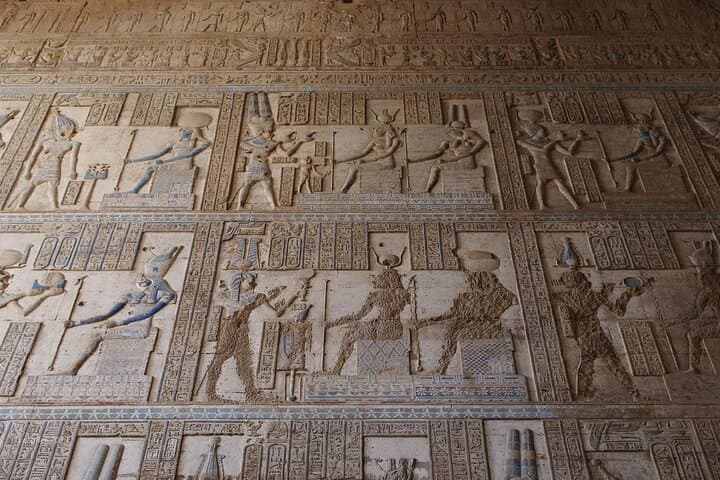
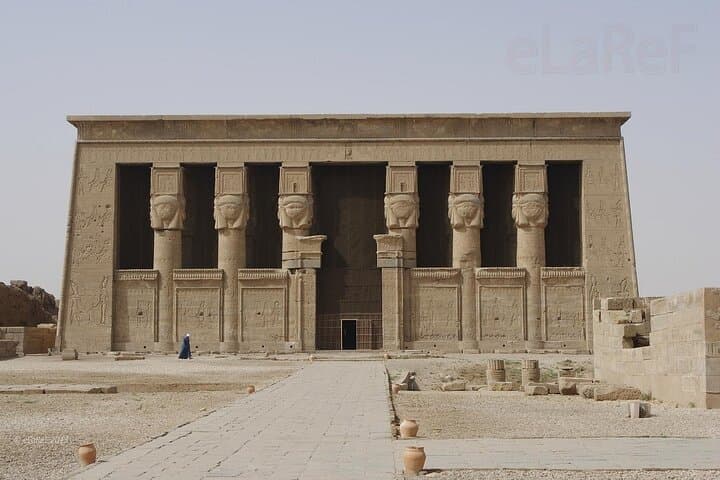
Morning light slides across the Nile as a private car eases out of Luxor and north toward Dendera — a flat, sun-baked plain giving way to a cluster of sandstone columns and painted ceilings. At Dendera the guide pauses at the ticket counter; inside, columns crowned with Hathor heads rise like watchful figures while a near-intact zodiac on the ceiling pulls visitors’ eyes upward. The rooftop chapels reward a quiet panorama of the surrounding countryside.
Morning light slides across the Nile as a private car eases out of Luxor and north toward Dendera — a flat, sun-baked plain giving way to a cluster of sandstone columns and painted ceilings. At Dendera the guide pauses at the ticket counter; inside, columns crowned with Hathor heads rise like watchful figures while a near-intact zodiac on the ceiling pulls visitors’ eyes upward. The rooftop chapels reward a quiet panorama of the surrounding countryside.
Later, arriving back in Luxor at Karnak shifts the scale: an accumulation of millennia where obelisks and hypostyle halls create a deliberate theatricality. Construction here began in the Middle Kingdom and swelled under New Kingdom pharaohs; the site reads as layers of ambition etched in stone. Walkways funnel you past colossal statues, ram-headed sphinx avenues, and graffiti left by Roman soldiers — human traces layered atop religious dedication.
Culturally, both sites reflect Egypt’s long continuity: Dendera’s Ptolemaic and Roman-era decoration contrasts with Karnak’s millennia of royal additions. Geologically, the temples sit on Nile alluvium and local limestone, their colors preserved by arid air.
Practical guidance: expect 6–7 hours total including drives; wear sun protection and closed shoes for uneven surfaces; bring local currency for entrance if needed (tickets may be bought on site); and follow your licensed guide’s route to protect fragile reliefs. The tour balances intimacy — a private vehicle and guide — with the scale and quiet authority of ancient ritual architecture.