THE ADVENTURE COLLECTIVE® · Independent discovery and booking for outdoor travel

Spend a full day tracing Egypt’s earliest monumental architecture on a private guided tour from Cairo. Visit Saqqara’s Step Pyramid, the open‑air museum of Memphis, and the iconic pyramids and Sphinx at Giza with an Egyptologist guide.
Spend a full day tracing Egypt’s earliest monumental architecture on a private guided tour from Cairo. Visit Saqqara’s Step Pyramid, the open‑air museum of Memphis, and the iconic pyramids and Sphinx at Giza with an Egyptologist guide.
You step out of an air‑conditioned van into a dry wind that dares you to look away. The three great pyramids puncture the horizon — sheer faces of worked limestone catching hard sunlight — while vendors and camel handlers move like punctuation along the plateau. This is Giza: a place where scale and silence force a different pace.
Verified experiences and guided adventures in the surrounding area.
Operated by Egypt Super Tours · Cairo, Cairo Governorate
You step out of an air‑conditioned van into a dry wind that dares you to look away. The three great pyramids puncture the horizon — sheer faces of worked limestone catching hard sunlight — while vendors and camel handlers move like punctuation along the plateau. This is Giza: a place where scale and silence force a different pace.
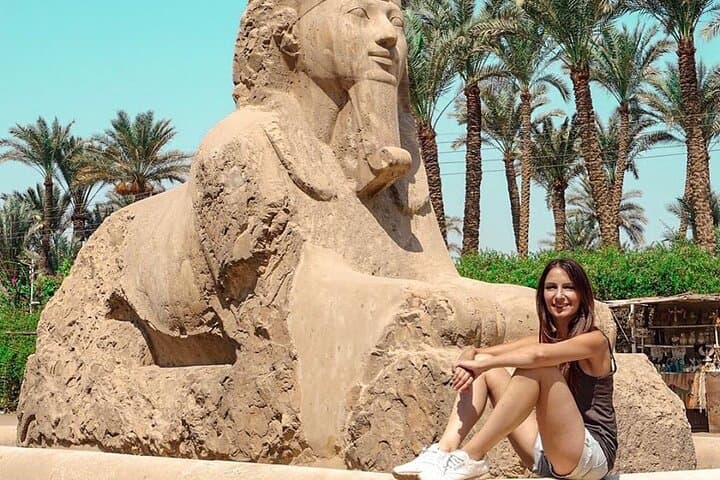
The day moves south in time as well as geography. At Saqqara you’ll stand before Djoser’s Step Pyramid, the first large stone monument in Egypt engineered by Imhotep some 4,700 years ago. Memphis preserves a toppled colossus of Ramses II and the alabaster sphinx that once guarded its ceremonial avenues. Back at Giza, the Great Pyramid of Khufu, Khafre’s adjacent monument and the human‑headed Sphinx reveal funerary design, quarrying logic and the Nile’s sedimentary limestone geology that made this architecture possible.
Local culture is immediate: camel handlers offer short rides, café owners sell strong tea, and licensed Egyptologists translate inscriptions and ritual context. Practicalities matter — entrance fees are charged on site, surfaces are uneven, and the midday sun is relentless. Expect 6–7 hours of mostly flat walking with short climbs onto viewing platforms and loose sand underfoot.
Bring sun protection, a reusable water bottle, comfortable closed shoes and a patient camera routine. Start early to avoid heat and crowds, follow your guide’s route to skip inefficient backtracking, and allow time for photos and quiet observation at each site.
easy.
6–7 hours.
Suitable for most travelers able to walk on uneven ground for several hours; minimal elevation change but expect loose sand.
No; entrance fees to the pyramids, Saqqara and Memphis are typically paid on site — bring a card or local currency as instructed.
Some areas have limited wheelchair access; the tour listing notes wheelchair‑accessible options but visitors should check specific site access with the operator in advance.
Access rules vary and interior entry (Great Pyramid passage) often requires separate tickets and can be restricted for preservation and safety; your guide will advise current access policies.
Sites are clustered on the western edge of Greater Cairo; expect short drives of 20–45 minutes between Saqqara, Memphis and Giza depending on traffic and the order visited.
Saqqara’s Step Pyramid marks the architectural shift from mudbrick mastabas to monumental stone, engineered under Djoser and Imhotep in the 27th century BCE; Memphis was an early political center that linked Upper and Lower Egypt.
High foot traffic and informal climbing stress fragile masonry; follow paths, avoid touching reliefs and support registered guides who work with local conservation efforts.
Egypt Super Tours operates guided outdoor trips and adventures with an emphasis on safety, stewardship, and memorable experiences.


You step out of an air‑conditioned van into a dry wind that dares you to look away. The three great pyramids puncture the horizon — sheer faces of worked limestone catching hard sunlight — while vendors and camel handlers move like punctuation along the plateau. This is Giza: a place where scale and silence force a different pace.
You step out of an air‑conditioned van into a dry wind that dares you to look away. The three great pyramids puncture the horizon — sheer faces of worked limestone catching hard sunlight — while vendors and camel handlers move like punctuation along the plateau. This is Giza: a place where scale and silence force a different pace.
The day moves south in time as well as geography. At Saqqara you’ll stand before Djoser’s Step Pyramid, the first large stone monument in Egypt engineered by Imhotep some 4,700 years ago. Memphis preserves a toppled colossus of Ramses II and the alabaster sphinx that once guarded its ceremonial avenues. Back at Giza, the Great Pyramid of Khufu, Khafre’s adjacent monument and the human‑headed Sphinx reveal funerary design, quarrying logic and the Nile’s sedimentary limestone geology that made this architecture possible.
Local culture is immediate: camel handlers offer short rides, café owners sell strong tea, and licensed Egyptologists translate inscriptions and ritual context. Practicalities matter — entrance fees are charged on site, surfaces are uneven, and the midday sun is relentless. Expect 6–7 hours of mostly flat walking with short climbs onto viewing platforms and loose sand underfoot.
Bring sun protection, a reusable water bottle, comfortable closed shoes and a patient camera routine. Start early to avoid heat and crowds, follow your guide’s route to skip inefficient backtracking, and allow time for photos and quiet observation at each site.